Verdict first: Kajabi is the best-designed all-in-one platform for experts who sell courses, coaching and community, and in 2026 it is also one of the most expensive ways to start. Basic is $179/month ($143 on annual) for 5 products and 2,500 contacts. If you have a proven offer and more than a few thousand people on your list, that is a fair price for replacing four tools. If you are under roughly $2,000–$3,000 a month in revenue, or you have never launched, it is a $1,716-a-year commitment to a platform whose cheapest tier caps you at 5 products — and Systeme.io does the same job at $0, then $17/month.
Who this is for: coaches, consultants and course creators with an existing audience, deciding whether Kajabi earns its price, and what the alternatives cost once you price the pieces separately.
Who this is not for: first-time sellers, funnel-first businesses (ClickFunnels is the better shape), or anyone who mainly needs a checkout with order bumps. You would be paying for a course business you have not built yet.
Prices, plan limits and fees below were read from kajabi.com/pricing on October 18, 2026. Kajabi does not state the trial length on the pricing page, so this review does not claim one.
What Kajabi is in 2026
Kajabi is not a course platform anymore. It is a suite aimed at people who monetize expertise:
- Courses — the product it built its reputation on, with drip content, quizzes and mobile access.
- Coaching — Backstage, launched as a premium, personalized coaching layer.
- Communities — branded spaces for discussion and membership.
- Newsletters, landing pages, funnels, websites — the marketing surface around the products.
- Marketing emails and pipelines — email plus a lightweight CRM.
- Payments, offers, upsells — its own payment stack (Kajabi Payments) and checkout.
- AI credits — 0 on Basic, 500 on Growth, 1,000 on Pro; extra credits cost $15/month for 500.
The pitch is “five tools that do not talk to each other, replaced by one”. The pricing page makes the same claim about à la carte costs, and for a course business that argument mostly holds.
Kajabi pricing in 2026
| Plan | Monthly | Annual (per month) | Products | Contacts | Admin seats | Websites / communities |
|---|---|---|---|---|---|---|
| Basic | $179 | $143 (save $432/yr) | 5 | 2,500 | 2 | 1 / 1 |
| Growth | $249 | $199 (save $600/yr) | 50 | 25,000 | 11 | 1 / 1 |
| Pro | $499 | $399 (save $1,200/yr) | Unlimited | 100,000 | 26 | 3 / 3 |
Two numbers decide most of this decision, and neither is the price: products and contacts.
The 5-product cap is smaller than it sounds
On Kajabi, a “product” is not a lesson — it is the thing you sell. A course, a membership, a coaching offer, a download bundle. Five of them on Basic is enough for someone with a single flagship program and a couple of funnels, and not enough for anyone running a portfolio:
- Flagship course + a smaller entry course + membership + 1:1 coaching + a template pack = 5. You are full.
- Add a seasonal workshop, a waitlist product, or a second brand, and you are pricing Growth at $249/month.
This is the quiet reason so many Kajabi users end up on Growth. It is not contacts; it is the product ceiling.
The 2,500-contact cap is the expensive one
Email lists grow whether or not revenue does. At 2,500 contacts on Basic, three things can happen when you cross the line:
- Upgrade to Growth: $249/month — a jump of $70/month, or $840 a year, for 10x the contacts and 10x the products.
- Buy additional contacts — Kajabi sells them in 25,000-contact blocks for $125/month — which is a Growth-tier escape hatch rather than a Basic one.
- Prune your list, which is the answer nobody chooses.
For context: a 2,500-contact list mailed weekly is roughly 10,000 sends a month, which most email tools price at $20–$40. You are not paying for email here. You are paying for the product layer around it.
Fees: 0% on Kajabi Payments, 0.5%–2% elsewhere
Kajabi’s pricing page states “no hidden fees, no revenue sharing” — and that is accurate when you use Kajabi Payments. Use a third-party processor and the platform fee comes back by tier:
| Payment setup | Basic | Growth | Pro |
|---|---|---|---|
| Kajabi Payments | 0% platform fee | 0% | 0% |
| Third-party processor (not PayPal) | 2% | 1% | 0.5% |
| Your card processor’s own rate | Applies on top, typically 2.9% + 30¢ | ||
That is materially better than the 5%–7.5% charged on the entry tiers of Podia, Kartra and Teachable, and it is the strongest honest argument for Kajabi’s price: the percentage you keep does not shrink as you grow.
What Kajabi genuinely does better
- The course and member experience. Out-of-the-box, a Kajabi course looks like a product rather than a page builder demo. Students get an app-like experience without you touching CSS.
- Coaching plus community in the same product. Backstage and Communities mean a cohort-based or hybrid offer does not need Slack, Circle or a separate scheduler.
- Marketing and sales in one place. Pipelines, offers, landing pages and email are wired to the same contact record, which is the real reason people consolidate.
- No revenue share. On a $5,000 month that is $250–$375 kept versus a 5%–7.5% entry tier — enough to erase the monthly price gap in the first month of a good launch.
- A polished surface with little configuration. If your constraint is time rather than money, this is what you are buying.
Where it costs you
- The floor is $1,716 a year on monthly billing before you have sold anything. Most solo businesses do not clear that in software spend in year one.
- Basic is a starter tier with a premium price. 5 products, 2,500 contacts and 2 admin seats are genuinely limited; the platform’s reputation is built on Growth and Pro.
- Funnels are the weakest part of the suite. If funnels are your business, ClickFunnels is the better shape and Systeme.io is the cheaper version of the same shape.
- AI is metered and thin at the entry tier. Basic includes 0 AI credits; Growth includes 500; overage is $15/month per 500.
Kajabi vs Systeme.io vs ClickFunnels
| Kajabi Basic | Systeme.io Free / Startup | ClickFunnels Launch | |
|---|---|---|---|
| Price | $179/mo ($143 annual) | $0 / $17/mo | $97/mo ($81 annual) |
| Contacts | 2,500 | 2,000 / 5,000 | 10,000 |
| Products / courses | 5 products | 1 / 5 courses | 3 courses |
| Transaction fees | 0% with Kajabi Payments; 2% third-party | 0% | 0% |
| Best at | Courses, coaching, community | Cheapest complete funnel stack | Funnel pages and checkout |
Read that table by shape rather than price. Kajabi is a product business platform: courses, coaching, community. ClickFunnels is a traffic conversion platform: pages, funnels, checkout. Systeme.io is the cheap version of both, with a lower design ceiling and no contact or email metering.
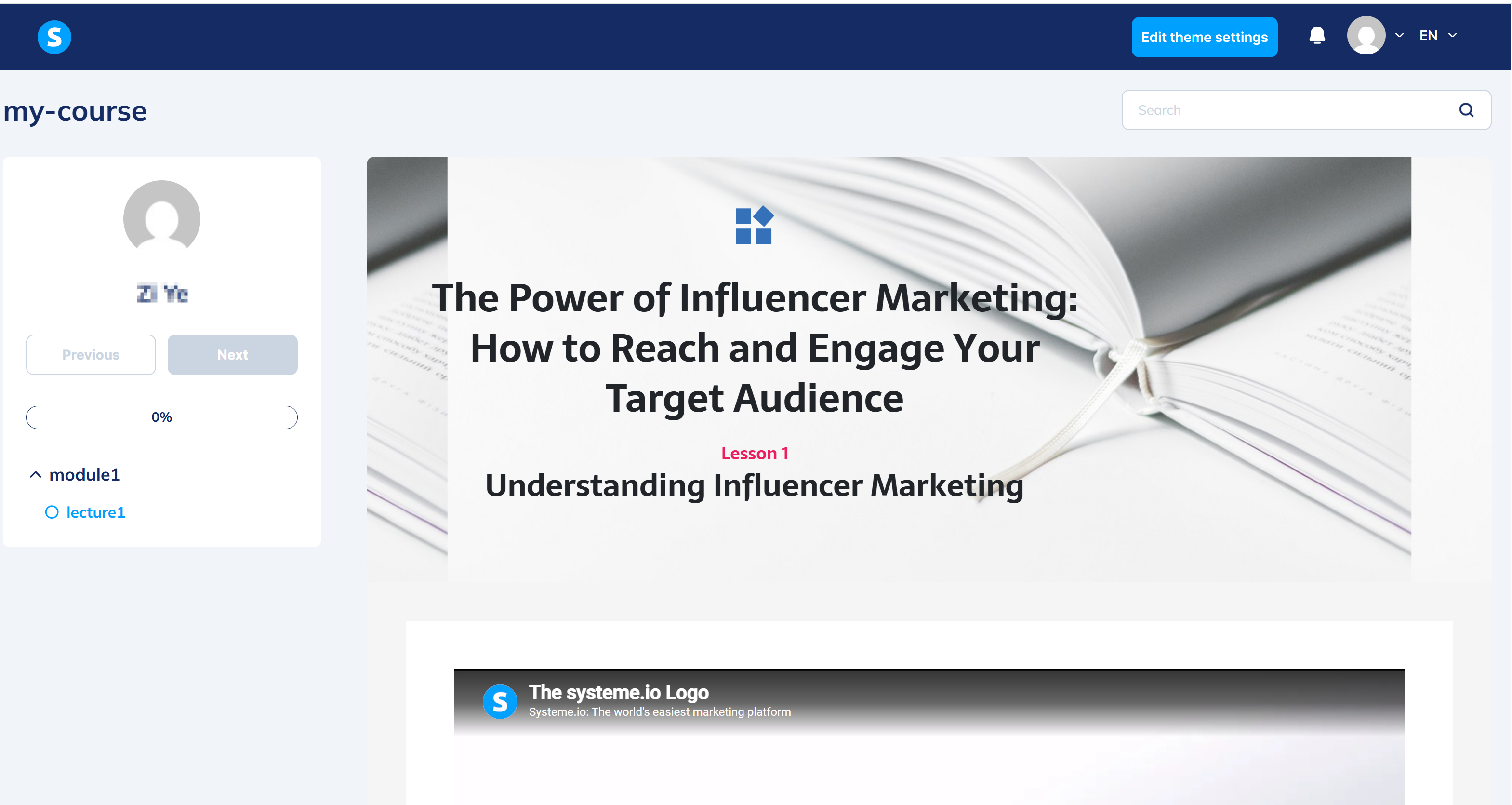
Our own course front page, built on Systeme.io’s free plan. Kajabi’s version is more polished — this is the baseline it has to beat at $179 a month.
Who should buy Kajabi
- You already sell a course or coaching program and have an audience — the platform’s polish pays for itself in perceived quality.
- You are replacing at least three tools (course host + community + email + funnel pages) and would otherwise pay $150+ a month anyway.
- You sell high-ticket offers where one extra sale covers the year.
- You are moving off a course plugin stack that breaks on every WordPress update.
Who should not (yet)
- You are pre-revenue. Start on a free plan, prove the offer, and pay for Kajabi from revenue.
- You have a 5,000-person list and a small offer. The contact cap pushes you to $249 before the product earns it.
- Funnels and paid traffic are your growth engine. ClickFunnels is the better instrument, and Systeme.io is the affordable one.
- You need one simple checkout and nothing else. Kajabi is a category too big for that job.
How we ranked and what we tested
Honest disclosure: this review is based on Kajabi’s own pricing page and plan documentation, read on October 18, 2026. I have not run a paid Kajabi account, so I am not claiming hands-on experience with Backstage, its community product or the 2026 editor. What I did build first-hand is the equivalent course product on Systeme.io’s free plan — course, sales page and lesson structure — and that is the benchmark used here (full Systeme.io review). Treat the qualitative comparisons as informed, and the numbers as verified.
On affiliate links: Kajabi is not an affiliate partner of this site and pays us nothing. The only affiliate link on this page is Systeme.io’s.
FAQ
Is Kajabi worth $179 a month?
For an established course or coaching business, usually yes — it replaces a course host, community tool, email tool and funnel builder, and it takes 0% of your sales with Kajabi Payments. For a business under about $2,000–$3,000 a month, the maths usually does not work yet, and a free or $17/month platform is the better starting point.
Does Kajabi have a free plan?
No. It offers a free trial and three paid tiers starting at $179/month. It does not state the trial length on its pricing page, so check the signup flow before you plan around it.
What happens if I go over 2,500 contacts on Basic?
You upgrade to Growth at $249/month, or buy contact capacity in 25,000-contact blocks at $125/month. In practice, most people who outgrow Basic move to Growth, because the product cap of 5 usually arrives first.
Does Kajabi take a percentage of my sales?
Not with Kajabi Payments — the pricing page advertises no revenue sharing. With a third-party processor it charges 2% on Basic, 1% on Growth and 0.5% on Pro, plus your processor’s own rate.
Kajabi or ClickFunnels?
Kajabi if what you sell is courses, coaching and community. ClickFunnels if what you sell is a funnel and the page is the product. The overlap is smaller than the marketing suggests, and picking the wrong shape is the expensive mistake — not the price difference.
Can I move from Kajabi to a cheaper platform later?
Contacts export; courses, pages and communities do not port automatically. Budget a day of rebuilding for a simple course, and check that your student accounts and purchases transfer before you cancel.
I’m an affiliate of Systeme.io: if you sign up through my links, I may earn a commission at no extra cost to you. Kajabi is not an affiliate partner of this site, and its pricing comes from its own public pricing page, checked on October 18, 2026.
Build the same course for $0 (no credit card, 0% transaction fees, unlimited emails) → systeme.io
Grab the free checklist (2026 Solopreneur Tool Stack: 10 tools, free tiers, and the exact moment to pay) → Get the free checklist
Related reading: Kajabi vs Teachable · Best Kajabi Alternatives (2026) · Best Online Course Platforms for Creators · Systeme.io Review 2026 · ClickFunnels Review 2026
Leave a Reply