Blog

  • Synthesia Alternatives (2026): 6 Cheaper AI Video Tools

    Synthesia Alternatives (2026): 6 Cheaper AI Video Tools

    Verdict first: Synthesia is the most polished avatar-video platform, and it prices like one: $29/month for 1,250 credits on Starter, $89/month on Pro, plus paid add-ons for custom avatars. The right alternative depends on one question — does your video need a human presenter? If yes, HeyGen is the closest substitute at the same $29 entry with a free tier. If not, you are overpaying for avatars: Fliki ($28 monthly, $21 annual) and Zebracat ($39 monthly, $23 annual) turn scripts into narrated videos for a third of the price, and both are platforms we actually built videos on.

    Who this is for: creators, course sellers and marketers who searched for a Synthesia alternative because of the price or the credit math, and want to know which of the cheaper tools can actually do the job.

    Who this is not for: enterprise L&D teams that need SCORM, SSO and a compliance workflow. That is exactly the market Synthesia is built for, and the alternatives below are weaker there.

    All prices were read from the vendors’ own pricing pages on October 18, 2026, in USD. Avatar quality is the one thing a pricing page cannot tell you — see the disclosure at the end for what we have and have not tested.


    What Synthesia costs in 2026 (the baseline)

    Plan Price Credits Notes
    Starter $29/mo billed monthly 1,250 credits/month Download videos, remove logo, templates, roleplays and surveys
    Pro $89/mo ($64/mo billed yearly) 6,000 credits/month (72,000/year) Everything in Starter, more capacity
    Enterprise Custom Custom SAML/SSO, custom avatars, volume pricing
    Add-ons Studio Express-1 avatar creation: $1,000/year (annual plans only). Learner seats: $87/month each.

    Two structural things push people to look elsewhere. First, the credit system is the real plan — you are buying video minutes in a currency, and the tiers scale by credits, not by features. Second, the add-ons are expensive relative to the subscription: a custom avatar costs more per year than the Starter plan itself, and extra learner seats are $87/month each, which is a team product in disguise.

    Why people leave — and what they actually need

    Most “Synthesia alternative” searches come from three situations, and they want different tools:

    1. “I need a presenter, but $89/month is too much.” → an avatar competitor with a cheaper tier: HeyGen, Elai, Colossyan.
    2. “I don’t need a human face at all — I need voiceover + stock/AI footage.” → a text-to-video tool: Fliki, Zebracat.
    3. “I already have footage and want it turned into videos.” → a repurposing tool: Pictory.

    Choosing an avatar tool when you needed a voiceover tool is the most expensive mistake in this category. The monthly price is similar; the output is not.

    The 6 alternatives at a glance

    # Tool Entry price Free plan / trial Avatar-led? Best for
    #1 HeyGen $29/mo ($24 annual) Yes, free tier Yes The closest Synthesia substitute for presenter videos
    #2 Fliki $28/mo ($21 annual) Yes, 3 credits/mo Optional Text-to-video with the strongest voice library
    #3 Zebracat $39/mo ($23 annual) Yes, free tier Partial Cheapest credits for social shorts and ads
    #4 Elai $29/mo ($23 annual) Limited free minutes Yes Minutes-based avatar video on a small budget
    #5 Colossyan Free tier; $59/mo annual (Pro) Yes, 20 min/mo free Yes Trying avatars at zero cost; training content
    #6 Pictory $25/mo billed annually Free trial No Turning long videos, webinars and URLs into clips

    The alternatives, one by one

    #1 HeyGen — the real Synthesia substitute

    HeyGen is the only tool here that competes with Synthesia on the same job: a presenter avatar speaking a script in a chosen language. Free to start, Creator $29/month ($24 on annual), Pro from $49/month, Business $149/month plus $20 per seat. It advertises 175+ languages and dialects, voice cloning on Creator, and a free tier that includes one custom video avatar — enough to see whether the output is good enough before paying.

    Where it loses: the corporate layer. No SCORM-style training tooling, no enterprise compliance story, and credit tiers that scale to thousands of dollars a month at high volume. For a solo creator making YouTube and course videos, neither matters.

    #2 Fliki — if you do not need a face, this is the value pick

    Fliki takes a script, a blog post or a URL and returns a narrated video with stock footage and AI voiceover. Free: 3 credits/month, 300 voices, 80+ languages, watermark. Standard: $28/month or $21/month billed yearly ($252/year), 1,000 voices (500 ultra-realistic), commercial rights. Premium: $88/month or $66 annual ($792/year), 2,000+ voices, avatars, API.

    I built videos on the free plan for our Fliki review, and the voice quality is the reason it keeps ranking: for talking-head-free explainers it is more than enough. What it is not is a Synthesia replacement — the avatars are secondary, and a presenter-led corporate video is not the use case.

    #3 Zebracat — cheapest credits for social

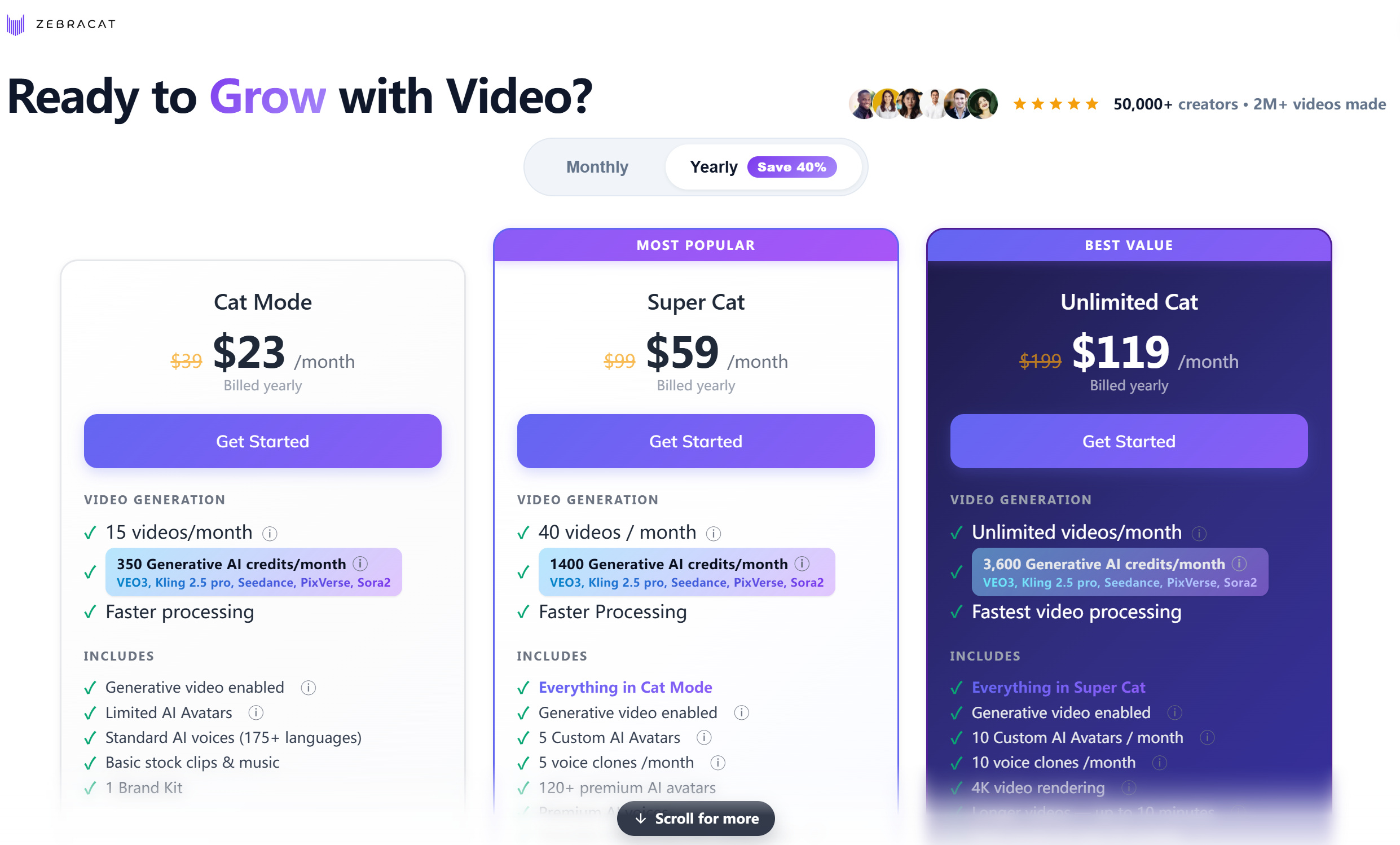
    Zebracat is built for short social video: script in, animated scenes and voiceover out. Free tier to start; Cat Mode $39/month ($23 annual), Super Cat $99 ($59 annual), Unlimited Cat $199 ($119 annual), Enterprise from $599. Annual billing saves 40%, the largest discount in this list.

    We tested it alongside Fliki (Zebracat review · Fliki vs Zebracat). Its strength is scenes that do not look template-y; its weakness is the same as Fliki’s — no convincing presenter.

    #4 Elai — minutes instead of credits

    Elai’s pitch is simple: avatar videos priced in minutes. Creator: $29/month ($23 annual) for 15 minutes/month. Team: $125/month ($100 annual) for 50 minutes, 3 editors and 3 guests. Extras are priced individually: a selfie avatar is $199/year, a studio avatar $500/year, voice cloning $200/year, and extra minutes $2 each.

    Fifteen minutes a month is a real limit for a content channel, but as a way to produce five polished avatar clips a month at $23, it is the cheapest legitimate avatar option here after Colossyan’s free tier.

    #5 Colossyan — the free way to test avatars

    Colossyan’s Starter tier is free, with 20 minutes a month and access to its avatar library — the most generous free avatar allowance in this comparison. Professional is $59/month on the annual plan, adds 30 minutes of NEO plus 10 minutes of NEO2, AI image generation, SCORM export and up to 3 editors. Custom avatars are an add-on.

    If you have never used an avatar tool and want to know whether the format works for your audience before spending $29–$89 a month, this is the rational first stop.

    #6 Pictory — the odd one out, deliberately

    Pictory is not an avatar tool. Starter $25/month billed annually (list $29), Professional $35/month annual (list $59), Team $119/month annual (list $199), with a free trial. It turns long videos, webinars and URLs into clips and narrated summaries.

    It belongs here because a large share of Synthesia buyers do not actually need a synthetic presenter — they need content out the door. If that is you, $25/month gets you more finished video per hour of work than any avatar tool on this page.
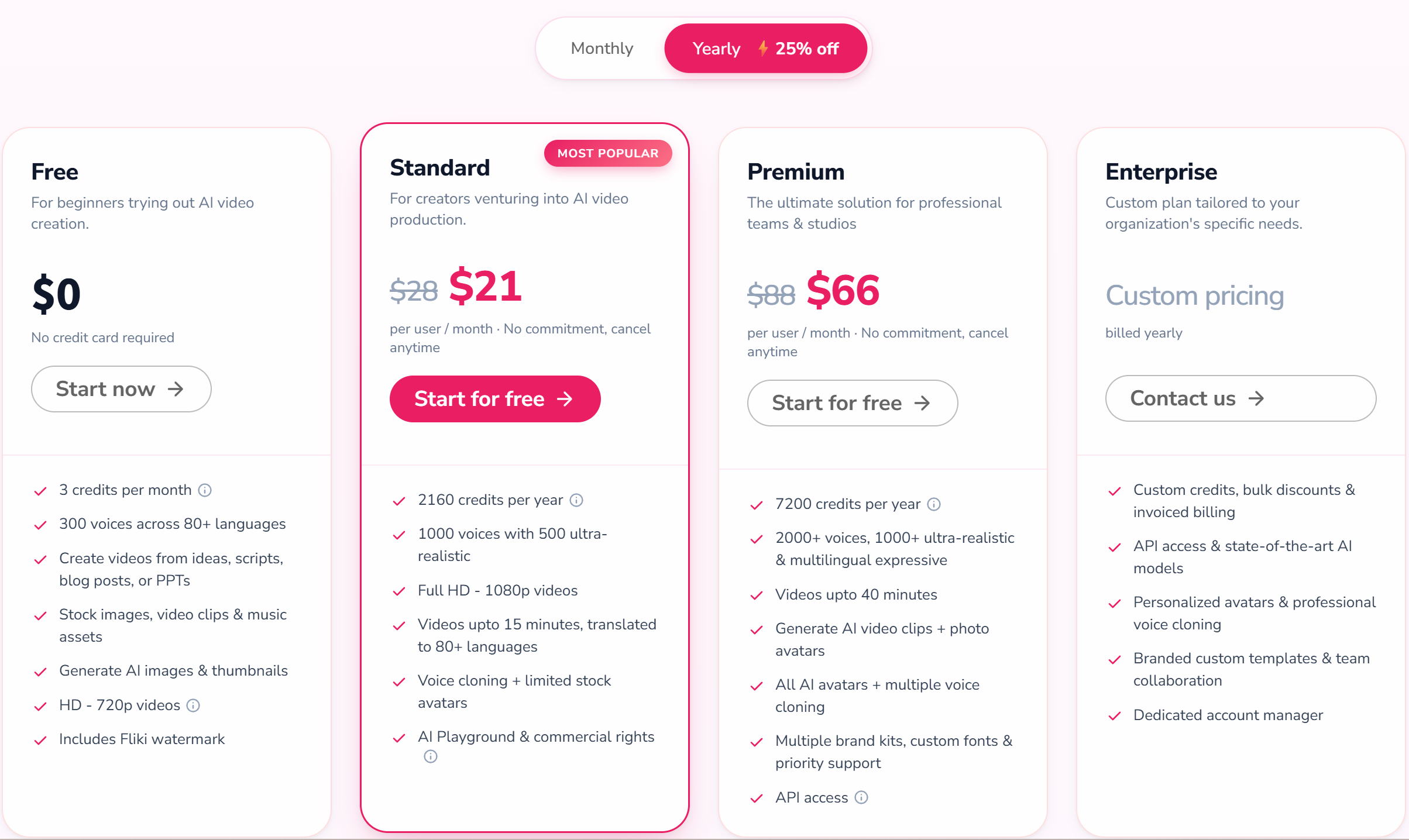
    Fliki pricing page showing Standard and Premium tiers
    Fliki’s own pricing page during our free-plan test: the Standard tier at $21–$28/month is where most solopreneurs land.

    Where Synthesia is still worth the money

    • Avatar realism and consistency. Its avatars remain the benchmark for corporate-grade video, and the alternatives trade some of that polish for price.
    • Learning and development workflows. Roleplays, surveys, templates and SCORM-style output for training are a different product category from “make me a YouTube video”.
    • Enterprise requirements. SSO, compliance, custom avatars and volume contracts. None of the six alternatives above is built for a procurement review.
    • Brand safety at scale. One avatar, one voice, hundreds of videos in many languages, with the same look across them.

    Which one should you pick?

    Your job Pick Why
    Presenter-led videos, cheaper than Synthesia HeyGen Same $29 entry, free tier, 175+ languages
    Explainers with voiceover and stock footage Fliki $21–$28/month, 1,000+ voices, built for text-to-video
    Short social videos at volume Zebracat $23/month annual, scenes that do not look templated
    Avatar video priced per minute Elai $23/month for 15 minutes, extras à la carte
    Testing whether avatars work for you Colossyan Free tier with 20 minutes/month
    Repurposing webinars and long videos Pictory Cheapest path from existing footage to clips

    How we ranked and what we tested

    Honest disclosure: Fliki and Zebracat are the two tools in this list we actually built videos on — free-plan accounts, real scripts, real renders; the screenshots on this page come from those accounts (Fliki review · Zebracat review · best AI video generators). Synthesia, HeyGen, Elai, Colossyan and Pictory are compared from their published pricing pages on October 18, 2026. I have not produced a video on those five, so I am deliberately not ranking them on avatar realism — only on price, credits and fit. Treat the quality comparisons as informed, and the numbers as verified.

    On affiliate links: Fliki and Zebracat are affiliate partners of this site. Synthesia, HeyGen, Elai, Colossyan and Pictory are not, and their prices come from their own public pages.

    FAQ

    What is the cheapest Synthesia alternative?
    For avatar video, Colossyan’s free tier (20 minutes/month) costs nothing to test, and Elai’s $23/month annual plan is the cheapest paid option with real minutes. If you do not need an avatar at all, Fliki at $21/month annual is the cheapest way to produce narrated videos.

    Is HeyGen better than Synthesia?
    For solo creators, often yes on price and flexibility: $29/month with a free tier, voice cloning and 175+ languages. For enterprise training and compliance workflows, Synthesia is the stronger product. “Better” depends on which job you are hiring it for.

    Can I replace Synthesia with a text-to-video tool?
    Only if your videos do not need a human presenter. Fliki and Zebracat produce narrated videos with stock or animated footage at a third of Synthesia’s price; neither will give you a convincing talking avatar for corporate training.

    Do these tools have free plans?
    HeyGen, Zebracat and Colossyan do; Fliki has a 3-credit monthly free tier; Elai offers limited free minutes; Pictory offers a free trial. Free tiers are usually watermarked or credit-capped — enough to judge output, not enough to publish a course.

    What happens if I run out of credits?
    Every tool on this list sells top-ups or an upgrade, and the per-credit cost drops as the tier rises. Budget for the plan one tier above the number you think you need; video production always consumes more than the estimate.


    I’m an affiliate of Fliki and Zebracat: if you sign up through my links, I may earn a commission at no extra cost to you. Both were tested on free-plan accounts, and the screenshots come from those accounts. Synthesia, HeyGen, Elai, Colossyan and Pictory are not affiliate partners, and their pricing comes from their own public pricing pages, checked on October 18, 2026.

    Try Fliki free (3 credits/month, no card) → fliki.ai

    Try Zebracat free → zebracat.ai

    Grab the free checklist (2026 Solopreneur Tool Stack: 10 tools, free tiers, and the exact moment to pay) → Get the free checklist

    Related reading: Best AI Video Generators (2026) · Fliki Review 2026 · Zebracat Review 2026 · Fliki vs Zebracat
  • Systeme.io Pricing 2026: All 4 Plans, Limits and What’s Really Free

    Systeme.io Pricing 2026: All 4 Plans, Limits and What’s Really Free

    Verdict first: Systeme.io has four plans, and three of them are optional. The free plan is a real tier — 2,000 contacts, 3 funnels, 15 funnel steps, 1 course, 500 students, unlimited emails, 0% transaction fees, no card — and most one-person businesses can run a full offer on it indefinitely. Startup at $17/month is the only upgrade the average solopreneur ever needs. Webinar at $47 exists for evergreen webinar funnels. Unlimited at $97 is for people past 10,000 contacts. The traps are not the contact limits; they are the funnel-step cap (15 → 50 → 300) and the automation-rule cap (1 → 10 → 100).

    Who this is for: anyone comparing Systeme.io’s plans before signing up, checking whether the free tier is a trial in disguise, or deciding which upgrade actually unlocks what they need.

    Who this is not for: teams evaluating enterprise email deliverability or a 500,000-contact list. Systeme.io is priced and built for solo operators and small teams.

    Every limit below was read from the plan comparison table on systeme.io/pricing on October 18, 2026. Prices are USD, billed monthly unless stated. The page itself is marked “Last updated: April 2026”.


    The four plans, in one table

    Plan Monthly Annual (per month) Contacts Funnels Courses Who it is for
    Free $0 — 2,000 3 1 Validating an offer, or running one small funnel
    Startup $17 $14.17 ($170/yr) 5,000 10 5 The first real upgrade: a list, a few funnels, a course
    Webinar $47 $39.17 ($470/yr) 10,000 50 20 Evergreen webinar funnels and heavier automation
    Unlimited $97 $80.83 ($970/yr) Unlimited Unlimited Unlimited Past 10,000 contacts, or running client sub-accounts

    Annual billing is advertised as two months free, which is exactly the 10× monthly figure in the table. All four plans include unbilled features that competitors meter: unlimited email sends, unlimited file storage, unlimited sub-accounts, unlimited newsletters and 0% transaction fees.

    Everything that changes between plans

    Feature Free Startup $17 Webinar $47 Unlimited $97
    Contacts 2,000 5,000 10,000 Unlimited
    Tags 1 10 100 Unlimited
    CRM pipelines 1 5 20 100
    Email campaigns 1 10 100 Unlimited
    Automation rules 1 10 100 Unlimited
    Workflows 1 5 20 Unlimited
    Funnels 3 10 50 Unlimited
    Funnel steps 15 50 300 Unlimited
    Evergreen webinars 0 0 10 Unlimited
    A/B tests 1 10 50 Unlimited
    Custom domains 1 3 10 Unlimited
    Websites / blogs / communities 1 each 5 each 20 each Unlimited
    Courses 1 5 20 Unlimited
    Students 500 Unlimited Unlimited Unlimited
    1-click upsells / order bumps 1 each 10 each 100 each Unlimited
    API requests per minute 30 60 120 Unlimited
    Transaction fees 0% on every plan, including free
    Emails sent Unlimited on every plan

    Read that table by looking for the rows where the free plan is not thin. Unlimited emails, unlimited storage, unlimited students on paid plans and 0% fees are the reason this platform keeps showing up in comparisons against tools that charge $97 for the same funnel. The genuinely limited rows are contacts, funnel steps and automation rules.

    What the free plan actually gets you

    This is not a 14-day trial. The free tier is permanent, requires no card, and includes:

    • 2,000 contacts and unlimited email sends, plus 1 email campaign and unlimited newsletters.
    • 3 funnels with 15 steps in total, 1 website, 1 blog, 1 community, 1 link-in-bio page.
    • 1 course with up to 500 students, 1 automated rule, 1 workflow, 1 A/B test.
    • 1 custom domain, 1 upsell, 1 order bump, 1 coupon, 50 product variants.
    • 0% transaction fees, Stripe and PayPal integration, a booking calendar with 1 event.
    • An affiliate program of your own on the free plan, and unlimited sub-accounts.

    Fifteen funnel steps sounds small until you count a real funnel: opt-in page, thank-you/download page, sales page, order page, upsell, thank-you page, plus a course module or two. A lead-magnet funnel fits comfortably; a five-product launch does not.

    A published Systeme.io funnel template page
    Our own Systeme.io account on the free plan: a funnel step published from a template. Three funnels and fifteen steps is the real ceiling, not the price.

    The five things that will actually make you upgrade

    1. You pass 2,000 contacts. Startup ($17) buys 5,000. This is the upgrade most people hit first, and the cheapest one.
    2. You want a fourth funnel or a 16th step. Startup allows 10 funnels and 50 steps. Real launches with multiple offers run out here before they run out of contacts.
    3. You need more than one automation rule. The free plan’s single rule is generous until you want a welcome sequence and a cart-abandonment sequence and a tag-based branch. Ten rules at $17 is the usual second upgrade.
    4. You want evergreen webinars. That is Webinar-only ($47), and it is the one feature that cannot be bought at $17. If your funnel is a pre-recorded webinar, the $30 jump is not optional.
    5. You pass 10,000 contacts. Then you are on Unlimited ($97), which is still cheaper than ClickFunnels’ $97 launch tier with unlimited contacts instead of 10,000.

    Annual billing: the only discount on the page

    Systeme.io advertises two months free on annual billing and nothing else — no coupon culture, no limited-time upgrade ladder. The effective monthly prices are $14.17 / $39.17 / $80.83 ($170 / $470 / $970 a year). If you are going to use the platform for six months, annual pays for itself inside the first year; if you are testing, monthly exists precisely so you do not have to commit.

    What is not in the price

    • Payment processing. Stripe or PayPal charge their own rate — typically 2.9% + 30¢ — on every sale. Systeme.io’s 0% is a platform fee, not a processing fee.
    • Your domain. A custom domain is included in the plan limits, but you still register it elsewhere for roughly $10–$15 a year.
    • Email deliverability. Unlimited sends does not mean unlimited inbox placement. A new sending domain needs warm-up, and authentication (SPF/DKIM) is on you.
    • Your time. The editor is simpler than ClickFunnels’ and the design ceiling is lower. If the funnel’s conversion depends on design, that gap has a price.

    How it compares at the same price points

    Systeme.io Free / $17 ClickFunnels $97 Kajabi $179 Teachable $39
    Contacts 2,000 / 5,000 10,000 2,500 —
    Emails Unlimited 50,000/mo Built in, contact-tiered Separate tool
    Transaction fee 0% 0% 0% (Kajabi Payments); 2% third-party on Basic 7.5% on Starter
    Best at Funnels + email + courses on a budget Funnel design, split testing, checkout Courses + coaching + community Course delivery

    Full breakdowns: ClickFunnels Review · Kajabi Review · Systeme.io vs ClickFunnels vs Kajabi.

    How we ranked and what we tested

    Honest disclosure: every limit in this article comes from Systeme.io’s own pricing page, read on October 18, 2026. The hands-on part is real: this site’s funnel, emails, automation rule and course were built on the free plan in a single afternoon, without a card, and the screenshots are from that account (full Systeme.io review). I have not tested the Webinar tier’s evergreen webinar feature or the Unlimited tier’s API limits, so those are documented rather than experienced.

    On affiliate links: Systeme.io is an affiliate partner of this site. If you sign up through my link I may earn a commission at no extra cost to you, and it does not change the plan limits quoted above.

    FAQ

    How much does Systeme.io cost?
    $0 for the free plan, $17/month for Startup, $47/month for Webinar and $97/month for Unlimited. Annual billing is two months free: $170, $470 and $970 per year.

    Is the free plan really free, or a trial?
    It is a permanent tier, not a trial. It does not expire, does not require a credit card, and includes unlimited email sends and 0% transaction fees. The limits are 2,000 contacts, 3 funnels, 15 funnel steps, 1 course and 500 students.

    What happens if I go over 2,000 contacts on the free plan?
    You upgrade to Startup ($17/month, 5,000 contacts). There is no per-contact overage charge on the free plan — it is a hard ceiling that pushes you to the next tier.

    Do I need the $97 plan to sell courses?
    No. The free plan includes one course with up to 500 students, and Startup ($17) allows 5 courses. Unlimited is about contacts, funnels and automation rules, not about unlocking course features.

    Can I downgrade or cancel later?
    Yes, from account settings at any time. Cancelling keeps your plan until the next billing date, then the account reverts to the free plan; for a mid-term downgrade, support can convert the remaining days into the lower plan.

    Is annual billing worth it?
    If you know you will use it for at least six months, yes — two months free is a 17% discount, and there is no other discount to wait for.


    I’m an affiliate of Systeme.io: if you sign up through my links, I may earn a commission at no extra cost to you. I built this site’s funnel and course on the free plan before writing this. Plan limits come from Systeme.io’s public pricing page, checked on October 18, 2026.

    Start free (no credit card, unlimited emails, 0% transaction fees) → systeme.io

    Grab the free checklist (2026 Solopreneur Tool Stack: 10 tools, free tiers, and the exact moment to pay) → Get the free checklist

    Related reading: Systeme.io Review 2026 · Systeme.io vs ClickFunnels vs Kajabi · Best Funnel Builders for Solopreneurs · How to Build a Sales Funnel for Free · ClickFunnels Alternatives

  • Kajabi vs Teachable (2026): Which One Fits Your Stage?

    Kajabi vs Teachable (2026): Which One Fits Your Stage?

    Verdict first: On the sticker price, Teachable wins: $39/month against Kajabi’s $179. It loses that advantage the moment you start selling. Teachable’s Starter plan takes 7.5% of every sale, so a $2,000 month costs you $253 on Teachable versus about $243 on Kajabi — and Kajabi throws in email marketing, pipelines, a community and coaching tools. Pick Teachable if you sell courses and little else and you are under roughly $2,500 a month in revenue. Pick Kajabi if you sell coaching, community and courses as one offer and want a single system — and pick a cheaper all-in-one entirely if you are pre-revenue.

    Who this is for: course creators and coaches who have narrowed it to these two and need to decide before paying for a year.

    Who this is not for: funnel-first businesses. ClickFunnels is the better shape for paid-traffic funnels, and Systeme.io is the affordable version of that shape.

    Prices, product limits and transaction fees were read from kajabi.com/pricing and teachable.com/pricing on October 18, 2026, in USD. Neither vendor states the trial length on its pricing page; this article does not claim one.


    The two platforms in one table

    Kajabi Teachable
    Entry price $179/mo ($143 annual) $39/mo ($29 annual)
    Transaction fee 0% with Kajabi Payments; 2% with a third-party gateway on Basic 7.5% on Starter; 0% from Builder ($89)
    Products on entry plan 5 5
    Contacts / email 2,500 contacts included; marketing email built in Email marketing on higher tiers; most sellers connect a separate tool
    Built for Courses + coaching + community + email + CRM Course delivery and selling, with less surrounding machinery
    Trial Free trial (length not stated) 7-day free trial, 30-day guarantee

    Where the price actually lands

    The 7.5% is the entire argument. Run the same month on both platforms, at 20 orders of $100 each (standard card processing at 2.9% + 30¢ is $64 on $2,000):

    Month Teachable Starter Teachable Builder Kajabi Basic Kajabi Growth
    $1,000 in sales $39 + $75 + $32 = $146 $89 + $0 + $32 = $121 $179 + $0 + $32 = $211 $249 + $32 = $281
    $2,000 in sales $39 + $150 + $64 = $253 $89 + $64 = $153 $179 + $64 = $243 $249 + $64 = $313
    $5,000 in sales $39 + $375 + $160 = $574 $89 + $160 = $249 $179 + $160 = $339 $249 + $160 = $409

    Two things jump out. First, Teachable Starter is only the cheaper option at very low volume — and by $5,000 a month it is the most expensive line in the table. Second, Teachable Builder undercuts Kajabi at every volume, because it has the same 0% fee for $89 instead of $179. If you sell courses and nothing else, Builder is the rational Teachable plan and it beats Kajabi on price outright.

    What Builder does not include is the reason anyone pays for Kajabi: email marketing with contact tiers, a CRM pipeline, a community product, coaching tools, and a single contact record across all of it.

    Products and limits, side by side

    Teachable Kajabi
    Entry plan 5 products 5 products
    Mid plan 10 products (Builder) 50 products (Growth)
    Top plan Custom / high-volume Unlimited products (Pro, $499)
    Contacts Not the pricing axis 2,500 / 25,000 / 100,000; extra blocks of 25,000 for $125/mo
    Admin seats Custom permissions on higher tiers 2 / 11 / 26 by plan
    Website + landing pages Yes Yes (1 / 1 / 3 websites)

    The products limits are closer than the prices suggest: both start at five. Kajabi’s real ceiling is contacts, and Teachable’s real ceiling is the fee. That is the whole decision in one sentence.

    What Kajabi does better

    • One system for a hybrid offer. A cohort program that bundles a course, group coaching and a community does not need Circle, Slack or a scheduler — Backstage, Communities and Courses are the same product.
    • Marketing is included. Email, pipelines, offers and landing pages are wired to the same contact record. On Teachable you will likely pay for an email tool separately ($20–$50/month), which narrows the price gap.
    • 0% with Kajabi Payments. The platform never takes a cut as long as you use its payment stack — the strongest long-run argument for the price.
    • A more finished learner experience. Out of the box, a Kajabi course looks like a product rather than a page builder demo.

    What Teachable does better

    • Price of entry. $39/month is a decision you can make this week; $179/month is a monthly revenue target.
    • Builder is excellent value. $89/month with 0% fees and 10 products is the best course-only deal in this comparison.
    • Course delivery is the product. If you do not want CRM, pipelines, communities or coaching tools, you are not paying for them.
    • A 30-day guarantee on top of the 7-day trial — more forgiving than a trial alone if you need to build a school before deciding.

    Which one should you pick?

    Pick Teachable if:

    • You sell one course, or a handful, with no coaching or community component.
    • You are under ~$2,500/month and want the lowest annual commitment — and you are willing to move to Builder the moment the 7.5% bites.
    • You already have email and do not want another inbox in your life.

    Pick Kajabi if:

    • Your offer is a bundle: course + coaching + community + membership.
    • You want marketing, checkout and delivery in one login and would otherwise pay for three tools.
    • You have (or expect) more than 2,500 contacts and want contact tiers rather than per-sale fees.

    Pick neither if you have not sold anything yet. Building a school on either platform before you have a validated offer is the most common way to spend $2,000 learning nothing. Our Kajabi alternatives breakdown and course platform comparison both start with the free and $17 options for that reason.

    How we ranked and what we tested

    Honest disclosure: this comparison is built from Kajabi’s and Teachable’s own pricing pages and plan documentation, read on October 18, 2026. I have not run paid accounts on either platform, so I am not claiming hands-on experience with their 2026 editors or course delivery. The hands-on build behind these screenshots is Systeme.io’s free plan — course, sales page and lessons — which is the benchmark used for “what a $0 course product looks like” (full Systeme.io review). The numbers are verified; the qualitative calls are informed judgement.

    On affiliate links: neither Kajabi nor Teachable is an affiliate partner of this site. The only affiliate link on this page is Systeme.io’s, and it is labelled.

    FAQ

    Is Teachable cheaper than Kajabi?
    On subscription, yes — $39 versus $179 at entry. On total cost it depends on volume: Teachable Starter takes 7.5% of sales, so above roughly $2,000 a month the gap closes, and a seller who moves to Teachable Builder ($89, 0% fee) pays less than Kajabi at every volume while getting fewer surrounding features.

    Does Kajabi charge transaction fees?
    Not with Kajabi Payments. With a third-party processor it charges 2% on Basic, 1% on Growth and 0.5% on Pro, plus your processor’s own rate.

    Which is better for coaching?
    Kajabi. Backstage and Communities are built for coaching and cohort programs; Teachable is a course platform first, and you would bolt on scheduling and community separately.

    Can I move my course from Teachable to Kajabi?
    Courses and student lists export in principle, but pages, offers and communities do not port automatically. Plan on rebuilding the sales pages and testing one product end to end before migrating a full catalogue.

    What about the free option?
    If you are pre-revenue, neither. Systeme.io’s free plan includes a course, a sales page, email and an automation rule at $0, and $17/month covers 5 courses and 5,000 contacts. Pay for Kajabi or Teachable when the platform’s polish and integrations are the constraint — not before.


    I’m an affiliate of Systeme.io: if you sign up through my links, I may earn a commission at no extra cost to you. Kajabi and Teachable are not affiliate partners of this site, and their pricing comes from their own public pricing pages, checked on October 18, 2026.

    Build the course for $0 first (no credit card, 0% transaction fees) → systeme.io

    Grab the free checklist (2026 Solopreneur Tool Stack: 10 tools, free tiers, and the exact moment to pay) → Get the free checklist

    Related reading: Kajabi Review 2026 · Best Kajabi Alternatives · Best Online Course Platforms for Creators · Systeme.io Review 2026

  • Kajabi Review 2026: Is $179/Month Worth It for a Solo Creator?

    Kajabi Review 2026: Is $179/Month Worth It for a Solo Creator?

    Verdict first: Kajabi is the best-designed all-in-one platform for experts who sell courses, coaching and community, and in 2026 it is also one of the most expensive ways to start. Basic is $179/month ($143 on annual) for 5 products and 2,500 contacts. If you have a proven offer and more than a few thousand people on your list, that is a fair price for replacing four tools. If you are under roughly $2,000–$3,000 a month in revenue, or you have never launched, it is a $1,716-a-year commitment to a platform whose cheapest tier caps you at 5 products — and Systeme.io does the same job at $0, then $17/month.

    Who this is for: coaches, consultants and course creators with an existing audience, deciding whether Kajabi earns its price, and what the alternatives cost once you price the pieces separately.

    Who this is not for: first-time sellers, funnel-first businesses (ClickFunnels is the better shape), or anyone who mainly needs a checkout with order bumps. You would be paying for a course business you have not built yet.

    Prices, plan limits and fees below were read from kajabi.com/pricing on October 18, 2026. Kajabi does not state the trial length on the pricing page, so this review does not claim one.


    What Kajabi is in 2026

    Kajabi is not a course platform anymore. It is a suite aimed at people who monetize expertise:

    • Courses — the product it built its reputation on, with drip content, quizzes and mobile access.
    • Coaching — Backstage, launched as a premium, personalized coaching layer.
    • Communities — branded spaces for discussion and membership.
    • Newsletters, landing pages, funnels, websites — the marketing surface around the products.
    • Marketing emails and pipelines — email plus a lightweight CRM.
    • Payments, offers, upsells — its own payment stack (Kajabi Payments) and checkout.
    • AI credits — 0 on Basic, 500 on Growth, 1,000 on Pro; extra credits cost $15/month for 500.

    The pitch is “five tools that do not talk to each other, replaced by one”. The pricing page makes the same claim about à la carte costs, and for a course business that argument mostly holds.

    Kajabi pricing in 2026

    Plan Monthly Annual (per month) Products Contacts Admin seats Websites / communities
    Basic $179 $143 (save $432/yr) 5 2,500 2 1 / 1
    Growth $249 $199 (save $600/yr) 50 25,000 11 1 / 1
    Pro $499 $399 (save $1,200/yr) Unlimited 100,000 26 3 / 3

    Two numbers decide most of this decision, and neither is the price: products and contacts.

    The 5-product cap is smaller than it sounds

    On Kajabi, a “product” is not a lesson — it is the thing you sell. A course, a membership, a coaching offer, a download bundle. Five of them on Basic is enough for someone with a single flagship program and a couple of funnels, and not enough for anyone running a portfolio:

    • Flagship course + a smaller entry course + membership + 1:1 coaching + a template pack = 5. You are full.
    • Add a seasonal workshop, a waitlist product, or a second brand, and you are pricing Growth at $249/month.

    This is the quiet reason so many Kajabi users end up on Growth. It is not contacts; it is the product ceiling.

    The 2,500-contact cap is the expensive one

    Email lists grow whether or not revenue does. At 2,500 contacts on Basic, three things can happen when you cross the line:

    • Upgrade to Growth: $249/month — a jump of $70/month, or $840 a year, for 10x the contacts and 10x the products.
    • Buy additional contacts — Kajabi sells them in 25,000-contact blocks for $125/month — which is a Growth-tier escape hatch rather than a Basic one.
    • Prune your list, which is the answer nobody chooses.

    For context: a 2,500-contact list mailed weekly is roughly 10,000 sends a month, which most email tools price at $20–$40. You are not paying for email here. You are paying for the product layer around it.

    Fees: 0% on Kajabi Payments, 0.5%–2% elsewhere

    Kajabi’s pricing page states “no hidden fees, no revenue sharing” — and that is accurate when you use Kajabi Payments. Use a third-party processor and the platform fee comes back by tier:

    Payment setup Basic Growth Pro
    Kajabi Payments 0% platform fee 0% 0%
    Third-party processor (not PayPal) 2% 1% 0.5%
    Your card processor’s own rate Applies on top, typically 2.9% + 30¢

    That is materially better than the 5%–7.5% charged on the entry tiers of Podia, Kartra and Teachable, and it is the strongest honest argument for Kajabi’s price: the percentage you keep does not shrink as you grow.

    What Kajabi genuinely does better

    • The course and member experience. Out-of-the-box, a Kajabi course looks like a product rather than a page builder demo. Students get an app-like experience without you touching CSS.
    • Coaching plus community in the same product. Backstage and Communities mean a cohort-based or hybrid offer does not need Slack, Circle or a separate scheduler.
    • Marketing and sales in one place. Pipelines, offers, landing pages and email are wired to the same contact record, which is the real reason people consolidate.
    • No revenue share. On a $5,000 month that is $250–$375 kept versus a 5%–7.5% entry tier — enough to erase the monthly price gap in the first month of a good launch.
    • A polished surface with little configuration. If your constraint is time rather than money, this is what you are buying.

    Where it costs you

    • The floor is $1,716 a year on monthly billing before you have sold anything. Most solo businesses do not clear that in software spend in year one.
    • Basic is a starter tier with a premium price. 5 products, 2,500 contacts and 2 admin seats are genuinely limited; the platform’s reputation is built on Growth and Pro.
    • Funnels are the weakest part of the suite. If funnels are your business, ClickFunnels is the better shape and Systeme.io is the cheaper version of the same shape.
    • AI is metered and thin at the entry tier. Basic includes 0 AI credits; Growth includes 500; overage is $15/month per 500.

    Kajabi vs Systeme.io vs ClickFunnels

    Kajabi Basic Systeme.io Free / Startup ClickFunnels Launch
    Price $179/mo ($143 annual) $0 / $17/mo $97/mo ($81 annual)
    Contacts 2,500 2,000 / 5,000 10,000
    Products / courses 5 products 1 / 5 courses 3 courses
    Transaction fees 0% with Kajabi Payments; 2% third-party 0% 0%
    Best at Courses, coaching, community Cheapest complete funnel stack Funnel pages and checkout

    Read that table by shape rather than price. Kajabi is a product business platform: courses, coaching, community. ClickFunnels is a traffic conversion platform: pages, funnels, checkout. Systeme.io is the cheap version of both, with a lower design ceiling and no contact or email metering.

    Course front page built on Systeme.io free plan
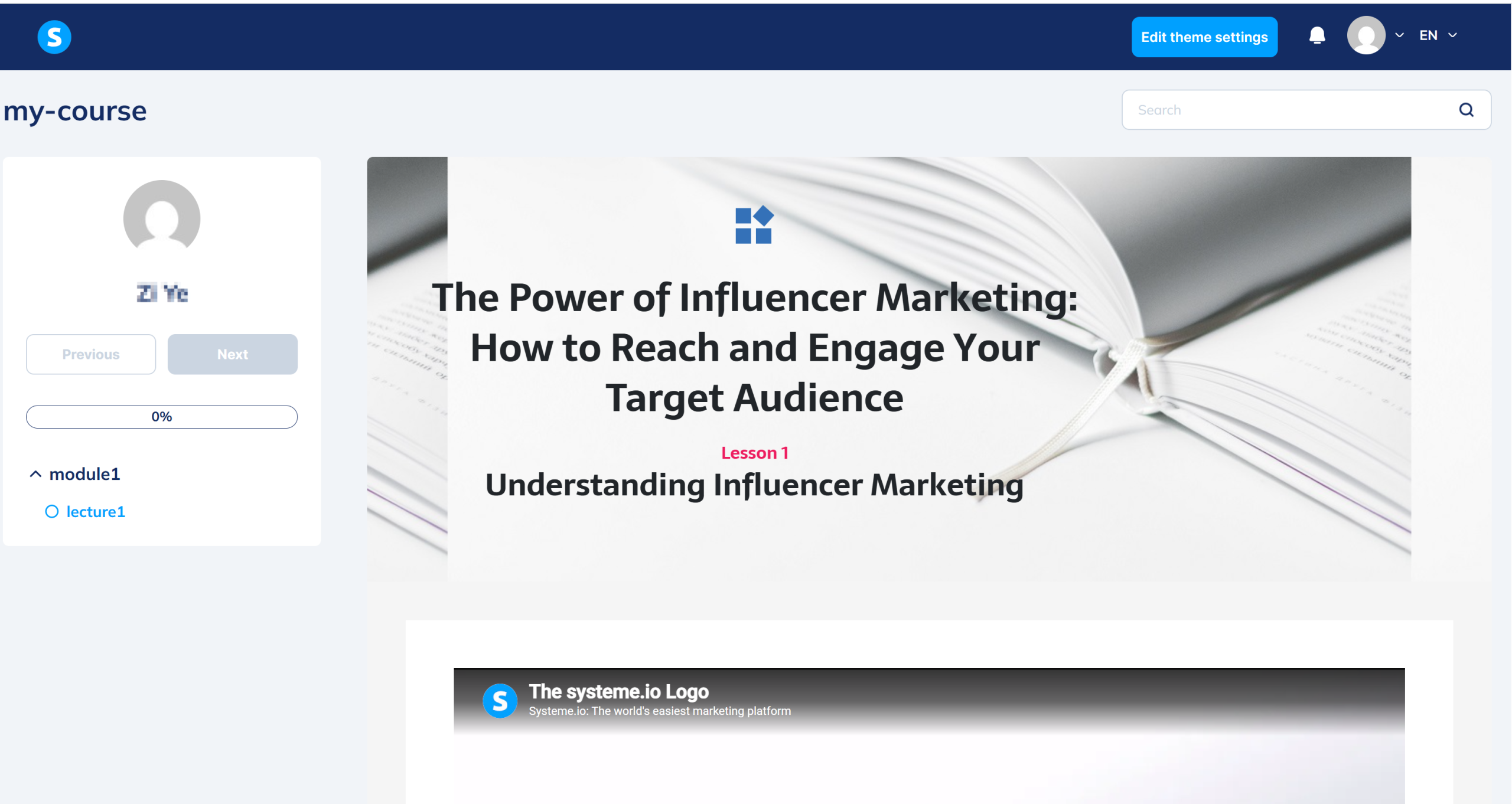
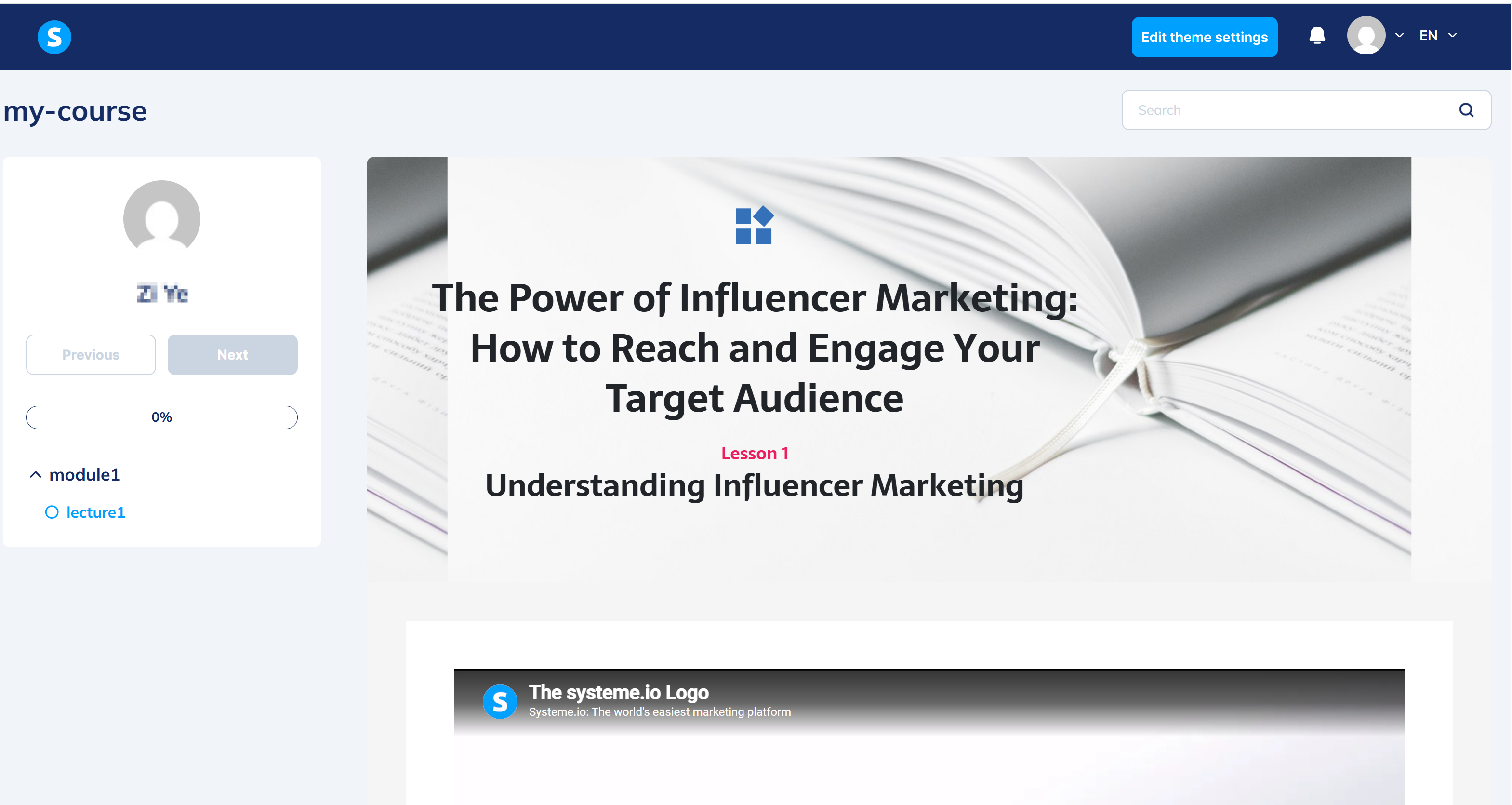
    Our own course front page, built on Systeme.io’s free plan. Kajabi’s version is more polished — this is the baseline it has to beat at $179 a month.

    Who should buy Kajabi

    • You already sell a course or coaching program and have an audience — the platform’s polish pays for itself in perceived quality.
    • You are replacing at least three tools (course host + community + email + funnel pages) and would otherwise pay $150+ a month anyway.
    • You sell high-ticket offers where one extra sale covers the year.
    • You are moving off a course plugin stack that breaks on every WordPress update.

    Who should not (yet)

    • You are pre-revenue. Start on a free plan, prove the offer, and pay for Kajabi from revenue.
    • You have a 5,000-person list and a small offer. The contact cap pushes you to $249 before the product earns it.
    • Funnels and paid traffic are your growth engine. ClickFunnels is the better instrument, and Systeme.io is the affordable one.
    • You need one simple checkout and nothing else. Kajabi is a category too big for that job.

    How we ranked and what we tested

    Honest disclosure: this review is based on Kajabi’s own pricing page and plan documentation, read on October 18, 2026. I have not run a paid Kajabi account, so I am not claiming hands-on experience with Backstage, its community product or the 2026 editor. What I did build first-hand is the equivalent course product on Systeme.io’s free plan — course, sales page and lesson structure — and that is the benchmark used here (full Systeme.io review). Treat the qualitative comparisons as informed, and the numbers as verified.

    On affiliate links: Kajabi is not an affiliate partner of this site and pays us nothing. The only affiliate link on this page is Systeme.io’s.

    FAQ

    Is Kajabi worth $179 a month?
    For an established course or coaching business, usually yes — it replaces a course host, community tool, email tool and funnel builder, and it takes 0% of your sales with Kajabi Payments. For a business under about $2,000–$3,000 a month, the maths usually does not work yet, and a free or $17/month platform is the better starting point.

    Does Kajabi have a free plan?
    No. It offers a free trial and three paid tiers starting at $179/month. It does not state the trial length on its pricing page, so check the signup flow before you plan around it.

    What happens if I go over 2,500 contacts on Basic?
    You upgrade to Growth at $249/month, or buy contact capacity in 25,000-contact blocks at $125/month. In practice, most people who outgrow Basic move to Growth, because the product cap of 5 usually arrives first.

    Does Kajabi take a percentage of my sales?
    Not with Kajabi Payments — the pricing page advertises no revenue sharing. With a third-party processor it charges 2% on Basic, 1% on Growth and 0.5% on Pro, plus your processor’s own rate.

    Kajabi or ClickFunnels?
    Kajabi if what you sell is courses, coaching and community. ClickFunnels if what you sell is a funnel and the page is the product. The overlap is smaller than the marketing suggests, and picking the wrong shape is the expensive mistake — not the price difference.

    Can I move from Kajabi to a cheaper platform later?
    Contacts export; courses, pages and communities do not port automatically. Budget a day of rebuilding for a simple course, and check that your student accounts and purchases transfer before you cancel.


    I’m an affiliate of Systeme.io: if you sign up through my links, I may earn a commission at no extra cost to you. Kajabi is not an affiliate partner of this site, and its pricing comes from its own public pricing page, checked on October 18, 2026.

    Build the same course for $0 (no credit card, 0% transaction fees, unlimited emails) → systeme.io

    Grab the free checklist (2026 Solopreneur Tool Stack: 10 tools, free tiers, and the exact moment to pay) → Get the free checklist

    Related reading: Kajabi vs Teachable · Best Kajabi Alternatives (2026) · Best Online Course Platforms for Creators · Systeme.io Review 2026 · ClickFunnels Review 2026

  • ClickFunnels Review 2026: What $97/Month Actually Gets You

    ClickFunnels Review 2026: What $97/Month Actually Gets You

    Verdict first: ClickFunnels is still the most complete funnel platform you can buy, and $97/month is still the highest floor in its category. The Launch plan buys 10,000 contacts, 50,000 emails a month, 3 courses, 5 custom domains and 1M AI words — real capacity, not a teaser. It is worth paying if funnels are already how you sell and you want pages, checkout, email and courses in one system. It is not worth paying while you are still validating an offer: Systeme.io’s free plan will run the same opt-in → thank-you → email sequence for $0, and $17/month after that. Buy ClickFunnels when the funnel is the business, not before.

    Who this is for: solo operators and small teams who want one funnel platform, already have traffic or an audience, and are deciding between ClickFunnels, Kajabi and the cheaper all-in-ones before committing a year of subscription.

    Who this is not for: anyone who needs only a landing page and an email tool. You will pay for a CRM, a community, an ecommerce store and an AI copywriter you may never open. A $17/month tool covers that job.

    All ClickFunnels prices and plan limits below were read from clickfunnels.com/pricing on October 18, 2026, in USD. Where the page does not state something — the exact trial length, for instance — this review says so rather than repeating what older affiliate pages claim.


    What ClickFunnels actually is in 2026

    The name undersells it now. ClickFunnels is a business platform with six products bolted together:

    • Funnels and pages — the original product, still the reason people arrive. Drag-and-drop editor, templates, countdown funnels, A/B testing on the higher tiers.
    • Email marketing — campaigns, automations, workflows, tied to the same contact list.
    • Courses and memberships — 3 courses on Launch, up to 20 on Dominate.
    • Store — a Shopify-shaped product for physical and digital goods.
    • CRM and community — pipelines, calendars, message hub, a community product.
    • AI tools — metered in words: 1M words on Launch, 10M on Dominate.

    That breadth is the argument for the price, and the argument against it: if you need four of those six, ClickFunnels is cheaper than four subscriptions. If you need two, it is expensive by definition.

    ClickFunnels pricing in 2026

    Plan Monthly Annual (per month) Contacts Emails / month Courses Other limits
    Launch $97 $81 (save $194/yr) 10,000 50,000 3 1 workspace, 2 team members, 5 custom domains, 1M AI words
    Scale $197 $164 (save $394/yr) 75,000 300,000 6 5 workspaces, 5 members, unlimited domains, custom code, API/webhooks, 2M AI words
    Optimize $297 $248 (save $594/yr) 150,000 750,000 10 10 workspaces, 10 members, 5M AI words
    Dominate $5,997/yr only — 400,000 1,200,000 20 20 workspaces, 20 members, VIP support, 3h onboarding, 10M AI words

    Three details that matter more than the row labels:

    1. All four plans list “Unlimited Funnels — Limited Time.” The pricing page says it in those words, on every tier. Plan for the funnels you have, not for a promise with an expiry date attached to it.
    2. There is no free plan. The button says “Start Free Trial” but the page does not state the trial length or whether a card is required. ClickFunnels does publish a 30-day money-back guarantee, which is the more useful fact if you are about to commit to annual billing.
    3. ClickFunnels takes 0% of your sales. Its own FAQ says “No. You’ll keep every penny you make.” You pay Stripe, PayPal or another processor separately — usually 2.9% + 30¢.

    What $97 a month actually buys you

    Strip the marketing and Launch is a five-part bundle for one person: a funnel builder, an email tool for 10,000 contacts, three courses, five domains and an AI copywriter. Priced separately in 2026 that is roughly $97–$150 a month, which is why people who genuinely use all five keep paying it.

    The binding constraint is not contacts — it is 50,000 emails a month. Run the arithmetic on your own list:

    • 10,000 contacts emailed weekly = 40,000 sends. You fit, with room for one extra broadcast.
    • 10,000 contacts emailed twice a week = 80,000 sends. You are over the cap before you have written a single automation.
    • 5,000 contacts emailed weekly plus a 5-email welcome sequence with 1,000 new signups a month = 20,000 + 5,000 = 25,000. Comfortable on Launch.

    So Launch suits a list of a few thousand that you mail once a week. The moment you combine a bigger list with a real launch cadence — or send daily during a launch week — the $197 Scale plan becomes the honest price, and the annual cost of “ClickFunnels” for you is $1,968, not $1,164.

    A two-step funnel built on Systeme.io's free plan
    The control case: this funnel — opt-in page, thank-you page, three-email sequence, one automation rule — was built on Systeme.io’s free plan. ClickFunnels gives you a better editor for the same structure at $97/month.

    What ClickFunnels does better than the cheap alternatives

    Having built the same funnel on both Systeme.io and, over the years, on ClickFunnels-style editors, the differences are real and specific:

    • The editor and templates. ClickFunnels’ page builder is more mature; you can ship a page that looks designed without touching CSS. Systeme.io’s editor is faster to learn and visibly simpler.
    • Checkout and upsell choreography. One-click upsells, order bumps and post-purchase flows are first-class features here rather than an add-on.
    • A/B testing and analytics. Split testing is on Scale and above; the reporting is tied to funnel steps, which is the unit you actually optimize.
    • One system, one login. The thing you are really buying is not features — it is the absence of integration glue between a page builder, an email tool, a course platform and a store.
    • Ecosystem. Templates, operators, a large affiliate community: when something breaks there is a tutorial for it in the first page of results.

    Where the price costs you

    The floor is the story. At $97/month, ClickFunnels costs more per year ($1,164) than most solo businesses spend on their entire software stack in the first year. Compare: Systeme.io Unlimited is $97/month with unlimited contacts and unlimited funnels; Kajabi Basic is $179/month with a much better course business underneath it. ClickFunnels sits between the two, priced like a platform but built around funnels.

    Feature sprawl is a tax on attention. Six products means six surfaces to learn. If you only need pages and email, the extra four will not make you money — they will make you read documentation.

    Trial terms are opaque. “Start Free Trial” without a stated length is a small thing that costs you ten minutes at the checkout. The 30-day money-back guarantee is the more reliable safety net.

    No free plan at all. Every competitor in this price band offers either a free tier or a long trial. ClickFunnels’ answer is “the guarantee”, which is fine if you are ready to buy and useless if you are only comparing.

    The 12-month math, three ways

    ClickFunnels Launch (annual billing) Systeme.io Unlimited (annual) Kajabi Basic (annual)
    Effective monthly $81 $80.83 ($970/yr) $143
    Contacts 10,000 Unlimited 2,500
    Emails 50,000/mo Unlimited Not metered on the plan card
    Courses 3 Unlimited 5 products
    Transaction fees 0% 0% 0% with Kajabi Payments; 2% with a third-party gateway on Basic
    Built for Funnels first, everything attached Cheapest complete stack Courses, coaching and community first

    At annual billing, ClickFunnels Launch and Systeme.io Unlimited cost within a dollar of each other per month — and Systeme’s plan has no contact or email ceiling. That does not make ClickFunnels the worse buy: its editor, checkout and split testing are better. It makes the decision about which capability you will actually use, not about price.

    Who should buy ClickFunnels

    • You already run paid traffic or a list, and a 1-point conversion improvement pays for the subscription.
    • You sell a high-ticket offer — coaching, a $997 program, a service — where a single extra sale covers a year.
    • You want one platform and will genuinely use funnels, email and courses together.
    • You are a small team: 2 seats on Launch, 5 on Scale, and workspaces to separate brands.

    Who should not (yet)

    • You have no offer and no traffic. A funnel builder cannot validate an offer; a free plan can test one.
    • Your business is courses, coaching and community. Kajabi is the better platform for that shape, and it shows in the features.
    • You are price-sensitive by necessity, not preference. $1,164 a year is a real number for a business that has not made its first $1,000.
    • You need a store more than a funnel. Shopify does the store better.

    How we ranked and what we tested

    Honest disclosure: this review is based on ClickFunnels’ own pricing page and plan documentation, read on October 18, 2026. I did not run a paid ClickFunnels account for this article, so I am not claiming hands-on experience with its 2026 editor. What I did test first-hand is the same funnel structure on Systeme.io’s free plan — opt-in page, thank-you page, three emails, one automation rule — and that is the benchmark I am comparing ClickFunnels against (full Systeme.io review). If you want a paid-account teardown of ClickFunnels, this is the wrong article; if you want to know what the price buys before you spend it, it is the right one.

    On affiliate links: ClickFunnels is not an affiliate partner of this site and pays us nothing. The only affiliate link on this page is Systeme.io’s, and it is labelled as such.

    FAQ

    Is ClickFunnels worth $97 a month?
    Only if you will use at least three of its products — funnels, email, courses, store, CRM — and you already have something to sell. On a purely feature-per-dollar basis Systeme.io is cheaper; on editor quality, checkout and split testing ClickFunnels is better. The price is justified by usage, not by the feature list.

    Does ClickFunnels have a free plan?
    No. It offers a free trial, whose length is not stated on the pricing page, plus a 30-day money-back guarantee. Every tier is a paid tier starting at $97/month.

    Does ClickFunnels take a cut of my sales?
    No — 0% of your sales. You pay your payment processor separately. That is one genuine advantage over platforms that take 5%–7.5% on entry plans.

    What happens when I hit 50,000 emails a month?
    You move up to Scale at $197/month (300,000 emails, 75,000 contacts), or you buy additional send capacity. The email cap, not the contact cap, is what usually triggers the upgrade.

    ClickFunnels or Systeme.io for a first funnel?
    Systeme.io, unless you already have revenue. $0 against $97 is not a close call while you are validating; the free plan includes pages, email, one course and an automation rule with unlimited sends. Move to ClickFunnels when conversion, design and split testing become the constraint.

    Can I import my ClickFunnels funnels somewhere else?
    Not automatically. Funnel pages do not port between platforms. Contacts export as CSV; pages get rebuilt. Budget a few hours for a simple funnel and a day for anything with subscriptions, coupons or dunning.


    I’m an affiliate of Systeme.io: if you sign up through my links, I may earn a commission at no extra cost to you. ClickFunnels is not an affiliate partner of this site, and its pricing comes from its own public pricing page, checked on October 18, 2026.

    Test the same funnel for free (no credit card, 0% transaction fees, unlimited emails on the free plan) → systeme.io

    Grab the free checklist (2026 Solopreneur Tool Stack: 10 tools, free tiers, and the exact moment to pay) → Get the free checklist

    Related reading: ClickFunnels Alternatives (2026) · Systeme.io Review 2026 · Systeme.io vs ClickFunnels vs Kajabi · Best Funnel Builders for Solopreneurs · Kajabi Review 2026

  • ThriveCart Alternatives (2026): 6 Options Compared on Real Checkout Cost

    ThriveCart Alternatives (2026): 6 Options Compared on Real Checkout Cost

    Verdict first: ThriveCart is a genuinely good checkout — and that is exactly the problem for most solo sellers in 2026: you pay $47/month (or $87 for Pro+) and still need pages to put in front of it. If what you want is one login, a permanent free plan and 0% transaction fees, Systeme.io is the better-value ThriveCart alternative: free up to 2,000 contacts, $17/month after that, 0% platform fees on every tier. Choose SamCart only if checkout conversion is your actual bottleneck and you already have traffic. Choose Lemon Squeezy if you would rather pay per sale (5% + 50¢) than a monthly fee, and you want someone else to handle sales tax.

    Who this is for: creators, coaches and course sellers who are paying for a cart plus a page builder plus an email tool, and want to know what the combination really costs. Also for anyone deciding between a cart and an all-in-one platform before they have revenue.

    Who this is not for: stores doing six figures a month with a developer on call. At that scale the 5%-style fees below become the expensive option, and a payment-optimized checkout like ThriveCart Pro+ or ClickFunnels is worth its monthly price.

    Every price in this article was checked on the vendor’s own pricing page on October 18, 2026, in USD. Where a vendor does not publish a number (ThriveCart’s Enterprise tier, for example), we say so instead of guessing.


    Why people look for a ThriveCart alternative (the honest version)

    ThriveCart used to be a cart. In 2026 it is a stack: checkout, upsells, order bumps, subscriptions, an affiliate center on Pro+, plus ThriveCart Academy for courses and branded communities. That is a better product than the one most reviews still describe — and it changes the alternatives list.

    The complaint is rarely quality. It is the shape of the bill:

    1. $47/month is the floor, not the price. Standard is $47/month; the conversion features that make ThriveCart worth talking about — multiple order bumps, subscription dunning, an affiliate center with automated payouts — sit on Pro+ at $87/month.
    2. It is still a cart. You need landing pages, an email tool and a course platform around it. ThriveCart’s 100+ integrations mean those tools talk to it, not that you stopped paying for them.
    3. Annual billing is not a big discount. You are choosing between $47 a month and roughly $37 a month equivalent on annual — a real saving, but not a different decision.

    None of that makes ThriveCart a bad purchase. It makes it a purchase you should make after you have sales, not before.

    ThriveCart pricing in 2026

    Plan Price Trial What you get
    Standard $47/mo 30 days free Checkout, funnels, 0% platform fees, 100+ integrations, one-time and subscription products
    Pro+ $87/mo 30 days free Everything in Standard plus multiple order bumps, subscription dunning, tax-inclusive pricing, affiliate center with automated payouts, Academy course/community hosting
    Enterprise Custom Contact sales Volume processing rates, white-glove setup, dedicated account manager, multi-brand support

    Two things worth noting. First, ThriveCart charges 0% of your sales — all three plans say it, and that is ThriveCart’s main structural advantage over platforms that take 5%. Second, the 30-day trial is genuinely 30 days and does not require you to pick a plan up front, which is more generous than most of this list.

    What ThriveCart does not publish is the Enterprise price, and its annual price did not render on the page we checked. If you need an exact annual number, get it from the checkout flow before you commit rather than from a review.

    The 6 alternatives at a glance

    # Tool Entry price Platform fee on sales Free plan / trial Best for
    #1 Systeme.io $0 (paid from $17/mo) 0% Free forever, no card The cheapest complete funnel + email + course stack
    #2 SamCart $79/mo 0% on SamPay 7-day free trial Checkout conversion and order bumps
    #3 Kartra $59/mo 5% on Essentials, 0% from $119 14-day trial All-in-one with helpdesk and affiliates
    #4 Podia $42/mo billed annually 5% on Mover, 0% from Shaker Free trial, no card The simplest course + downloads store
    #5 Lemon Squeezy $0/mo 5% + 50¢ per sale Free, no trial needed Merchant of record — they handle VAT and sales tax
    #6 Teachable $39/mo 7.5% on Starter, 0% from Builder 7-day trial, 30-day guarantee Selling courses with no funnel choreography

    The alternatives, one by one

    #1 Systeme.io — best overall ThriveCart alternative for solo sellers

    Systeme.io is the only tool here where the free plan is a real tier rather than a trial. It includes 2,000 contacts, 3 funnels, 1 course, 1 affiliate program, 1 custom domain, 1 automation rule and 1 email campaign — plus unlimited email sends and unlimited file storage, which is the part most free plans meter. No credit card, and the plan does not expire.

    Paid tiers: Startup $17/mo (5,000 contacts, 10 funnels, 5 courses), Webinar $47/mo (10,000 contacts, 50 funnels, 20 courses, evergreen webinars), Unlimited $97/mo. Annual billing is two months free ($170 / $470 / $970). Transaction fees are 0% on all four plans, and the same core tools ship on every tier.

    I built a working funnel on that free plan — opt-in page, thank-you page, a three-email sequence and an automation rule — in about 30 minutes, without entering a card. That build is what most of the screenshots on this site come from.

    Systeme.io funnel steps built on the free plan
    Our own Systeme.io account: the two-step funnel built on the free tier. The same funnel would sit behind a $47/month cart if we used ThriveCart.

    Where ThriveCart wins: checkout design, order bumps at scale, dunning flows, and a cart that is genuinely optimized for revenue. Systeme.io’s editor is simpler and its design ceiling is lower. If your funnel converts because of design, you will feel it.

    Best for: the seller who wants pages, email and a course in one login starting at $0.

    #2 SamCart — the checkout specialist

    SamCart is what you buy when the cart, not the page, is the problem. Plans are Core $79/mo and Pro $199/mo, both with a 7-day free trial, and SamCart takes no added fee when you use SamPay (standard card processing is 2.9% + 30¢). Pro adds unlimited seats, multiple marketplaces, an affiliate center, advanced analytics and third-party processor support.

    The catch is the price: SamCart Core starts above ThriveCart Standard, so this is not a cheaper alternative — it is a differently weighted one. You also still need pages and email around it.

    Best for: sellers who already get traffic and whose order value is high enough that a 1-point conversion lift pays for the difference.

    #3 Kartra — all-in-one with the biggest fee trap

    Kartra is the closest competitor to ClickFunnels, not to ThriveCart: funnels, pages, email, helpdesk, calendars, affiliates. Plans are Essentials $59/mo, Starter $119/mo ($99 on annual), Growth $229/mo ($189 annual), Professional $549/mo ($429 annual), with a 14-day trial.

    Read Essentials carefully: it charges a 5% transaction fee, caps you at 500 contacts, 5 pages, 1 product and 1 course. The 0% fee and unlimited pages start at Starter ($119). At $2,000 a month in sales, Essentials costs more than its sticker price in fees alone.

    Best for: businesses that want one platform for funnels, email, helpdesk and affiliates — at the $119+ tier, not the $59 one.

    #4 Podia — the simplest store, with subscriber walls

    Podia is the least intimidating option on this list. Mover is $42/mo billed annually ($504/year) and includes a 5% transaction fee, 100 email subscribers, 50 products and 500 videos. Shaker is $84/mo billed annually ($1,008/year) with no Podia fee and 500 subscribers; Earthquaker adds capacity again. There is a free trial and no card required.

    The hard walls are email subscribers, not products. A 100-subscriber limit makes Mover a testing tier, not a business tier.

    Best for: someone selling one course and a handful of downloads who wants the shortest path from login to a live product page.

    #5 Lemon Squeezy — no monthly fee, and they pay the taxman

    Lemon Squeezy is a merchant of record: you pay $0/month and 5% + 50¢ per transaction, and they handle global sales tax and VAT compliance, which is the single most annoying part of selling digital products internationally. Email marketing is included free up to 500 subscribers, and there is no trial to run out — it is free to start.

    The math flips as you grow. On $10,000 a month in sales, 5% is about $500 plus per-order fees — more than the $47 that ThriveCart charges, which is exactly why carts exist.

    Best for: digital-product sellers doing under $5K/month who would rather not register for tax in six countries.

    #6 Teachable — courses only, and the fee is the price

    If your offer is literally “buy my course”, Teachable is the cheapest credible route: Starter $39/mo ($29 annual) with a 7.5% transaction fee, Builder $89/mo ($69 annual) with 0%, Growth $189/mo ($139 annual). Seven-day trial, 30-day guarantee.

    On $5,000 of course sales, Starter’s 7.5% is $375 — most of the price difference between Starter and Builder. The 0% fee, unbranded checkout and affiliate program start at Builder.

    Best for: course sellers who do not want a funnel builder and will not use upsells.

    What each option actually costs at $2,000/month in sales

    Sticker price is the least useful number in this comparison. Here is the same month on each platform: $2,000 in sales across 20 orders at $100 average, using standard Stripe pricing (2.9% + 30¢) where the platform does not process payments itself.

    Platform (monthly billing) Subscription Platform fee Card processing Total for the month
    Systeme.io Startup $17 $0 $64 $81
    Lemon Squeezy $0 $110 included $110
    ThriveCart Standard $47 $0 $64 $111
    SamCart Core $79 $0 $64 $143
    Teachable Builder $89 $0 $64 $153
    Podia Shaker (annual) $84 $0 $64 $148
    Kartra Starter $119 $0 $64 $183
    Podia Mover $49 $100 (5%) $64 $213
    Kartra Essentials $59 $100 (5%) $64 $223
    Teachable Starter $39 $150 (7.5%) $64 $253

    Two conclusions fall out of that table. Entry-tier plans with percentage fees are the most expensive rows on it, and the gap between the cheapest and the most expensive option is roughly $170 a month — about two thousand dollars a year, on the same sales.

    How we ranked (read this before you buy)

    Ranking is weighted toward cost to a solo operator who is still validating an offer, then on whether the tool can carry you from page to payment to follow-up without a second subscription. Prices were verified on the vendors’ own pricing pages on October 18, 2026.

    Honest disclosure about testing: only Systeme.io has been hands-on tested on this site — I registered the free plan and built a real funnel, email campaign and automation rule, and the screenshots are from my own account (full Systeme.io review). ThriveCart, SamCart, Kartra, Podia, Lemon Squeezy and Teachable are assessed from their published pricing pages and plan limits, not from paid accounts. I have not verified their editors or checkout flows first-hand, and plan limits change; re-check the live page before you switch.

    On affiliate links: only Systeme.io is an affiliate partner of this site. None of the other five tools pay us anything, and they are in the list because an alternatives article that quietly omitted the tools people actually compare would be useless.

    FAQ

    Is there a free alternative to ThriveCart?
    Yes. Systeme.io’s free plan is a permanent tier, not a trial: 2,000 contacts, 3 funnels, 1 course, unlimited emails and 0% transaction fees, no card required. Lemon Squeezy is also free to start but takes 5% + 50¢ per sale. ThriveCart itself has no free plan, only a 30-day trial.

    What is the cheapest way to sell a digital product in 2026?
    If you need pages, email and delivery: Systeme.io at $0, then $17/month. If you only need checkout and want tax handled: Lemon Squeezy at 5% + 50¢ per sale. If you sell a single $10 file a few times a month, the percentage model is cheaper — the monthly plans only win once you sell consistently.

    Does ThriveCart charge transaction fees?
    No. ThriveCart charges 0% of your sales on Standard and Pro+; you pay Stripe or PayPal processing separately. Its business model is the subscription, plus ThriveCart Academy as the bundle that justifies Pro+.

    Can I migrate from ThriveCart to Systeme.io?
    Yes, but not automatically. Funnel pages do not port between platforms — you rebuild pages and re-import contacts. For a simple funnel that is a couple of hours; for a subscription business with dunning and coupons, plan a day and test one product end to end before moving the rest.

    Do I need a cart at all if I use an all-in-one platform?
    No. Systeme.io, Kartra and Podia include checkout, so a separate cart is an optimization, not a requirement. The reason to add ThriveCart or SamCart later is conversion — order bumps, upsells and one-click upsells that are better than the built-in checkout.


    I’m an affiliate of Systeme.io: if you sign up through my links, I may earn a commission at no extra cost to you. I only recommend tools I have actually registered and built with — the funnel screenshots on this site come from my own account. The other tools in this comparison are not affiliate links, and their pricing comes from their own public pricing pages.

    Start free (no credit card, 0% transaction fees) → systeme.io

    Grab the free checklist (2026 Solopreneur Tool Stack: 10 tools, free tiers, and the exact moment to pay) → Get the free checklist

    Related reading: Systeme.io Review 2026 · Best Online Course Platforms for Creators · ClickFunnels Alternatives · Best Funnel Builders for Solopreneurs

  • How to Build a Sales Funnel for Free (Step-by-Step, 2026)

    How to Build a Sales Funnel for Free (Step-by-Step, 2026)

    Verdict first: You can build a real, working sales funnel for $0 — and I did, start to finish, in about 30 minutes on Systeme.io's free plan. This guide is that exact build, step by step, with the screenshots and the two places it actually tripped me up. The free plan covers a landing page, a funnel, an email list and a 3-email follow-up sequence; you do not need a credit card. The catch is not the price, it's two defaults: templates publish with demo text still in them, and free-mail senders (Gmail/Yahoo) are blocked by the platform. Both are fixable in minutes once you know about them.

    Who this is for: solopreneurs, coaches, newsletter writers and side-hustlers who need one funnel to collect emails or sell a first small product — and who would rather not pay $97/month to find out if the idea works.

    Who this is not for: anyone who needs split-testing at scale, complex multi-branch automation, or a large webinar funnel. Free-tier funnel builders are for validating an offer, not for running a mature business — I say exactly where the ceiling is at the bottom.


    What you will have at the end

    The funnel below is the one I actually built and tested. It is deliberately boring, because boring funnels convert:

    Traffic (social post / blog / email)
      └── Opt-in page  ──►  collects name + email
            └── Thank-you page  ──►  delivers the download
                  └── Automation rule  ──►  subscribes them to a campaign
                        └── Email 1 (instant, with the PDF attached)
                            Email 2 (+1 day)
                            Email 3 (+3 days, first soft pitch)

    Two steps, one automation rule, three emails. That is the entire machine. Everything else in funnel-building is decoration you can add later.

    What "free" actually gets you

    Free-plan limit What it means in practice
    2,000 contacts Enough for a validated offer. You will outgrow it before you outgrow the plan.
    3 funnels Plenty — most people need one funnel plus a spare.
    1 custom domain Use it. It materially helps deliverability (see the Gmail/Yahoo gotcha below).
    Unlimited emails Not metered. No "you've hit your send limit" wall on the free tier.
    No credit card The free plan is a real tier, not a 14-day trial.

    Paid tiers start at $17/mo (Startup: 5,000 contacts, 10 funnels) and go up to $47/mo (Webinar) and $97/mo (Unlimited). You do not need any of them to finish this guide.

    Step 1 — Decide what the funnel is for

    Pick exactly one of these before you touch the builder. This is the step people skip, and it is the reason most "my funnel doesn't convert" problems are actually positioning problems:

    • Lead magnet funnel — you give away a checklist, template or PDF in exchange for an email. Two steps. This is what I built. Start here.
    • Free-trial / demo funnel — sign-up page, then onboarding.
    • Small-product funnel — opt-in → sales page → checkout.

    Write the offer in one sentence first: "I help [who] get [result] with [deliverable]." If you cannot fill that in, more funnel steps will not help.

    Step 2 — Create the funnel and pick a template

    Inside Systeme.io: Funnels → Create → Landing Page, then choose a lead-magnet style template.

    Systeme.io funnel steps list

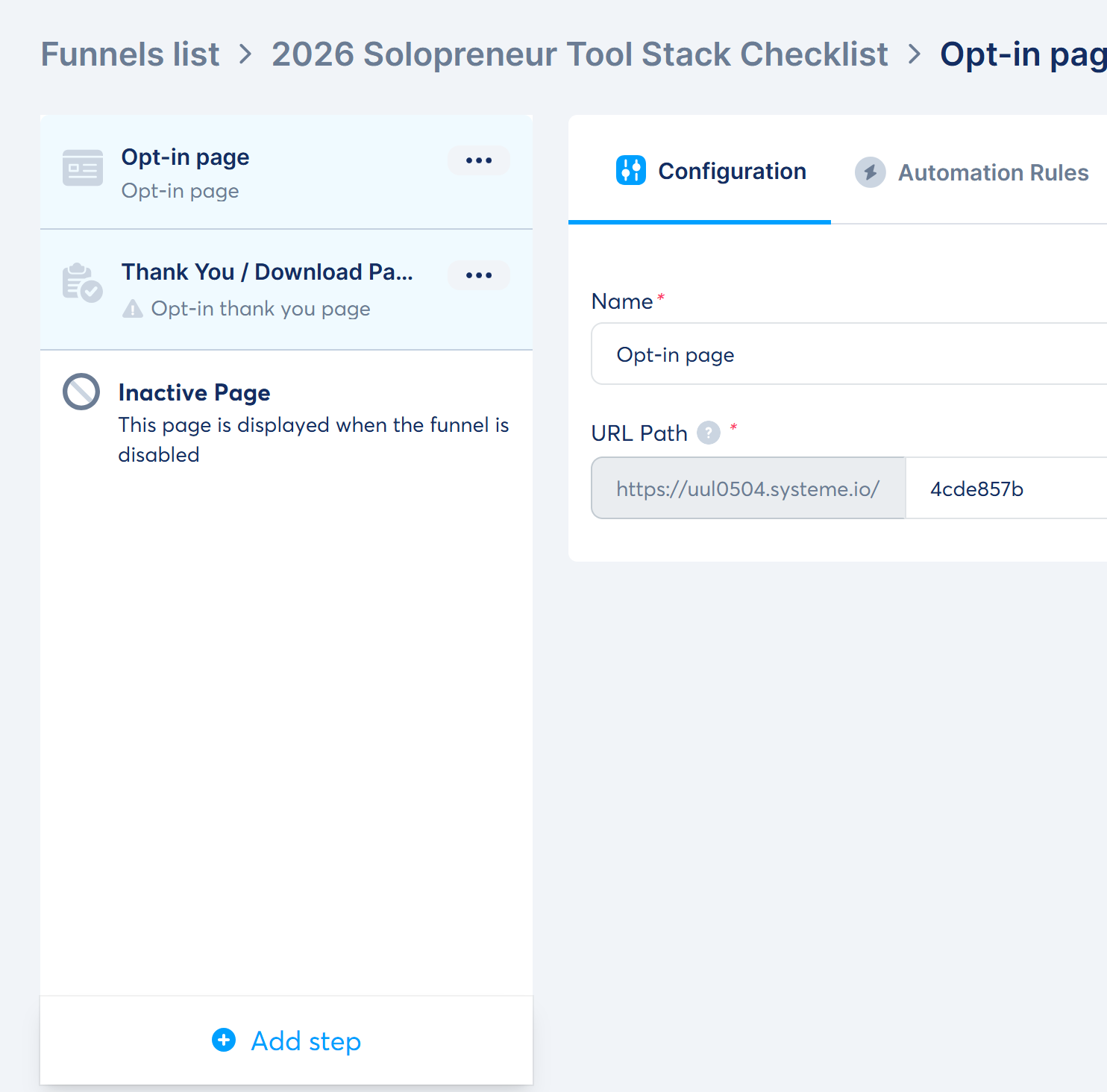
    Honest note on the UI: if you learned funnel-building from older tutorials you are expecting a canvas with arrows. You will not get one. The 2026 interface shows a clean vertical step list. The opt-in template creates two steps by default — Opt-in page → Thank-you / Download page. That is correct for a lead magnet; the "3-step funnel" you have read about needs a sales page you add manually.

    Step 3 — Replace the template's demo content (do not skip this)

    This is the mistake I actually made, and it is the most embarrassing one in the whole process.

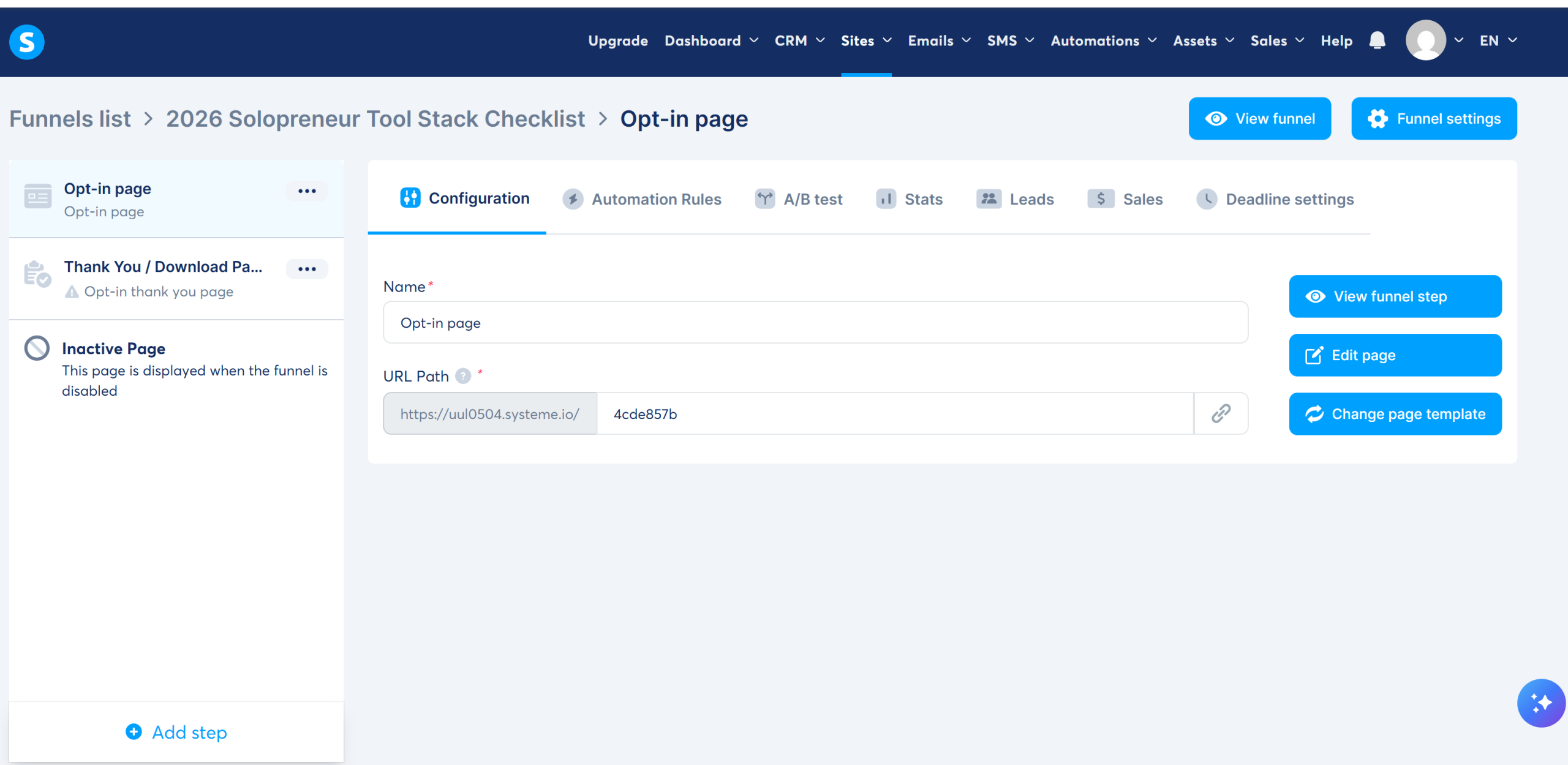
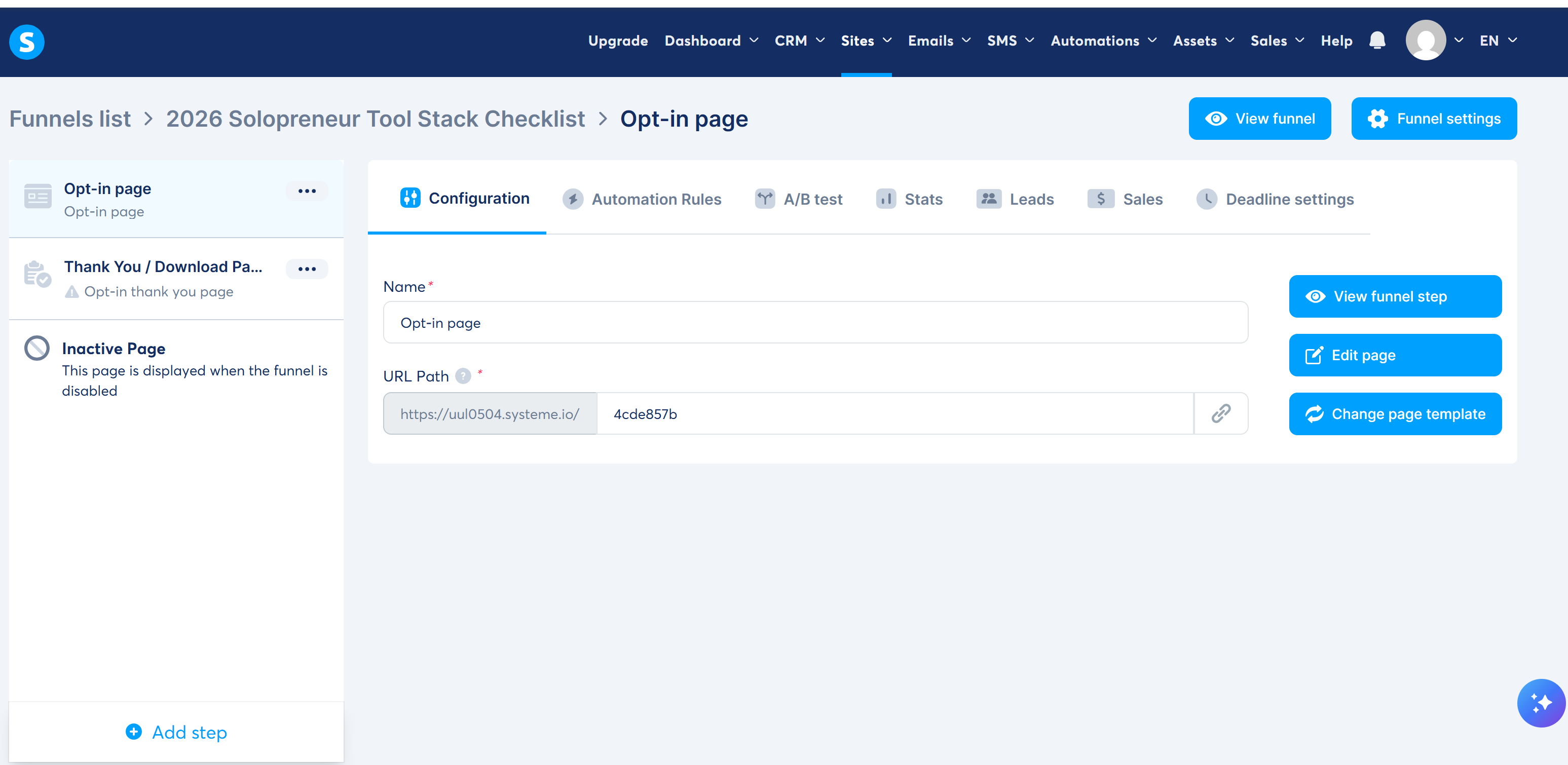
    Systeme.io landing page step configuration

    Step configuration is where you set the page name and the URL path. Once you publish, you have a live URL — mine was https://uul0504.systeme.io/4cde857b.

    Published Systeme.io landing page still showing template demo content

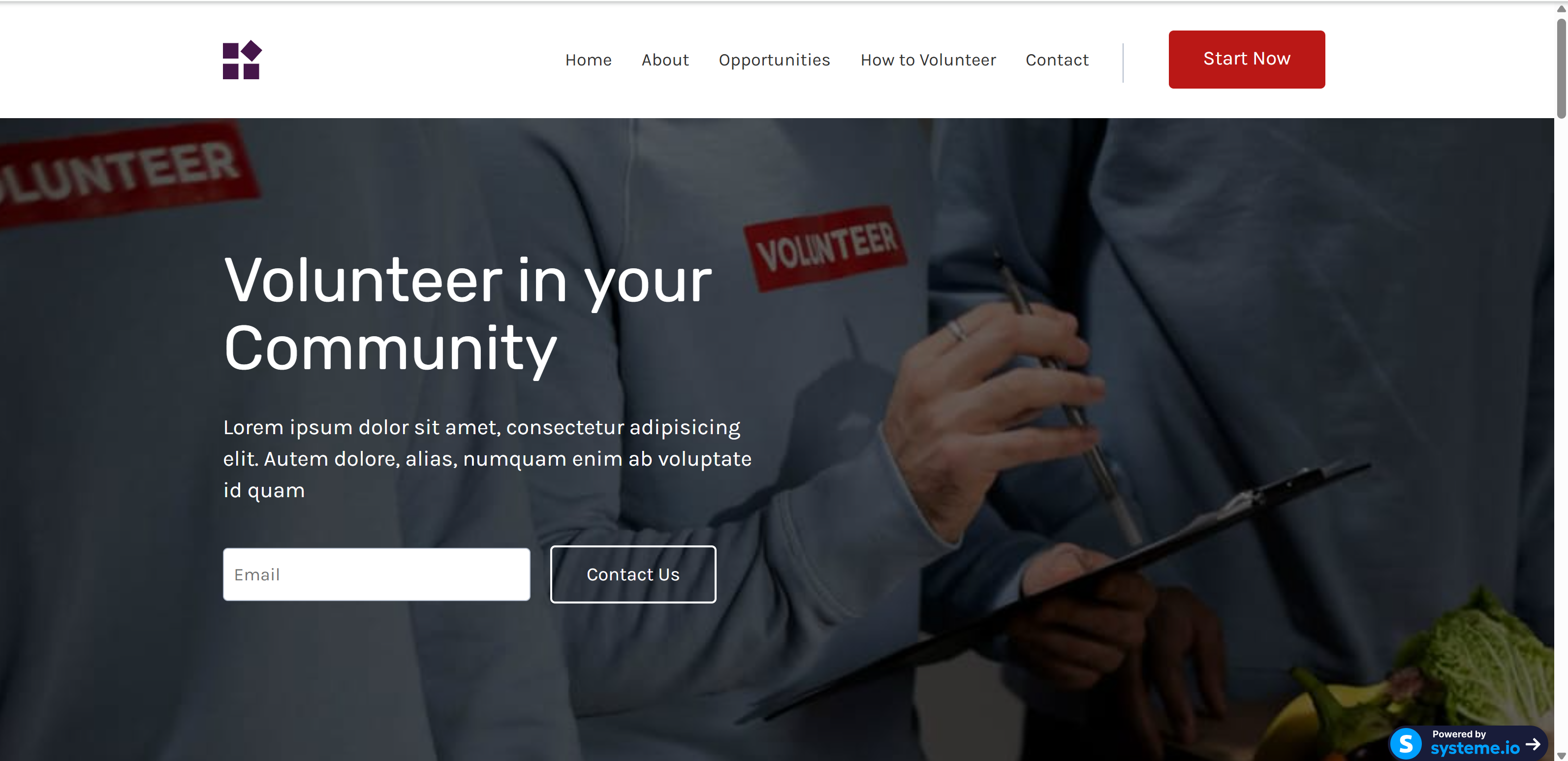
    Look carefully at that screenshot: my first "published" page was still showing the template's demo copy ("Volunteer in your Community") and placeholder text. Systeme.io templates are demo pages, not skeletons. Every block arrives pre-filled, and publishing does not warn you. Walk every single section and replace the text before you hit publish — and if you already published, delete the leftover sections in the editor and re-publish.

    Step 4 — Build the Thank-you / delivery page

    The second step is already created for you. Put the actual deliverable here as well as in the email (people lose emails, and a download link on the page reduces support pings). Keep it to a headline, the download button, and one line telling them what to expect next.

    Step 5 — Create the email that delivers the promise

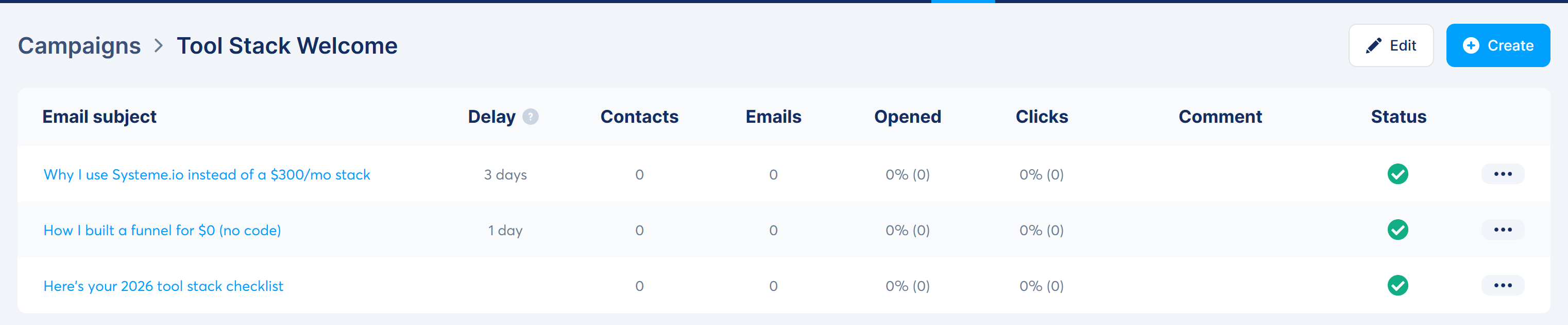
    Go to Emails → Campaigns → Create and name the sequence (e.g. Tool Stack Welcome).

    Systeme.io campaign list

    Inside the campaign, create three emails: the first with no delay, the second at +1 day, the third at +3 days. Attach your PDF to email 1 from the right-hand panel.

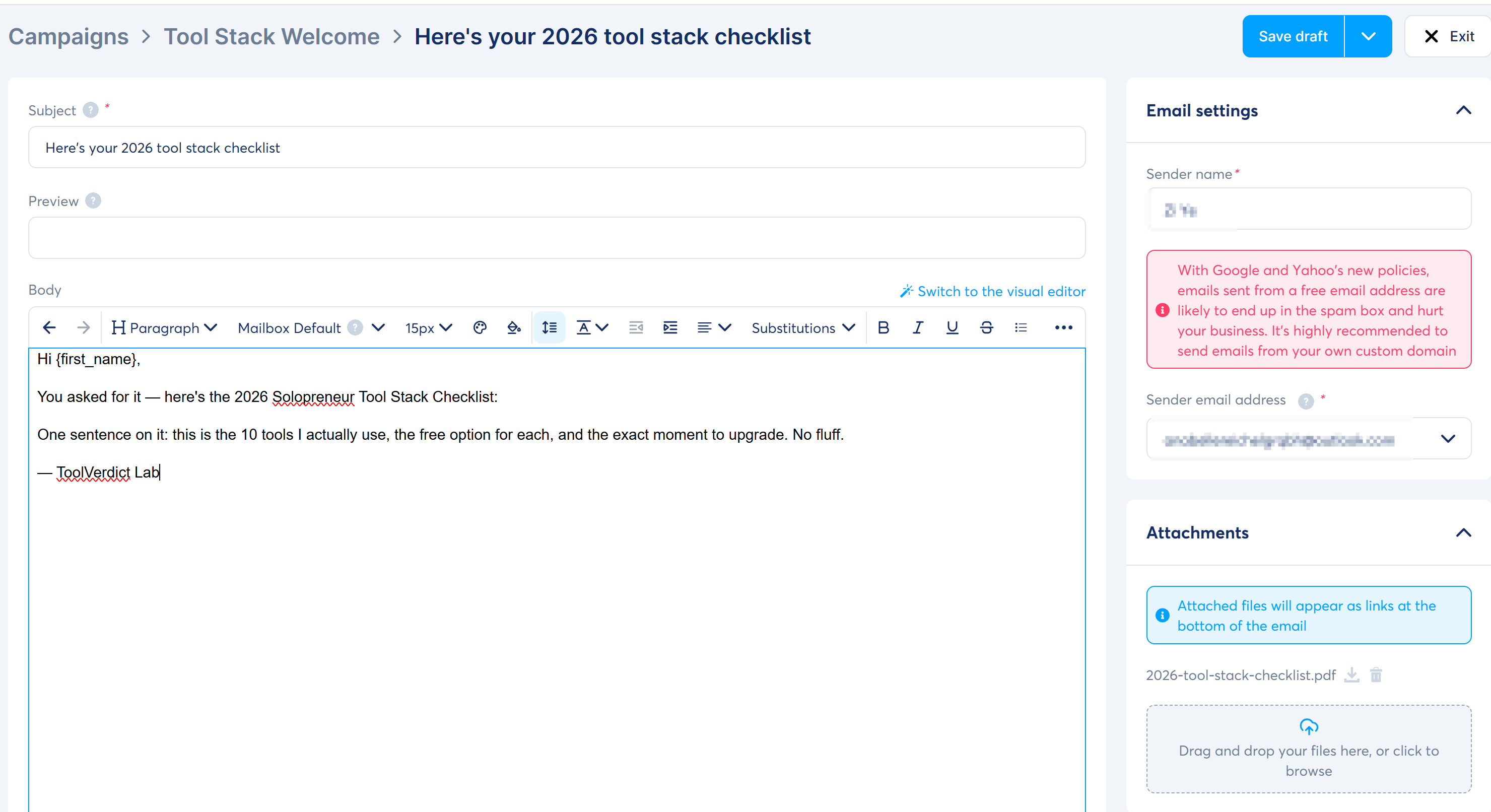
    Systeme.io email editor with PDF attachment

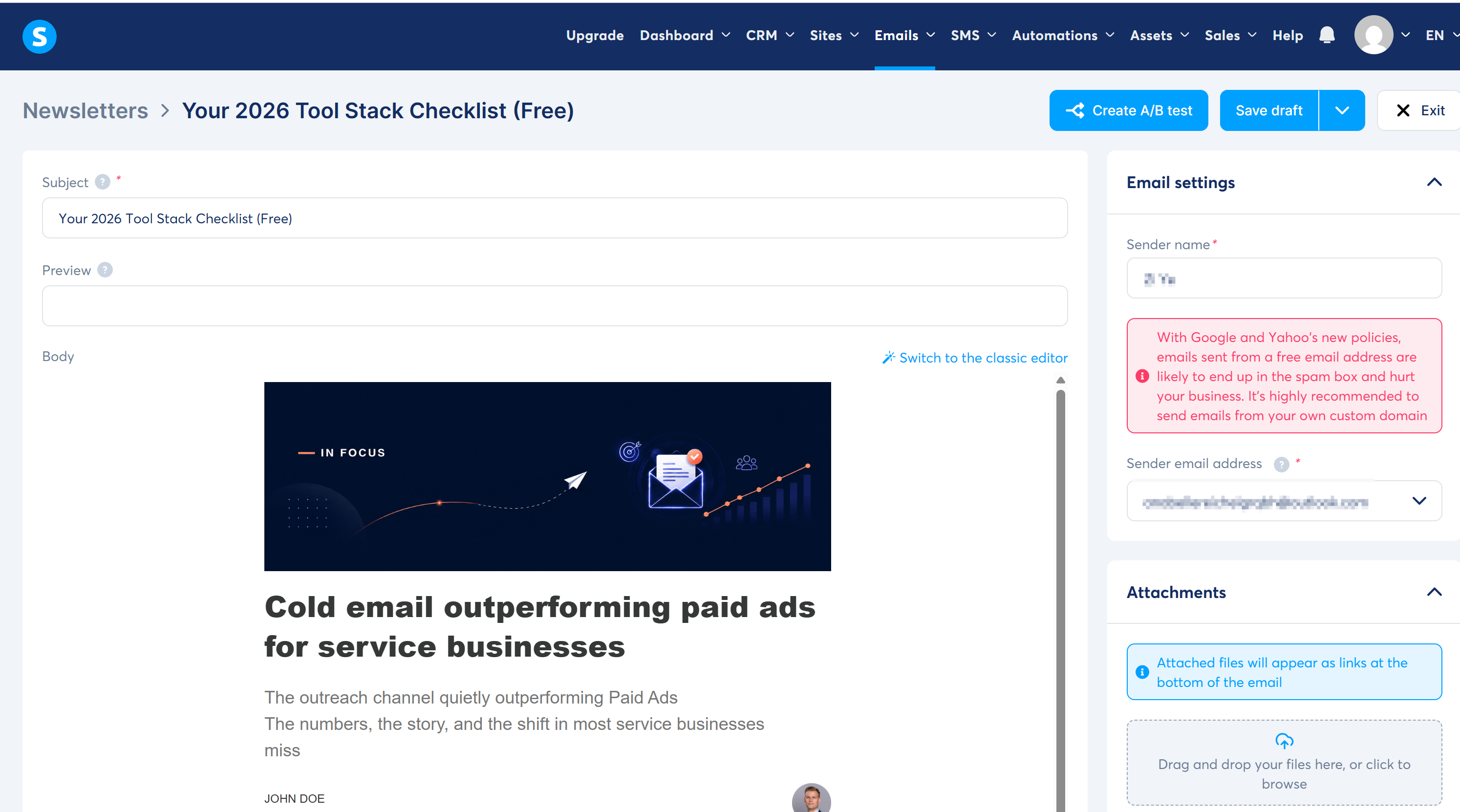
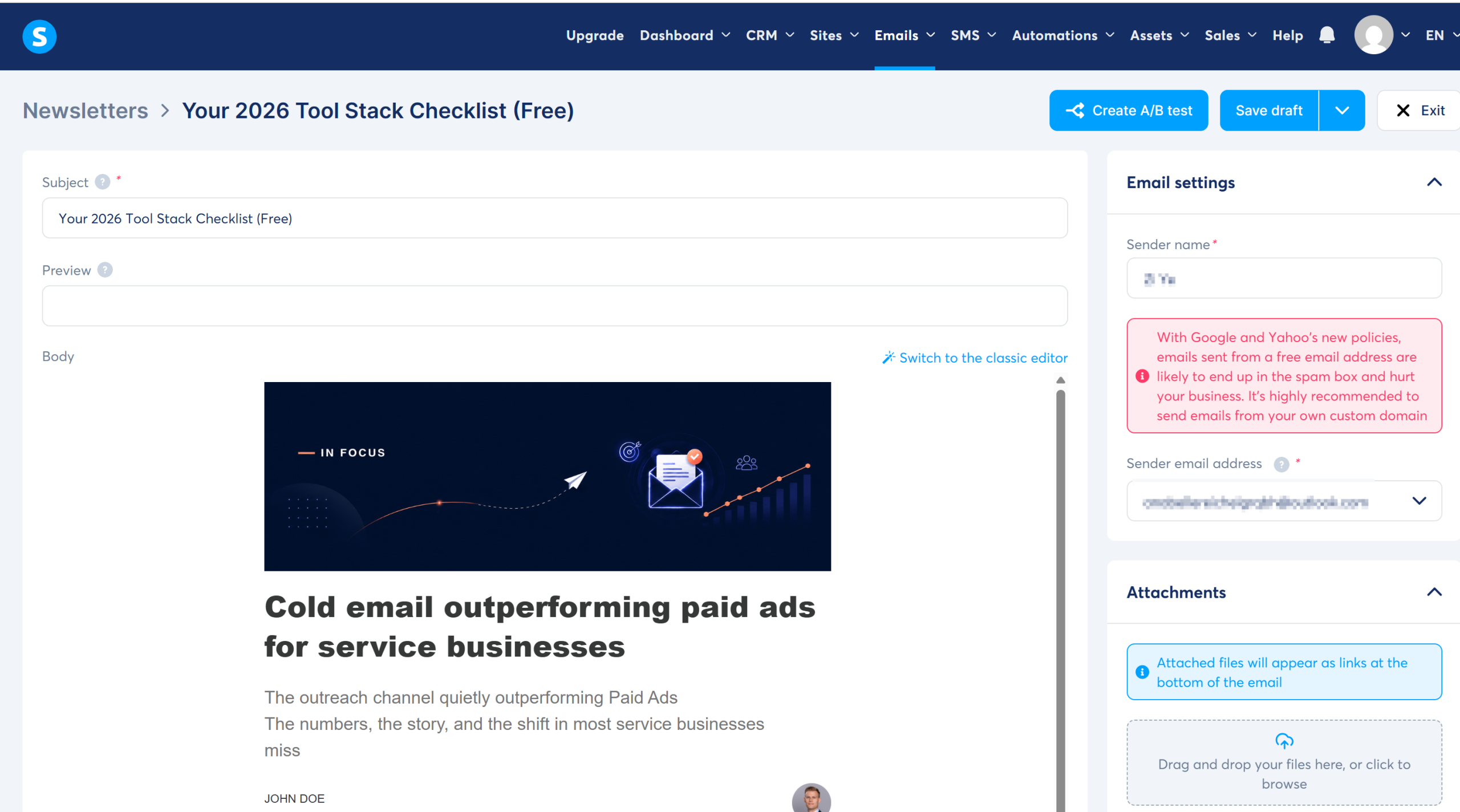
    Two things to fix while you are here: the email body also ships with demo content (a fake banner and a "JOHN DOE" signature — delete both), and you should set a real sender name now rather than later.

    Step 6 — Wire the automation rule

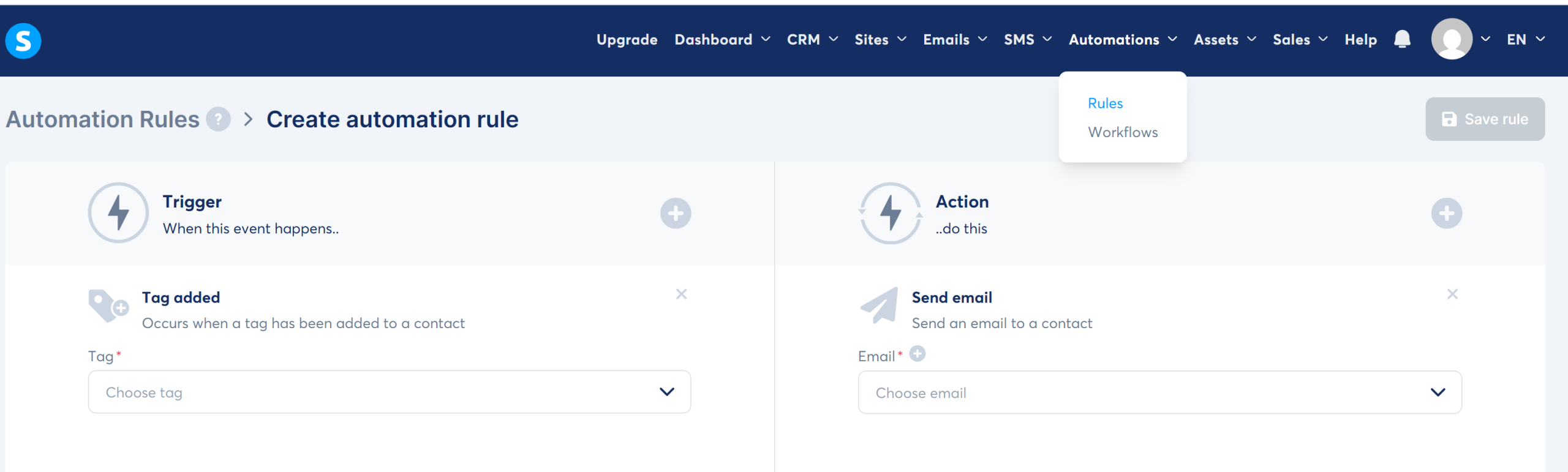
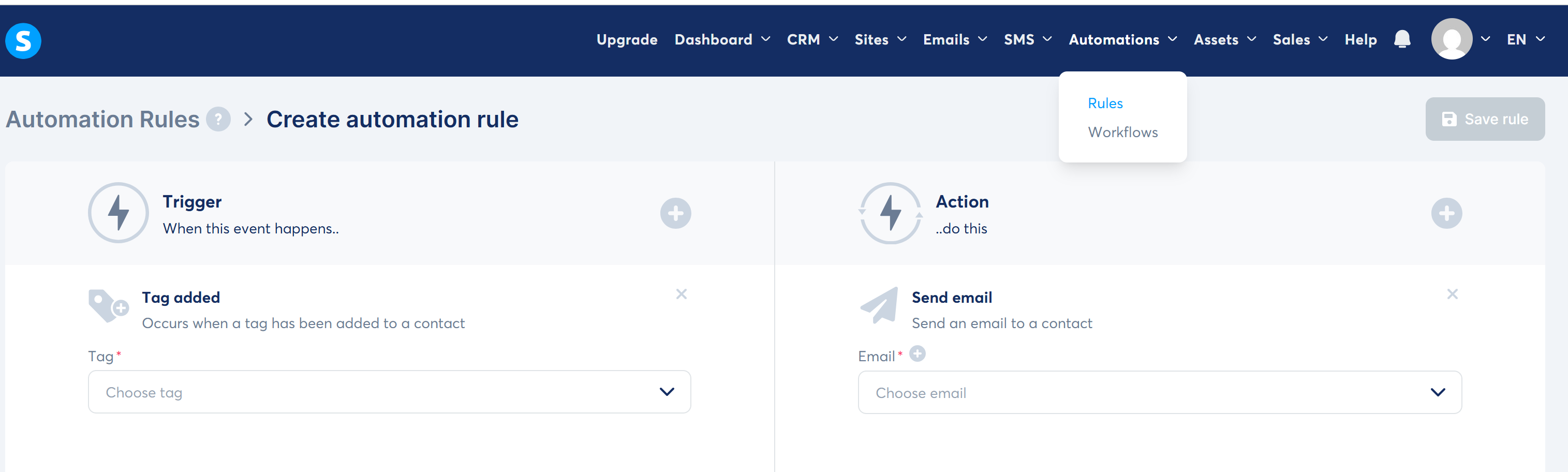
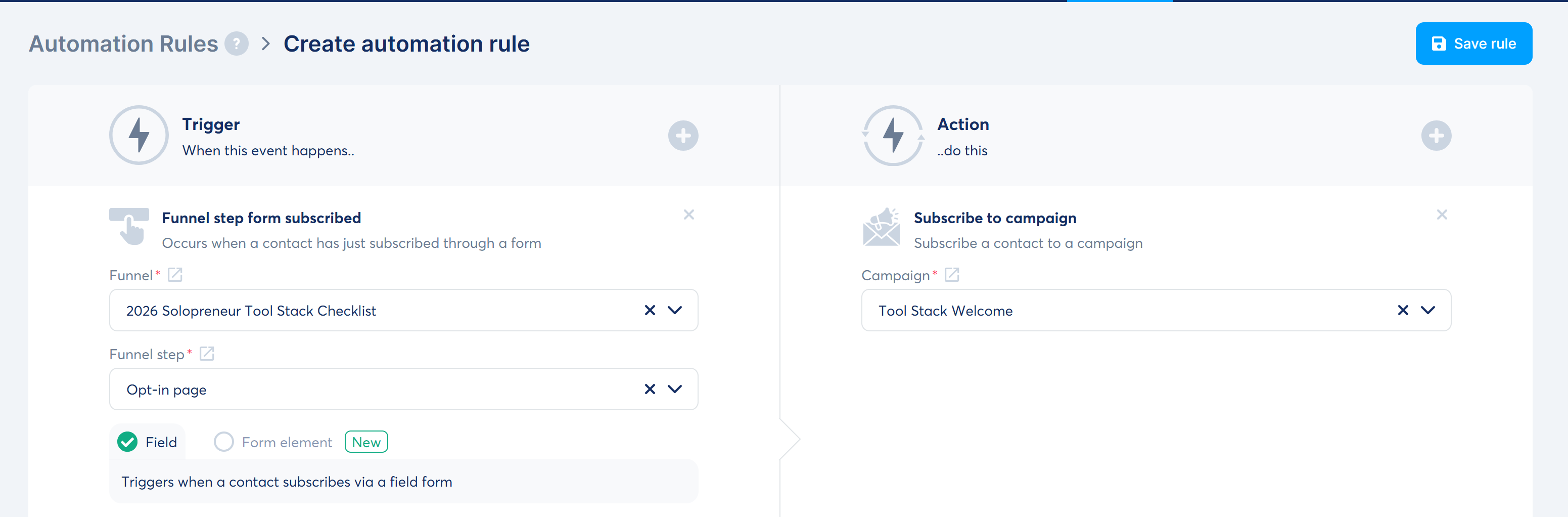
    This is the step that actually connects the page to the emails. Go to Automations → Rules → Create:

    • Trigger: Funnel step form subscribed → select your opt-in page
    • Action: Subscribe to campaign → select the campaign you just built

    Systeme.io automation rule editor

    Gotcha: the rule will not save while any trigger/action field is still empty — Save simply stays greyed out. It looks broken the first time; it is a validation quirk.

    Systeme.io welcome sequence rule configured

    Some page templates also expose a campaign dropdown directly in the form settings, which lets you skip the rule entirely. Check there first — if the option exists, use it.

    Step 7 — Send a real test, to a real inbox

    Do not trust the preview. Subscribe through your own funnel form with a second email address and confirm the whole chain fires.

    Systeme.io newsletter editor

    Test email received in inbox

    Welcome email with PDF attachment received

    In my test the email landed in the inbox (not spam) without a custom domain configured, and the PDF attachment arrived. That is the happy path — but read the next section before you scale it.

    The one thing that will bite you: Gmail/Yahoo senders are blocked

    Systeme.io now blocks free-mail senders (Gmail, Yahoo) or lets them get spam-flagged, because of the 2024+ bulk-sender rules the mailbox providers enforce. This is genuinely annoying mid-build and it is also the platform protecting your sender reputation.

    Fix: connect your own domain. The free plan includes 1 custom domain (Settings → Custom domains), and it takes one CNAME record. Do this before you send to anyone but yourself. A funnel that collects 200 emails and gets auto-filed to spam has negative value.

    Step 8 — Publish, then point traffic at it

    The funnel is useless without traffic, and traffic is the part no builder sells you. The cheapest reliable sources for a brand-new funnel:

    1. One blog post or video per week that answers a real question, with the funnel linked where the answer naturally ends.
    2. Answer questions where your audience already is (Reddit, niche forums, LinkedIn) and link only when the resource is genuinely the answer — never as a drive-by drop.
    3. Your email signature and social bio. Free, permanent, compounds.

    Track two numbers only for the first month: opt-in page conversion rate and email open rate on email 1. If conversion is under ~20% the problem is the page (offer clarity, headline, or the fact that the promise is vague). If open rate on email 1 is under ~40% the problem is deliverability — go back and connect the domain.

    Where the free plan actually stops

    Being straight with you, because a guide that pretends there is no ceiling wastes your time:

    • No meaningful split-testing on the low tiers. You will be guessing at headlines.
    • Automation is rule-based, not visual-branching. Fine for this funnel; limiting once you want "if they clicked but didn't buy, do X."
    • 2,000 contacts. A good problem to have — but it is a hard wall.
    • Events/webinars and advanced course features sit on the $47+ tiers.

    For validating a first offer, none of that matters. If you are already at 5,000 contacts with a working funnel, you have outgrown this guide and should be comparing paid tiers, not free ones.

    FAQ

    Can I really build a sales funnel for free?
    Yes. The funnel in this guide — opt-in page, thank-you page, email campaign and automation rule — was built and tested on Systeme.io's free plan without entering payment details. The only genuine constraint worth planning around is the 2,000-contact ceiling and the need to connect your own domain for deliverability.

    How long does this take?
    About 30 minutes for the build itself, assuming you already have your lead magnet written. Most of that time went into replacing template demo content, not into configuring anything.

    Do I need a custom domain?
    Not to build it, but yes before you send to real subscribers. Systeme.io blocks or spam-flags free-mail senders (Gmail, Yahoo) under current provider rules, and the free plan includes one custom domain.

    What is the best free funnel builder?
    For a $0 all-in-one build (funnel + email + course + automation in one account), Systeme.io is the one I tested end to end. See our full funnel builder comparison for how it stacks up against the paid options.

    How many funnel steps do I actually need?
    For a lead magnet, two: opt-in page and thank-you/delivery page. A third sales-page step only earns its place once you have something to sell.

    Why did my published page show text I never wrote?
    Because templates ship as fully populated demo pages, not as empty skeletons. Replace every block before publishing — and if you have already published, delete the leftover sections and re-publish.


    I'm an affiliate of Systeme.io: if you sign up through my links, I may earn a commission at no extra cost to you. I only recommend tools I have actually registered and built with — the funnel, emails and screenshots in this guide are from my own working account.

    Start your funnel free (no credit card) → systeme.io

    Grab the free checklist (2026 Solopreneur Tool Stack: 10 tools, free tiers, and upgrade moments) → Get the free checklist

    Related reading: Systeme.io Review 2026 · Best Funnel Builders for Solopreneurs · ClickFunnels Alternatives · The 2026 Solopreneur Tool Stack Checklist

  • Best Online Course Platforms for Creators (2026): 7 Options Compared

    Best Online Course Platforms for Creators (2026): 7 Options Compared

    Verdict first: The best online course platform for a creator in 2026 depends on one question — are you selling a course, or selling a course business? If you are publishing your first course, Systeme.io is the best value by a wide margin: a permanent free plan (1 course, 500 students, no credit card), $17/month when you outgrow it, and 0% transaction fees. If you want the most polished learner experience, Teachable ($29/mo annual) or Thinkific ($40/mo annual) are the focused options. If you want a white-labelled academy that looks like your own product, LearnWorlds is built for exactly that. And if you have already proven a high-ticket offer, Kajabi remains the premium all-in-one — it is just not where you should start.

    Who this is for: coaches, consultants, teachers, newsletter writers and subject-matter experts choosing where to host and sell a course, membership or training programme.

    Who this is not for: enterprise learning-and-development teams needing SCORM at scale, SSO and procurement processes — those buyers should be talking to LearnWorlds Corporate or Thinkific Plus, not reading a solo-creator comparison.


    The five things that actually decide your bill

    Every course platform advertises a monthly price. The real cost is set by five things, and the first two are where money quietly moves from your pocket to theirs:

    1. Transaction fees. A 5% cut on $10,000 of sales is $500 — often more than the entire annual price difference between tiers.
    2. Student, contact and product caps. These are hard walls. Course platforms generally notify you rather than auto-upgrading, which means your sales can simply stop until you pay more.
    3. Video hosting and bandwidth. Thinkific meters video traffic in GB per month (100 / 200 / 400). Video-heavy courses hit this before they hit student limits.
    4. White-labelling and certificates. "Powered by [platform]" removal and completion certificates are near-universally locked to the mid or upper tier.
    5. Whether email is included. Some platforms are also your email service; others expect you to pay for a separate ESP.

    The 7 best course platforms at a glance

    # Platform Entry price Transaction fee Free option Best for
    #1 Systeme.io $0 (paid from $17/mo) 0% Free forever (1 course, 500 students) First course on a $0 budget, plus funnel and email
    #2 Teachable $39/mo (annual $29/mo) 7.5% Starter, 0% Builder+ 7-day trial + 30-day refund Polished, course-only experience
    #3 Thinkific $54/mo (annual $40/mo) 1–5% on third-party gateways 30-day trial Academies, client and partner training
    #4 Podia $49/mo (annual $42/mo) 5% on Mover, 0% above 30-day trial, no card The simplest possible course store
    #5 LearnWorlds $29/mo (annual $24/mo) $5 per paid enrollment on Starter 30-day trial White-label branded schools
    #6 Kajabi $179/mo (annual $143/mo) 0.5–2% on third-party gateways No (14-day trial) Mature high-ticket course businesses
    #7 Kartra $59/mo (real use $119/mo) 5% on Essentials, 0% above 14-day trial Course sales plus heavy marketing automation

    The platforms, one by one

    #1 Systeme.io — best course platform for creators starting from zero

    Systeme.io is unusual in this list because it is a funnel-and-email platform that also hosts courses — which turns out to be the right shape for a first launch, since selling a course requires a landing page and a follow-up sequence anyway, and this way it is one subscription instead of three.

    I tested it hands-on. On the free plan I built a course shell, uploaded lesson material, added a lesson and set a price, and separately built a complete email funnel with an automation rule (full review, funnel walkthrough).

    Free plan: 1 course with up to 500 students, 2,000 contacts, 3 funnels, 1 automation rule, 1 blog, 1 custom domain — and unlimited email sending and unlimited file storage on every tier, which is the opposite of how most course platforms meter you. Paid: Startup $17/mo (5 courses, 5,000 contacts), Webinar $47/mo (20 courses, 10,000 contacts, evergreen webinars), Unlimited $97/mo. Annual billing $170 / $470 / $970 with two months free. 0% transaction fees on all tiers.

    Course front page generated by Systeme.io
    The course front page Systeme.io generated automatically on the free plan — lessons accept files and PDFs.

    Where it loses: the course player and page design are functional rather than beautiful, community features are thin compared with Kajabi or Thinkific, and advanced automation starts at $47/month. If your brand depends on a premium-feeling learning portal, this is not the tool for that.

    Best for: launching a first course for $0 and keeping 100% of revenue from day one.

    #2 Teachable — best polished course-only platform

    Teachable is the most straightforward "this is where my course lives" option. Starter $39/mo (annual $29/mo, 5 products, 1 admin), Builder $89/mo (annual $69/mo, 10 products, 0% transaction fee), Growth $189/mo (annual $139/mo, 50 products, 5 admins), plus Custom. 7-day trial with a 30-day refund guarantee.

    The decisive number is Starter's 7.5% transaction fee — the highest of any platform here. Card processing is separate (2.9% + 30¢ domestic, 3.9% + 30¢ international, $15 per chargeback). Unbranding, certificates, student import and custom permissions all begin at Growth.

    Best for: creators who want the course itself to feel professional and do not need a funnel builder attached.

    #3 Thinkific — best for academies and training programmes

    Thinkific is built for course businesses that resemble schools. Basic $54/mo (annual $40/mo, 100GB video/month, 5 digital downloads), Start $109/mo (annual $82/mo, 200GB), Grow $219/mo (annual $164/mo, 400GB), plus quoted Plus pricing. 30-day trial, ~25% off annual, 10,000 students on every listed tier.

    Two structures to understand before choosing a tier. First, the third-party gateway fee: 5% on Basic, 2% on Start, 1% on Grow if you use Stripe, waived on Thinkific Payments (2.9% + 30¢). Second, the video bandwidth meter, which a video-heavy course can exhaust before its student cap. Community spaces are 1 / 1 / 3, unbranding starts at Grow, and a branded mobile app is a $199/month add-on.

    Best for: businesses training customers, partners or staff, where the course is a product line with a lifecycle.

    #4 Podia — best for the shortest learning curve

    Mover $49/mo (annual $42/mo, 5% transaction fee, 100 subscribers, 50 products, 500 videos), Shaker $99/mo (annual $84/mo, 0% fees, 500 subscribers, 150 products), Earthquaker $179/mo (annual $150/mo, 1,000 subscribers, unlimited products). Trial: 30 days, no credit card required.

    Podia is the platform you are least likely to abandon halfway through setup, and the one where you are most likely to hit a subscriber ceiling early — Mover's 100-subscriber cap is tight if you also run a newsletter. Annual plans are refundable only within 72 hours.

    Best for: a single course or a handful of downloads and coaching offers, with the least possible software to learn.

    #5 LearnWorlds — best white-label course school

    Starter $29/mo (annual $24/mo, 1,000 active students, 1 admin, 300 AI credits), Pro Trainer $99/mo (annual $79/mo, 2,000 students, 5 admins, 20 SCORM packages, no enrollment fee), Learning Center $299/mo (annual $249/mo, white-label, 10 customer groups, 25 admins), plus Corporate. 30-day trial.

    The Starter fee model is the one to watch: $5 per paid enrollment. At 200 enrollments that is $1,000 — more than the annual difference to Pro Trainer, which is where successful users inevitably end up. AI credits are capped per tier and gateway fees (2.9% + 30¢) apply on top.

    Best for: course businesses and corporate trainers who need the school to carry their own brand, not the platform's.

    #6 Kajabi — best premium all-in-one

    Basic $179/mo (annual $143/mo, 5 products, 2,500 contacts, 2 admin users), Growth $249/mo (annual $199/mo, 50 products, 25,000 contacts), Pro $499/mo (annual $399/mo, unlimited products, 100,000 contacts). No free plan; a 14-day trial that cannot be extended and locks some features. Gateway fees of 2% / 1% / 0.5% and metered AI credits (500 for $15/mo) sit on top.

    The Basic tier's 5-product and 2-admin limits are the pinch point: hitting either forces the jump to $199/month annual — a 39% increase. Detailed comparison in Kajabi alternatives.

    Best for: coaches and experts with a proven high-ticket offer who want courses, community, email and CRM in one system.

    #7 Kartra — best when marketing automation outranks course design

    Essentials $59/mo (annual $52/mo, 5% fee, 500 contacts, 10,000 emails/month, 1 product, 1 course), Starter $119/mo (annual $99/mo, 0% fees, 2,500 contacts, unlimited courses), Growth $229/mo (annual $189/mo), Professional $549/mo (annual $429/mo). 14-day trial.

    Essentials will not run a course business — one product and one course is a demo, not a catalogue. Starter is the true entry point, and what you are buying there is the surrounding machinery: affiliate management, helpdesk, and eventually real-time funnel analytics.

    Best for: operators whose bottleneck is acquisition and follow-up, not course delivery.

    How we ranked (read this before you buy)

    Ranking priority: total cost to a creator who has not launched yet, then revenue retention (transaction fees), then whether the platform covers page → payment → delivery → follow-up without a second subscription. Every price was read from the vendor's own pricing page on 2026-09-14 in USD. Unpublished figures — SamCart's annual equivalent, ThriveCart's lifetime licence, whether a given trial requires a card — are flagged as unconfirmed rather than estimated.

    Honest disclosure about testing: only Systeme.io has been hands-on tested here — free account, a real course shell with uploaded lesson material, and a real email funnel whose delivery I verified (review). The other six are ranked from official pricing pages and published plan limits; we have not published a course on them, and their entries are well-sourced research rather than a hands-on verdict.

    On affiliate links: Systeme.io is our affiliate partner. Teachable, Thinkific, Podia, LearnWorlds, Kajabi and Kartra pay us nothing.

    FAQ

    What is the best online course platform for beginners?
    Systeme.io, because the free plan covers one course with up to 500 students, requires no credit card and charges 0% transaction fees — and it does not cap email sending. Podia's 30-day no-card trial is the best way to see a paid-tier course experience before spending anything.

    Which course platform has the lowest fees?
    Systeme.io charges 0% transaction fees on every tier, and ThriveCart charges 0% on carts. Among course-first platforms: Teachable Builder and above 0%, Thinkific Grow 1% (5% on Basic), Kartra Starter and above 0%, Podia Shaker and above 0%, LearnWorlds Pro Trainer and above 0%.

    Is Teachable or Thinkific better?
    Teachable is cheaper to enter ($29/mo annual vs Thinkific's $40) and has a cleaner course-only interface. Thinkific is stronger for academies and training programmes — better video allowances at scale, more admin seats, and SCORM support on upper tiers. Both beat their own entry tiers only after you upgrade past the transaction fees.

    Do I need a separate email tool with a course platform?
    Usually yes — Teachable, Thinkific, Podia, LearnWorlds and Kajabi either limit email or expect a separate ESP. Systeme.io and Kartra include email sending, and Systeme.io does not meter it on any plan.

    Can I move my course to another platform?
    Not automatically. Video and lesson content must be re-uploaded, course structure rebuilt, and students re-imported (usually CSV). Automation logic does not port between platforms at all. Choose on total cost, not on a first-month discount.

    Which platform is best for a white-label course business?
    LearnWorlds, whose Learning Center tier is built around white-labelling. Kajabi and Thinkific also offer unbranding, but on their upper tiers (Kajabi Growth/Pro; Thinkific Grow and above, plus a $199/month branded app add-on).


    I'm an affiliate of Systeme.io: if you sign up through my links, I may earn a commission at no extra cost to you. I only recommend tools I have actually registered and built with — the course and funnel screenshots on this site are from my own account. The other platforms in this comparison are not affiliate links, and their pricing comes from their own public pricing pages.

    Start free (no credit card, 1 course + 500 students, 0% transaction fees) → systeme.io

    Grab the free checklist (2026 Solopreneur Tool Stack: 10 tools, free tiers, and upgrade moments) → Get the free checklist

    Related reading: Kajabi vs Teachable · ThriveCart Alternatives · Kajabi Review 2026 · Systeme.io Review 2026 · Best Kajabi Alternatives · Best Funnel Builders for Solopreneurs · ClickFunnels Alternatives · The 2026 Solopreneur Tool Stack Checklist

  • Best Funnel Builders for Solopreneurs (2026): 7 Tools Tested & Ranked

    Best Funnel Builders for Solopreneurs (2026): 7 Tools Tested & Ranked

    Verdict first: For a solopreneur, the best funnel builder in 2026 is not the most powerful one — it is the one you will still be paying for in month six. Systeme.io wins that test: it is the only tool here with a permanent free plan (no credit card), it charges 0% transaction fees, it does not meter email sends or file storage, and I built a complete funnel on it end to end. ClickFunnels ($97/month minimum) is genuinely better at page design and ecosystem depth, and it is the right answer if money is not the constraint. ThriveCart is the best pick if your problem is checkout conversion rather than pages, and Kartra is the most ClickFunnels-like all-in-one below ClickFunnels pricing.

    Who this is for: solo founders, coaches, freelancers, course sellers and side-hustlers who need to capture leads or sell a first offer, and who want to compare the real monthly cost of each option — including transaction fees and contact caps, which is where the advertised price stops being the real price.

    Who this is not for: agencies running dozens of client workspaces, or businesses past ~100K contacts with heavy split-testing needs. Those cases genuinely belong in the $197–$499/month tiers, and nothing in the budget half of this list will serve them better.


    What a funnel builder actually has to do

    Strip away the marketing and there are only five jobs:

    1. Build pages — landing, opt-in, sales, thank-you, checkout. (Page quality and template design live here.)
    2. Take the money — checkout, order bumps, one-click upsells, subscriptions.
    3. Send the email — both the automated follow-up sequence and broadcast newsletters.
    4. Automate the routing — "they subscribed, so tag them and start the sequence."
    5. Not surprise you later — transaction fees, email send caps, contact ceilings, and how politely the tool forces an upgrade.

    Job five is the one nobody advertises and the one that decides your real cost. Three patterns to watch for specifically:

    • Transaction fees dressed up as a cheap entry tier. Kartra Essentials, Podia Mover and Teachable Starter all take 5–7.5% of sales.
    • Metered email. ClickFunnels' $97 tier includes 50,000 sends/month. Systeme.io, ThriveCart and Kartra's paid tiers treat email as unlimited.
    • "Unlimited" with an asterisk. ClickFunnels' pricing page labels its unlimited funnels "Limited Time". Read the modifier, not the headline.

    The 7 best funnel builders for solopreneurs at a glance

    # Tool Real entry cost Free plan Transaction fee Email metering Best for
    #1 Systeme.io $0, then $17/mo Yes, permanent 0% Unlimited on all tiers Starting from zero and growing into paid
    #2 ClickFunnels $97/mo No 0% 50K/mo on Launch Design depth and a full business ecosystem
    #3 ThriveCart $47/mo or $444/yr 30-day trial 0% Unlimited Cart conversion, upsells and order bumps
    #4 Kartra $59/mo (5% fee), real use $119/mo 14-day trial 5% on Essentials 10K/mo on Essentials Marketing automation + helpdesk in one
    #5 SamCart $79/mo 7-day trial None (gateway only) Not the focus Digital-product checkout
    #6 Podia $49/mo (5% fee) 30-day trial, no card 5% on Mover 100 subscribers cap The simplest possible store
    #7 Kajabi $179/mo No (14-day trial) 0.5–2% gateway Contact-tiered Course businesses with high-ticket offers

    The funnel builders, one by one

    #1 Systeme.io — best overall funnel builder for solopreneurs (hands-on tested)

    Systeme.io is the only tool in this list I have built on for real. On the free plan I created a funnel with an opt-in page and a thank-you/download page, published it, built a 3-email campaign with a PDF attachment, wired an automation rule so form submissions subscribe to that campaign, and confirmed the whole chain by sending it to a second inbox — in about 30 minutes, without entering card details (full step-by-step walkthrough).

    Free plan: 2,000 contacts, 3 funnels, 15 funnel steps, 1 automation rule, 1 course (500 students), 1 blog, 1 custom domain — with unlimited email sends and unlimited file storage on every tier. Paid: Startup $17/mo (5,000 contacts, 10 funnels, 5 courses), Webinar $47/mo (10,000 contacts, 50 funnels, evergreen webinars), Unlimited $97/mo ($80.83/mo annual). Annual billing is $170 / $470 / $970 with two months free and free migration. 0% transaction fees on all four tiers.

    Two things I would tell a friend before they sign up. First, templates publish with demo content still in them — my first published page went live showing the template's placeholder copy, and publishing gives no warning. Walk every block. Second, free-mail senders (Gmail/Yahoo) are blocked or spam-flagged under current provider rules, so connect your own domain (the free plan includes one) before you send to anyone but yourself. Both are learning-curve problems, not deal-breakers, and both are described with screenshots in the walkthrough.

    Configuring a funnel step in Systeme.io
    Configuring a funnel step in Systeme.io. The free plan allows 3 funnels and 15 funnel steps, with unlimited email sending.

    Where it loses: the editor and templates are plainer than ClickFunnels, and split-testing plus webinar features sit on the $47 tier or above. If design is the product, that gap is real.

    Best for: the solopreneur who wants a funnel, an email list and a small course in one account, starting at $0.

    #2 ClickFunnels — best if budget is not the constraint

    ClickFunnels still sets the standard for funnel page design and breadth. Launch $97/mo ($81/mo annual: 1 workspace, 2 members, 10K contacts, 50K emails/month, 3 courses, 5 domains), Scale $197/mo ($164/mo annual), Optimize $297/mo ($248/mo annual), Dominate $5,997/year (~$500/mo). No free plan; the pricing page says "Start Free Trial" without stating the length or card requirement, while ClickFunnels' affiliate page references a 14-day trial — treat that as unconfirmed until the signup form. It charges 0% transaction fees and includes unlimited hosting and visitors.

    The reason it does not win here is arithmetic, not quality: $97/month is $1,164/year before your first sale, and the 50K email cap on the entry tier is a hard wall. Full breakdown in our ClickFunnels alternatives guide.

    Best for: operators with revenue already, who need design control, workspaces and the widest integration surface.

    #3 ThriveCart — best checkout and upsell layer

    ThriveCart is the tool you add when your pages are fine but your cart is leaking. Standard $47/mo or $444/year (~$37/mo); Pro+ $87/mo or $804/year (~$67/mo). 0% platform fees, 30-day trial. A lifetime licence is advertised but priced only at checkout — we are not quoting an unpublished number.

    The catch is which tier the value is on: multiple order bumps, subscription dunning and an affiliate centre with automatic payouts are Pro+. On Standard you get one order bump. Annual pricing at $444/$804 is not a budget escape route.

    Best for: creators with existing traffic who want measurable lifts from upsells and cart recovery.

    #4 Kartra — best ClickFunnels-style all-in-one below ClickFunnels pricing

    Essentials $59/mo ($52/mo annual), Starter $119/mo ($99/mo annual), Growth $229/mo ($189/mo annual), Professional $549/mo ($429/mo annual), with a 14-day trial.

    Be careful with Essentials — it carries a 5% transaction fee, 500 contacts, 10,000 emails/month and just 5 pages, 1 product and 1 course. The tier that behaves like a real funnel builder is Starter at $119/mo (0% fees, 2,500 contacts, unlimited pages, products and courses, 5 seats). Kartra's differentiator is the surrounding machinery: built-in affiliate management, helpdesk, and real-time funnel analytics on the upper tiers.

    Best for: one-person businesses that want funnels, email, courses, affiliates and support desk under one login.

    #5 SamCart — best for digital-product checkout

    Core $79/mo, Pro $199/mo, Enterprise custom, 7-day trial, optional $19/mo human support add-on. No platform transaction fee — you pay your gateway (SamPay is 2.9% + 30¢). Core is limited to one seat and one marketplace; the affiliate centre, advanced analytics and unlimited AI/video are Pro features. SamCart advertises 25% off yearly billing but the monthly-equivalent figure did not render when we checked, so we are not quoting an annual price.

    Best for: sellers whose bottleneck is the cart, especially for digital products with order bumps and one-click upsells.

    #6 Podia — best for the shortest path to a first sale

    Podia trades depth for approachability. Mover $49/mo ($42/mo annual, 5% transaction fee, 100 subscribers, 50 products), Shaker $99/mo ($84/mo annual, 0% fees, 500 subscribers), Earthquaker $179/mo ($150/mo annual, 1,000 subscribers). Trial: 30 days, no credit card — the most generous here.

    Subscriber limits are walls rather than soft warnings, and annual billing is refundable only within 72 hours of payment.

    Best for: a first course, download or coaching offer where "simple enough to finish" beats "powerful enough to configure".

    #7 Kajabi — best funnel builder for a mature course business

    Basic $179/mo ($143/mo annual), Growth $249/mo ($199/mo annual), Pro $499/mo ($399/mo annual). No free plan, 14-day trial that cannot be extended, and some capabilities locked during the trial. On top of the plan price: gateway fees (2% / 1% / 0.5%) and metered AI credits (500 for $15/mo).

    It is on this list because it is a legitimate answer for a specific person — a coach with a proven high-ticket offer who wants courses, community, email and CRM that already talk to each other. It is not a budget funnel builder. More detail in Kajabi alternatives.

    Best for: established course and coaching businesses, not first funnels.

    How we ranked (read this before you buy)

    We weighted, in order: what it costs a solopreneur who has not made money yet; whether the tool covers the full path from page to payment to follow-up without a second subscription; and how gracefully it handles growth (contact caps, send limits, upgrade pressure). Every price here was read from the vendor's own pricing page on 2026-09-14, in USD. Where a vendor does not publish a figure — SamCart's annual equivalent, ThriveCart's lifetime price, ClickFunnels' trial length — we say so instead of inventing one.

    Honest disclosure about testing: of the seven, only Systeme.io has been hands-on tested here. I registered the free plan, built and published a real funnel, sent a real email sequence and verified delivery to a second inbox — the screenshots and the two failure modes I hit (template demo content, Gmail/Yahoo sender blocking) are in the walkthrough. The other six are ranked from official pricing pages and published plan limits, verified on the date above. We have not built funnels in them, and we are not going to pretend otherwise.

    On affiliate links: Systeme.io is our affiliate partner. None of the other six are, and an honest best-of list has to include ClickFunnels and ThriveCart whether or not they pay us.

    FAQ

    What is the best funnel builder for a solopreneur?
    Systeme.io, on the strength of a permanent free plan, 0% transaction fees, unmetered email and a working funnel you can build in half an hour. ClickFunnels is better if design depth matters more than cost; ThriveCart is better if only the checkout is broken.

    Is there a free funnel builder that is actually free?
    Yes — Systeme.io's free plan is a permanent tier, not a trial: 2,000 contacts, 3 funnels, 15 funnel steps, 1 automation rule and unlimited emails, with no credit card required.

    What is the cheapest way to start selling online?
    Systeme.io free plan (page + email + 1 course), or Podia's 30-day no-card trial if you want a paid-tier experience before spending. Both avoid the 5–7.5% transaction fees on other entry tiers for as long as you stay on the free or trial plan.

    Which funnel builders charge transaction fees?
    Systeme.io (0% all tiers), ClickFunnels (0%), ThriveCart (0%) and SamCart (no platform fee) do not. Kartra Essentials 5%, Podia Mover 5%, Teachable Starter 7.5%, Thinkific Basic 5% on third-party gateways, and Kajabi 0.5–2% by plan.

    Do I need a funnel builder to sell a course?
    No. A course platform alone is enough if people already find you — see course platforms compared. Funnel builders earn their price when you need to convert cold traffic, not just host content.

    Can I switch funnel builders later?
    Yes, but pages do not migrate automatically between any of these platforms. Contacts export as CSV; pages and automation get rebuilt by hand. Switching cost is why it is worth choosing on total cost rather than a first-month discount.


    I'm an affiliate of Systeme.io: if you sign up through my links, I may earn a commission at no extra cost to you. I only recommend tools I have actually registered and built with — the funnel, campaign and automation screenshots on this site are from my own account. The other tools in this ranking are not affiliate links, and their pricing comes from their own public pricing pages.

    Start free (no credit card, 0% transaction fees, unlimited emails) → systeme.io

    Grab the free checklist (2026 Solopreneur Tool Stack: 10 tools, free tiers, and upgrade moments) → Get the free checklist

    Related reading: Systeme.io Pricing 2026 · ClickFunnels Review 2026 · ThriveCart Alternatives · How to Build a Sales Funnel for Free · ClickFunnels Alternatives · Systeme.io Review 2026 · Systeme.io vs ClickFunnels vs Kajabi · Best Kajabi Alternatives

  • Best Kajabi Alternatives (2026): 7 Options Tested & Priced

    Best Kajabi Alternatives (2026): 7 Options Tested & Priced

    Verdict first: Kajabi is a great product with a steep entry price — $179/month, or $143/month billed annually, and no free plan. If you are still proving the offer, that is the wrong $1,700/year to spend. The best Kajabi alternative for most solo creators is Systeme.io: a real free plan (no credit card), $17/month when you grow, 0% transaction fees, and courses, funnels and email in the same account. If you only sell courses and want the most polished learner experience, Teachable ($29/mo annual) or Thinkific ($40/mo annual) are the better fits — and Thinkific currently pays the most generous affiliate terms of the three, though that is our problem, not yours. If you want the simplest interface on the market, pick Podia.

    Who this is for: coaches, course creators, newsletter writers and consultants who want to sell knowledge products without committing to Kajabi's price tier, or who want to compare what they actually get at each price point.

    Who this is not for: established businesses already earning well on Kajabi with a big list and heavy automation — the switching cost will outweigh the savings, and Kajabi's $499 Pro tier exists precisely because some operators genuinely need it.


    Kajabi pricing in 2026 (and what it actually costs)

    Plan Monthly Annual (per month) Products Contacts Admin users
    Basic $179/mo $143/mo 5 2,500 2
    Growth $249/mo $199/mo 50 25,000 11
    Pro $499/mo $399/mo Unlimited 100,000 26

    Kajabi has no free plan — only a 14-day trial, which is not extendable, and during the trial some capabilities (bulk import, your own sending domain, parts of automation) are locked. Two costs sit on top of the sticker price: 0.5–2% fees on third-party payment gateways (2% Basic, 1% Growth, 0.5% Pro) and metered AI credits (Basic includes none; extra credits are sold at 500 for $15/month).

    The four real reasons people look for a Kajabi alternative:

    1. The floor. $143/month before you have a single student is a lot of conviction to ask of yourself.
    2. Hard product and user caps. Basic allows just 5 products and 2 admin users. Hit either and you jump to $199/month — a 39% increase, not a gentle step.
    3. Metered extras. Gateway percentages and paid AI credits make the true cost higher than the plan price.
    4. Overkill. If you sell one course and send a weekly email, you will use maybe 20% of the platform.

    The 7 best Kajabi alternatives at a glance

    # Tool Entry price Free option Transaction fee Best for
    #1 Systeme.io $0 (paid from $17/mo) Free forever, no card 0% Course + funnel + email on a starter budget
    #2 Teachable $39/mo (annual $29/mo) 7-day trial + 30-day refund 7.5% on Starter, 0% Builder+ Pure course selling with a clean learner UI
    #3 Thinkific $54/mo (annual $40/mo) 30-day trial 1–5% on third-party gateways Courses at scale, academies, client training
    #4 Podia $49/mo (annual $42/mo) 30-day trial, no card 5% on Mover, 0% above Absolute beginners, simplest interface
    #5 LearnWorlds $29/mo (annual $24/mo) 30-day trial $5 per paid enrollment on Starter White-label course schools and training businesses
    #6 Kartra $59/mo (annual $52/mo) 14-day trial 5% on Essentials, 0% above Marketing-heavy course businesses
    #7 ThriveCart $47/mo or $444/yr 30-day trial 0% Upgrade your checkout, keep your course host

    The alternatives, one by one

    #1 Systeme.io — best overall Kajabi alternative for solo creators

    Systeme.io is the only option here with a genuinely permanent free plan, and it is the one I have actually tested. I built a course shell, uploaded lesson material, set a price, and separately built a full email funnel with an automation rule — on the free tier, in one sitting, no credit card (Systeme.io review and the free funnel walkthrough).

    The free plan: 2,000 contacts, 3 funnels, 15 funnel steps, 1 automation rule, 1 course with up to 500 students, 1 blog and 1 custom domain. Notably, email sending and file storage are unlimited on every plan — the two things most course platforms meter first. Paid tiers: Startup $17/mo (5,000 contacts, 10 funnels, 5 courses), Webinar $47/mo (10,000 contacts, 20 courses, evergreen webinars), Unlimited $97/mo. Annual: $170 / $470 / $970, which is two months free. Transaction fees: 0% on all four tiers.

    Building a course on Systeme.io's free plan
    Building a course on Systeme.io's free plan — the free tier covers one course with up to 500 students.

    Where Kajabi beats it: design polish, community features, CRM depth, and the maturity of the marketing automation builder. Systeme.io is a working tool, not a beautiful one — if the look of your course portal is part of your brand, that matters.

    Best for: the creator who wants Kajabi's shape (courses + funnels + email in one place) at a fraction of the price, and who wants to start for free.

    #2 Teachable — best pure course platform

    Teachable does one thing with focus: it hosts and sells courses. Starter $39/mo ($29/mo annual, 5 products, 1 admin), Builder $89/mo ($69/mo annual, 10 products, 0% transaction fee), Growth $189/mo ($139/mo annual, 50 products, 5 admins), plus a Custom tier. There is a 7-day trial and a 30-day refund guarantee.

    The number that decides your plan is the transaction fee: Starter takes 7.5%. On $5,000 of sales that is $375 — nearly the annual gap between Starter and Builder. Card processing is separate either way (2.9% + 30¢ domestic, 3.9% + 30¢ international, $15 per chargeback). Unbranding, certificates, student import and custom permissions are all Growth-and-above features.

    Best for: creators who sell courses and do not need a funnel builder bolted on.

    #3 Thinkific — best for academies and training businesses

    Thinkific skews toward "school" rather than "personal course". Basic $54/mo ($40/mo annual), Start $109/mo ($82/mo annual), Grow $219/mo ($164/mo annual), plus a quoted Plus tier. Roughly 25% off annually, a 30-day trial, and student limits of 10,000 on every listed tier.

    Watch the video traffic allowance — 100GB / 200GB / 400GB per month — because video-heavy courses hit that quietly. Digital downloads are capped at 5 on Basic, and community spaces at 1. The gateway fee is the classic gotcha: 5% on Basic, 2% on Start, 1% on Grow if you use Stripe or another third-party processor, waived if you use Thinkific Payments (2.9% + 30¢). A branded mobile app is an extra $199/month.

    Best for: businesses and coaches training employees, clients or partners, where the course is a product line rather than a side project.

    #4 Podia — best for absolute beginners

    Podia is the friendliest interface here, and its trial is the most generous: 30 days free, no credit card required. Plans: Mover $49/mo ($42/mo annual), Shaker $99/mo ($84/mo annual), Earthquaker $179/mo ($150/mo annual).

    Mover takes a 5% transaction fee and caps you at 100 email subscribers, 50 products and 500 videos. You get 0% fees and 500 subscribers on Shaker. Subscriber counts are hard limits — Podia says it will notify rather than auto-upgrade you, which means your list stops growing until you act. Annual plans are refundable only within 72 hours.

    Best for: someone publishing a first course or download who wants the least friction and the longest free look at the tool.

    #5 LearnWorlds — best white-label course school

    LearnWorlds targets training businesses that want their own branded academy. Starter $29/mo ($24/mo annual, 1,000 active students, 1 admin), Pro Trainer $99/mo ($79/mo annual, 2,000 students, 5 admins, 20 SCORM packages), Learning Center $299/mo ($249/mo annual, white-label, 25 admins), plus Corporate pricing. 30-day trial.

    The Starter tier charges $5 per paid enrollment — a per-sale cut that becomes painful exactly when you start succeeding, and is the reason most successful users end up on Pro Trainer. AI credits are capped per tier (300 / 500 / 1,000).

    Best for: established course businesses and corporate trainers who want a fully white-labelled school rather than a hosted course page.

    #6 Kartra — best if marketing automation is the priority

    Kartra is an all-in-one marketing platform that includes courses. Essentials $59/mo ($52/mo annual), Starter $119/mo ($99/mo annual), Growth $229/mo ($189/mo annual), Professional $549/mo ($429/mo annual), 14-day trial.

    The Essentials tier is a decoy for anyone selling courses: 5% transaction fee, 500 contacts, 10,000 emails/month, and only 1 product and 1 course. Real course use starts at Starter ($119/mo). What you get for that is serious marketing machinery — affiliate management, helpdesk, and later real-time funnel analytics.

    Best for: solo operators whose bottleneck is marketing automation, not course delivery.

    #7 ThriveCart — when your course host is fine but your checkout is not

    You do not have to leave your current platform to fix the money part. ThriveCart is a conversion-focused cart and course add-on: Standard $47/mo or $444/year (~$37/mo) and Pro+ $87/mo or $804/year (~$67/mo), 0% platform fees, 30-day trial. ThriveCart also lists a lifetime one-time licence, but the price is only visible via a checkout link and we are not quoting an unpublished figure.

    Multiple order bumps, subscription dunning and an affiliate centre with automatic payouts are all Pro+. Annual billing is not a bargain at $444/$804.

    Best for: creators already getting traffic who want better upsells and cart recovery without migrating their course content.

    How we ranked (read this before you buy)

    Weighting, in order: cost to a creator who is still validating an offer, then whether the platform covers the whole journey (page → payment → delivery → follow-up), then learner experience. All prices were read from the vendors' own pricing pages on 2026-09-14 and are in USD. Where a vendor does not publish a number — SamCart's annual equivalent, ThriveCart's lifetime price, Kajabi's exact trial card requirement — we have said so rather than guessed.

    Honest disclosure about testing: only Systeme.io has been hands-on tested on this site (free account, real course shell and a real email funnel — see the review). The other six are assessed from their official pricing pages and published plan limits; we have not delivered a course on them or verified their checkout flows ourselves. Treat their entries as well-sourced research, not a hands-on verdict.

    On affiliate links: only Systeme.io is our affiliate partner. The other six pay us nothing, and they are here because an alternatives list that omits Teachable, Thinkific and Podia would be dishonest.

    FAQ

    What is the best Kajabi alternative?
    Systeme.io for most solo creators, because it covers courses, funnels and email from $0 with 0% transaction fees — and it is the only option here we hands-on tested. Teachable or Thinkific are better if you only sell courses; Podia is better if you want the simplest interface.

    Is there a cheaper alternative to Kajabi?
    Yes, substantially. Kajabi starts at $143/month billed annually. Systeme.io starts at $0, Teachable at $29/month annually, Thinkific at $40, LearnWorlds at $24 and Podia at $42.

    Does any Kajabi alternative have a free plan?
    Only Systeme.io has a permanent free tier (2,000 contacts, 1 course, 1 automation rule, no credit card). Podia and LearnWorlds offer 30-day trials, Thinkific 30 days, Teachable 7 days, and Kartra 14 days. Kajabi's trial is 14 days and cannot be extended.

    Is Teachable or Thinkific better than Kajabi?
    For pure course delivery at a lower price, yes — both are cheaper and both are solid. What you give up versus Kajabi is the tightly integrated email/CRM/community layer and design polish. See our course platform comparison.

    Can I move my courses from Kajabi to another platform?
    There is no automatic migration between these platforms. Expect to re-upload video and rebuild course structure, then re-import contacts as CSV. Budget a weekend for one or two courses; budget longer if you have heavy automation, because automation logic does not port.

    Do these alternatives charge transaction fees?
    Systeme.io (0% all tiers) and ThriveCart (0%) do not. Watch the entry tiers: Teachable Starter 7.5%, Podia Mover 5%, Kartra Essentials 5%, LearnWorlds Starter $5 per enrollment, Thinkific Basic 5% on third-party gateways, and Kajabi 0.5–2% by plan.


    I'm an affiliate of Systeme.io: if you sign up through my links, I may earn a commission at no extra cost to you. I only recommend tools I have actually registered and built with — the course and funnel screenshots on this site are from my own account. The other tools in this comparison are not affiliate links, and their pricing comes from their own public pricing pages.

    Start free (no credit card, 0% transaction fees) → systeme.io

    Grab the free checklist (2026 Solopreneur Tool Stack: 10 tools, free tiers, and upgrade moments) → Get the free checklist

    Related reading: Kajabi vs Teachable · Kajabi Review 2026 · Systeme.io Review 2026 · Best Online Course Platforms for Creators · Best Funnel Builders for Solopreneurs · ClickFunnels Alternatives · The 2026 Solopreneur Tool Stack Checklist