Category: Comparisons

Side-by-side tool comparisons for your exact stage and budget, with real prices.

  • Best Kajabi Alternatives (2026): 7 Options Tested & Priced

    Best Kajabi Alternatives (2026): 7 Options Tested & Priced

    Verdict first: Kajabi is a great product with a steep entry price — $179/month, or $143/month billed annually, and no free plan. If you are still proving the offer, that is the wrong $1,700/year to spend. The best Kajabi alternative for most solo creators is Systeme.io: a real free plan (no credit card), $17/month when you grow, 0% transaction fees, and courses, funnels and email in the same account. If you only sell courses and want the most polished learner experience, Teachable ($29/mo annual) or Thinkific ($40/mo annual) are the better fits — and Thinkific currently pays the most generous affiliate terms of the three, though that is our problem, not yours. If you want the simplest interface on the market, pick Podia.

    Who this is for: coaches, course creators, newsletter writers and consultants who want to sell knowledge products without committing to Kajabi's price tier, or who want to compare what they actually get at each price point.

    Who this is not for: established businesses already earning well on Kajabi with a big list and heavy automation — the switching cost will outweigh the savings, and Kajabi's $499 Pro tier exists precisely because some operators genuinely need it.


    Kajabi pricing in 2026 (and what it actually costs)

    Plan Monthly Annual (per month) Products Contacts Admin users
    Basic $179/mo $143/mo 5 2,500 2
    Growth $249/mo $199/mo 50 25,000 11
    Pro $499/mo $399/mo Unlimited 100,000 26

    Kajabi has no free plan — only a 14-day trial, which is not extendable, and during the trial some capabilities (bulk import, your own sending domain, parts of automation) are locked. Two costs sit on top of the sticker price: 0.5–2% fees on third-party payment gateways (2% Basic, 1% Growth, 0.5% Pro) and metered AI credits (Basic includes none; extra credits are sold at 500 for $15/month).

    The four real reasons people look for a Kajabi alternative:

    1. The floor. $143/month before you have a single student is a lot of conviction to ask of yourself.
    2. Hard product and user caps. Basic allows just 5 products and 2 admin users. Hit either and you jump to $199/month — a 39% increase, not a gentle step.
    3. Metered extras. Gateway percentages and paid AI credits make the true cost higher than the plan price.
    4. Overkill. If you sell one course and send a weekly email, you will use maybe 20% of the platform.

    The 7 best Kajabi alternatives at a glance

    # Tool Entry price Free option Transaction fee Best for
    #1 Systeme.io $0 (paid from $17/mo) Free forever, no card 0% Course + funnel + email on a starter budget
    #2 Teachable $39/mo (annual $29/mo) 7-day trial + 30-day refund 7.5% on Starter, 0% Builder+ Pure course selling with a clean learner UI
    #3 Thinkific $54/mo (annual $40/mo) 30-day trial 1–5% on third-party gateways Courses at scale, academies, client training
    #4 Podia $49/mo (annual $42/mo) 30-day trial, no card 5% on Mover, 0% above Absolute beginners, simplest interface
    #5 LearnWorlds $29/mo (annual $24/mo) 30-day trial $5 per paid enrollment on Starter White-label course schools and training businesses
    #6 Kartra $59/mo (annual $52/mo) 14-day trial 5% on Essentials, 0% above Marketing-heavy course businesses
    #7 ThriveCart $47/mo or $444/yr 30-day trial 0% Upgrade your checkout, keep your course host

    The alternatives, one by one

    #1 Systeme.io — best overall Kajabi alternative for solo creators

    Systeme.io is the only option here with a genuinely permanent free plan, and it is the one I have actually tested. I built a course shell, uploaded lesson material, set a price, and separately built a full email funnel with an automation rule — on the free tier, in one sitting, no credit card (Systeme.io review and the free funnel walkthrough).

    The free plan: 2,000 contacts, 3 funnels, 15 funnel steps, 1 automation rule, 1 course with up to 500 students, 1 blog and 1 custom domain. Notably, email sending and file storage are unlimited on every plan — the two things most course platforms meter first. Paid tiers: Startup $17/mo (5,000 contacts, 10 funnels, 5 courses), Webinar $47/mo (10,000 contacts, 20 courses, evergreen webinars), Unlimited $97/mo. Annual: $170 / $470 / $970, which is two months free. Transaction fees: 0% on all four tiers.
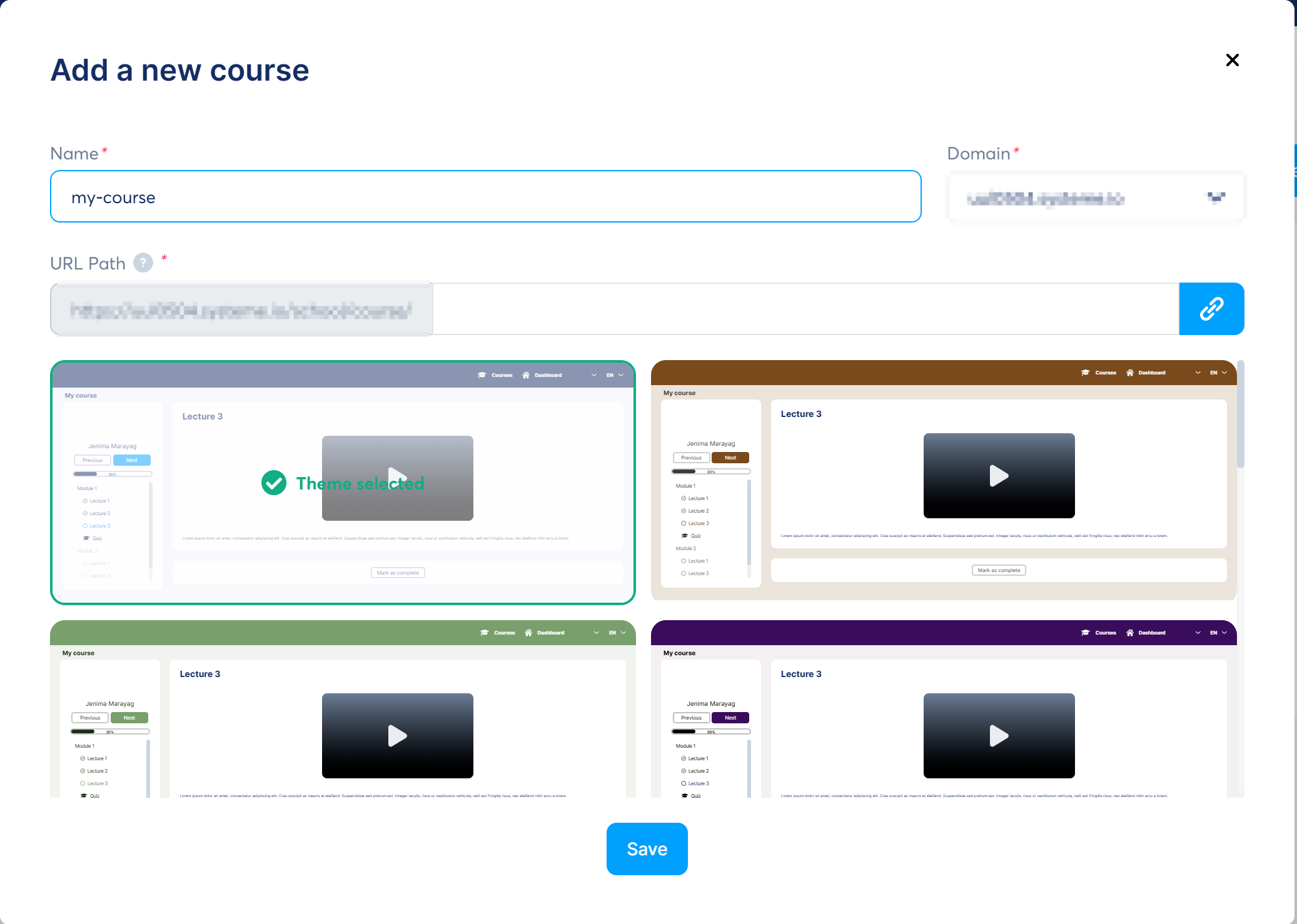
    Building a course on Systeme.io's free plan
    Building a course on Systeme.io's free plan — the free tier covers one course with up to 500 students.

    Where Kajabi beats it: design polish, community features, CRM depth, and the maturity of the marketing automation builder. Systeme.io is a working tool, not a beautiful one — if the look of your course portal is part of your brand, that matters.

    Best for: the creator who wants Kajabi's shape (courses + funnels + email in one place) at a fraction of the price, and who wants to start for free.

    #2 Teachable — best pure course platform

    Teachable does one thing with focus: it hosts and sells courses. Starter $39/mo ($29/mo annual, 5 products, 1 admin), Builder $89/mo ($69/mo annual, 10 products, 0% transaction fee), Growth $189/mo ($139/mo annual, 50 products, 5 admins), plus a Custom tier. There is a 7-day trial and a 30-day refund guarantee.

    The number that decides your plan is the transaction fee: Starter takes 7.5%. On $5,000 of sales that is $375 — nearly the annual gap between Starter and Builder. Card processing is separate either way (2.9% + 30¢ domestic, 3.9% + 30¢ international, $15 per chargeback). Unbranding, certificates, student import and custom permissions are all Growth-and-above features.

    Best for: creators who sell courses and do not need a funnel builder bolted on.

    #3 Thinkific — best for academies and training businesses

    Thinkific skews toward "school" rather than "personal course". Basic $54/mo ($40/mo annual), Start $109/mo ($82/mo annual), Grow $219/mo ($164/mo annual), plus a quoted Plus tier. Roughly 25% off annually, a 30-day trial, and student limits of 10,000 on every listed tier.

    Watch the video traffic allowance — 100GB / 200GB / 400GB per month — because video-heavy courses hit that quietly. Digital downloads are capped at 5 on Basic, and community spaces at 1. The gateway fee is the classic gotcha: 5% on Basic, 2% on Start, 1% on Grow if you use Stripe or another third-party processor, waived if you use Thinkific Payments (2.9% + 30¢). A branded mobile app is an extra $199/month.

    Best for: businesses and coaches training employees, clients or partners, where the course is a product line rather than a side project.

    #4 Podia — best for absolute beginners

    Podia is the friendliest interface here, and its trial is the most generous: 30 days free, no credit card required. Plans: Mover $49/mo ($42/mo annual), Shaker $99/mo ($84/mo annual), Earthquaker $179/mo ($150/mo annual).

    Mover takes a 5% transaction fee and caps you at 100 email subscribers, 50 products and 500 videos. You get 0% fees and 500 subscribers on Shaker. Subscriber counts are hard limits — Podia says it will notify rather than auto-upgrade you, which means your list stops growing until you act. Annual plans are refundable only within 72 hours.

    Best for: someone publishing a first course or download who wants the least friction and the longest free look at the tool.

    #5 LearnWorlds — best white-label course school

    LearnWorlds targets training businesses that want their own branded academy. Starter $29/mo ($24/mo annual, 1,000 active students, 1 admin), Pro Trainer $99/mo ($79/mo annual, 2,000 students, 5 admins, 20 SCORM packages), Learning Center $299/mo ($249/mo annual, white-label, 25 admins), plus Corporate pricing. 30-day trial.

    The Starter tier charges $5 per paid enrollment — a per-sale cut that becomes painful exactly when you start succeeding, and is the reason most successful users end up on Pro Trainer. AI credits are capped per tier (300 / 500 / 1,000).

    Best for: established course businesses and corporate trainers who want a fully white-labelled school rather than a hosted course page.

    #6 Kartra — best if marketing automation is the priority

    Kartra is an all-in-one marketing platform that includes courses. Essentials $59/mo ($52/mo annual), Starter $119/mo ($99/mo annual), Growth $229/mo ($189/mo annual), Professional $549/mo ($429/mo annual), 14-day trial.

    The Essentials tier is a decoy for anyone selling courses: 5% transaction fee, 500 contacts, 10,000 emails/month, and only 1 product and 1 course. Real course use starts at Starter ($119/mo). What you get for that is serious marketing machinery — affiliate management, helpdesk, and later real-time funnel analytics.

    Best for: solo operators whose bottleneck is marketing automation, not course delivery.

    #7 ThriveCart — when your course host is fine but your checkout is not

    You do not have to leave your current platform to fix the money part. ThriveCart is a conversion-focused cart and course add-on: Standard $47/mo or $444/year (~$37/mo) and Pro+ $87/mo or $804/year (~$67/mo), 0% platform fees, 30-day trial. ThriveCart also lists a lifetime one-time licence, but the price is only visible via a checkout link and we are not quoting an unpublished figure.

    Multiple order bumps, subscription dunning and an affiliate centre with automatic payouts are all Pro+. Annual billing is not a bargain at $444/$804.

    Best for: creators already getting traffic who want better upsells and cart recovery without migrating their course content.

    How we ranked (read this before you buy)

    Weighting, in order: cost to a creator who is still validating an offer, then whether the platform covers the whole journey (page → payment → delivery → follow-up), then learner experience. All prices were read from the vendors' own pricing pages on 2026-09-14 and are in USD. Where a vendor does not publish a number — SamCart's annual equivalent, ThriveCart's lifetime price, Kajabi's exact trial card requirement — we have said so rather than guessed.

    Honest disclosure about testing: only Systeme.io has been hands-on tested on this site (free account, real course shell and a real email funnel — see the review). The other six are assessed from their official pricing pages and published plan limits; we have not delivered a course on them or verified their checkout flows ourselves. Treat their entries as well-sourced research, not a hands-on verdict.

    On affiliate links: only Systeme.io is our affiliate partner. The other six pay us nothing, and they are here because an alternatives list that omits Teachable, Thinkific and Podia would be dishonest.

    FAQ

    What is the best Kajabi alternative?
    Systeme.io for most solo creators, because it covers courses, funnels and email from $0 with 0% transaction fees — and it is the only option here we hands-on tested. Teachable or Thinkific are better if you only sell courses; Podia is better if you want the simplest interface.

    Is there a cheaper alternative to Kajabi?
    Yes, substantially. Kajabi starts at $143/month billed annually. Systeme.io starts at $0, Teachable at $29/month annually, Thinkific at $40, LearnWorlds at $24 and Podia at $42.

    Does any Kajabi alternative have a free plan?
    Only Systeme.io has a permanent free tier (2,000 contacts, 1 course, 1 automation rule, no credit card). Podia and LearnWorlds offer 30-day trials, Thinkific 30 days, Teachable 7 days, and Kartra 14 days. Kajabi's trial is 14 days and cannot be extended.

    Is Teachable or Thinkific better than Kajabi?
    For pure course delivery at a lower price, yes — both are cheaper and both are solid. What you give up versus Kajabi is the tightly integrated email/CRM/community layer and design polish. See our course platform comparison.

    Can I move my courses from Kajabi to another platform?
    There is no automatic migration between these platforms. Expect to re-upload video and rebuild course structure, then re-import contacts as CSV. Budget a weekend for one or two courses; budget longer if you have heavy automation, because automation logic does not port.

    Do these alternatives charge transaction fees?
    Systeme.io (0% all tiers) and ThriveCart (0%) do not. Watch the entry tiers: Teachable Starter 7.5%, Podia Mover 5%, Kartra Essentials 5%, LearnWorlds Starter $5 per enrollment, Thinkific Basic 5% on third-party gateways, and Kajabi 0.5–2% by plan.


    I'm an affiliate of Systeme.io: if you sign up through my links, I may earn a commission at no extra cost to you. I only recommend tools I have actually registered and built with — the course and funnel screenshots on this site are from my own account. The other tools in this comparison are not affiliate links, and their pricing comes from their own public pricing pages.

    Start free (no credit card, 0% transaction fees) → systeme.io

    Grab the free checklist (2026 Solopreneur Tool Stack: 10 tools, free tiers, and upgrade moments) → Get the free checklist

    Related reading: Systeme.io Review 2026 · Best Online Course Platforms for Creators · Best Funnel Builders for Solopreneurs · ClickFunnels Alternatives · The 2026 Solopreneur Tool Stack Checklist
  • ClickFunnels Alternatives (2026): 7 Cheaper Options That Actually Work

    ClickFunnels Alternatives (2026): 7 Cheaper Options That Actually Work

    Verdict first: ClickFunnels is a genuinely powerful funnel platform, and it is also $97/month before you have made a single sale. That gap is why most people searching for a ClickFunnels alternative are really asking one question: can I get 90% of the funnel for 10% of the price? For solo creators, the answer is yes — Systeme.io is the best ClickFunnels alternative overall, because it has a real free plan (no credit card), starts at $17/month, and charges 0% transaction fees on every tier. ThriveCart is the better pick if you mainly want a high-converting checkout rather than a page builder, and Kajabi is the better pick if you are running a mature course business and price is not the constraint.

    Who this is for: solopreneurs, coaches, course creators and small agencies who want funnels and email without a $97-297/month habit, and who would rather validate an offer before paying for one.

    Who this is not for: teams who need ClickFunnels' full ecosystem — deep workspace collaboration, the highest contact/email tiers, or the agency-level features on the $297+/month plans. If you are already at 100K contacts, this article will not save you money; you have outgrown the alternatives too.


    Why people leave ClickFunnels (the honest version)

    None of this is a knock on the product. It is a pricing-shape problem:

    1. The floor is high. ClickFunnels' entry plan is $97/month ($81/month billed annually). That is the price of a paid tier at almost every alternative in this list, for the entry tier here.
    2. Email and contact caps are tiered tightly. The $97 Launch plan includes 10,000 contacts and 50,000 emails per month. Cross 50K sends in a month — easy with a modest list — and you are jumping to the $197 Scale plan or buying extra send volume.
    3. Feature bloat for simple funnels. ClickFunnels now spans funnels, websites, ecommerce, email, courses, CRM and community. If all you need is landing page → thank-you → follow-up emails, you are paying for four products you will not open.
    4. "Unlimited Funnels" is limited-time. The pricing page labels it exactly that. Plan features you can rely on, not features with an asterisk.

    ClickFunnels pricing in 2026

    Plan Monthly Annual (per month) Key limits
    Launch $97/mo $81/mo 1 workspace, 2 members, 10K contacts, 50K emails/mo, 3 courses, 5 domains
    Scale $197/mo $164/mo 5 workspaces, 5 members, 75K contacts, 300K emails/mo, 6 courses
    Optimize $297/mo $248/mo 10 workspaces, 10 members, 150K contacts, 750K emails/mo, 10 courses
    Dominate Annual only $5,997/yr (~$500/mo) 20 workspaces, 20 members, 400K contacts, 1.2M emails/mo, 20 courses

    There is no free plan. The pricing page says "Start Free Trial" but does not state the trial length or whether a card is required; ClickFunnels' own affiliate page refers to a 14-day trial. Treat the trial terms as unconfirmed until you reach the signup form. On the plus side, ClickFunnels charges 0% transaction fees — you keep what you sell — and the plans include unlimited hosting and unlimited visitors.

    The 7 ClickFunnels alternatives at a glance

    # Tool Entry price Free plan / trial Transaction fees Best for
    #1 Systeme.io $0 (paid from $17/mo) Free forever, no card 0% all tiers Cheapest working funnel + email + course in one account
    #2 ThriveCart $47/mo or $444/yr 30-day trial 0% Checkout and upsells that convert
    #3 Kartra $59/mo 14-day trial 5% on Essentials only All-in-one marketing with built-in helpdesk
    #4 SamCart $79/mo 7-day trial Payment processor fees only Digital-product checkout and order bumps
    #5 Podia $49/mo (annual $42/mo) 30-day trial, no card 5% on Mover only Simplest possible course + downloads store
    #6 Kajabi $179/mo (annual $143/mo) 14-day trial 0.5–2% on third-party gateways Mature course businesses with high-ticket offers
    #7 Teachable $39/mo (annual $29/mo) 7-day trial + 30-day refund 7.5% on Starter Selling courses only, no funnel needed

    The alternatives, one by one

    #1 Systeme.io — best overall ClickFunnels alternative for solopreneurs

    Systeme.io is the only tool in this list you can use indefinitely for $0, and I know that because I built a working funnel on the free plan myself — opt-in page, thank-you page, a 3-email welcome campaign and an automation rule, in about 30 minutes, without entering a card (full walkthrough: how to build a sales funnel for free).

    What you get free: 2,000 contacts, 3 funnels, 15 funnel steps, 1 automation rule, 1 course and 1 custom domain, with unlimited emails and unlimited file storage on every tier — that last part is rare and it is the exact thing ClickFunnels meters.

    Paid tiers: Startup $17/mo (5,000 contacts, 10 funnels), Webinar $47/mo (10,000 contacts, evergreen webinars), Unlimited $97/mo. On annual billing: $170 / $470 / $970 per year. Transaction fees are 0% on all four tiers, and the annual plans include two months free plus free migration.

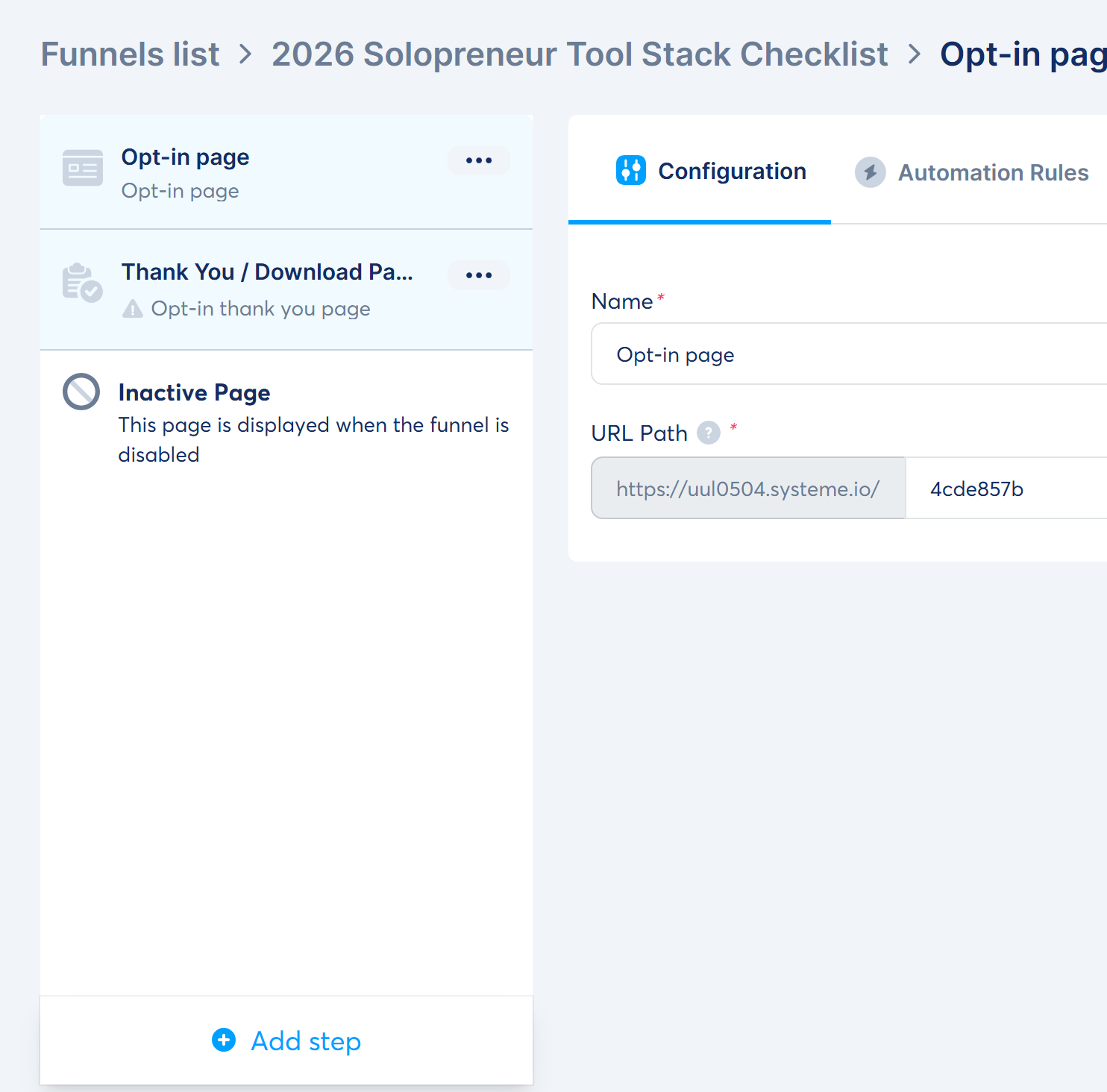
    Systeme.io funnel steps built on the free plan
    The funnel I built on Systeme.io's free plan: an opt-in step and a thank-you/download step, created from a template in one click.

    Where it loses to ClickFunnels: the page editor and templates are more basic, and the design ceiling is lower. Split-testing and webinar features sit on the $47 tier. If pixel-perfect, agency-grade funnel design is your main requirement, ClickFunnels earns its price.

    Best for: a solopreneur who wants funnels, email and a course in one login, starting at zero and growing into $17/month.

    #2 ThriveCart — best if the checkout is the product

    ThriveCart is not really a funnel-page builder; it is a conversion-focused cart that sits in front of whatever pages you have. Standard is $47/month or $444/year (~$37/month); Pro+ is $87/month or $804/year (~$67/month). There is a 30-day trial, 0% platform transaction fees, and ThriveCart also lists a lifetime one-time option — the price for that is not published on the pricing page, only available through a checkout link, so treat it as unconfirmed.

    The honest catch: the growth features that make ThriveCart interesting — multiple order bumps, subscription dunning, an affiliate centre with automatic payouts — are on Pro+, not Standard. Annual billing is not a cheap escape hatch either at $444/$804.

    Best for: creators who already get traffic and want better upsells, order bumps and cart recovery than their all-in-one platform gives them.

    #3 Kartra — best all-in-one with helpdesk and built-in marketing

    Kartra is the closest philosophical match to ClickFunnels on this list. Plans: Essentials $59/mo ($52/mo annual), Starter $119/mo ($99/mo annual), Growth $229/mo ($189/mo annual), Professional $549/mo ($429/mo annual), with a 14-day trial.

    Read the entry tier carefully, because it is the trap: Essentials carries a 5% transaction fee, 500 contacts, 10,000 emails/month and a very small allowance of pages and products (5 pages, 1 product, 1 course). The 0% fee and unlimited pages/products only start at $119/mo. In other words, the "cheap" Kartra plan is more expensive than it looks once you sell anything.

    Best for: businesses that want one platform for funnels, email, helpdesk and affiliates, and are ready to pay the $119+/month tier.

    #4 SamCart — checkout specialist for digital products

    SamCart does checkout and order bumps extremely well. Core is $79/month and Pro is $199/month, with a 7-day trial and an optional $19/month human-support add-on. There is no platform transaction fee — you pay your gateway (SamPay is 2.9% + 30¢) — but Core limits you to one seat, one marketplace and thinner AI/video allowances; the affiliate centre and advanced analytics are Pro features.

    One practical note: SamCart advertises 25% off yearly billing, but the monthly-equivalent figure did not render on the pricing page when we checked it, so we are not quoting an annual price. SamCart also does not publish a public affiliate program — the "Affiliate Center" is a feature for its merchants.

    Best for: sellers whose bottleneck is cart conversion, not page building.

    #5 Podia — best for the simplest possible start

    Podia is the most beginner-friendly option here, and the trial terms are the friendliest: 30 days free, no credit card required. Plans are Mover $49/mo ($42/mo annual), Shaker $99/mo ($84/mo annual) and Earthquaker $179/mo ($150/mo annual).

    The trade-off is the same shape as everywhere else: Mover takes a 5% transaction fee and caps you at 100 email subscribers and 50 products. The 0% fee starts at Shaker. Subscriber limits are hard walls, and annual plans are only refundable within 72 hours of payment.

    Best for: someone selling one course or a handful of downloads who wants the least intimidating interface and the longest free look.

    #6 Kajabi — for established businesses, not for starting out

    Kajabi is excellent and it is not a budget alternative. Basic $179/mo ($143/mo annual), Growth $249/mo ($199/mo annual), Pro $499/mo ($399/mo annual), 14-day trial, no free plan. It also stacks gateway fees on top: 2% on Basic, 1% on Growth, 0.5% on Pro when you use a third-party payment processor, and AI credits are metered and sold separately (500 credits for $15/mo).

    If you are choosing between Kajabi and ClickFunnels, the decision is about what you sell, not price — see our Kajabi alternatives breakdown.

    Best for: coaches and experts with a proven, high-ticket offer who want courses, community, email and CRM tightly integrated.

    #7 Teachable — courses only, and cheap if you skip the funnel

    If you do not actually need a funnel, Teachable is the cheapest credible route to selling a course: Starter $39/mo ($29/mo annual), Builder $89/mo ($69/mo annual), Growth $189/mo ($139/mo annual), with a 7-day trial and a 30-day refund guarantee.

    Starter's 7.5% transaction fee is the highest in this comparison — on $5,000 of course sales that is $375, which is most of the price difference between Starter and Builder. The 0% fee and unbranded experience start at Builder, and certificates and custom permissions sit on Growth ($139/mo annual).

    Best for: creators whose offer is simply "buy my course" with no funnel choreography.

    How we ranked (read this before you buy)

    Ranking is weighted toward cost to a solo operator who is still validating an offer, then on whether the tool can actually carry you from landing page to payment to follow-up. Prices were verified on the vendors' own pricing pages on 2026-09-14 and are quoted in USD.

    Honest disclosure about testing: of the tools above, only Systeme.io has been hands-on tested on this site — I registered the free plan and built a real funnel, email campaign and automation rule, and the screenshots in that walkthrough are from my own account (full Systeme.io review). Every other tool in this list is assessed from its official pricing page and published plan limits, not from a paid test; I have not verified their editors or deliverability first-hand. Prices change and tiers get restructured, so re-check the live page before you commit.

    On affiliate links: only Systeme.io is an affiliate partner of this site. None of the other six tools pay us anything, and they are in this list because an alternatives article that quietly drops ThriveCart, Kajabi and Teachable would be useless to you.

    FAQ

    What is the cheapest ClickFunnels alternative?
    Systeme.io, because its free plan is a permanent tier rather than a trial — 2,000 contacts, 3 funnels, 1 course, 1 automation rule and unlimited emails, with no credit card. That covers a lead-magnet funnel end to end.

    Is there a free ClickFunnels alternative?
    Yes — Systeme.io's free plan is the one we tested. Podia offers a 30-day free trial without a card but has no free tier, and ClickFunnels itself has no free plan at all.

    Why is ClickFunnels so expensive?
    It is priced as an all-in-one business platform (funnels, sites, ecommerce, email, courses, CRM, community) with 0% transaction fees, so revenue comes from subscription tiers. If you only need funnels and email, you are paying for capability you will not use.

    Can I migrate from ClickFunnels to Systeme.io?
    Systeme.io advertises free migration on annual plans. Funnel pages themselves do not port automatically between any of these platforms — plan on rebuilding pages and re-importing contacts, which is a few hours of work for a simple funnel.

    Which alternative has the best free plan?
    Systeme.io. It is the only permanent free tier here, and unlike most freemium plans it does not meter email sends or file storage.

    Do any of these charge transaction fees?
    Systeme.io (0% on all tiers), ThriveCart (0%), ClickFunnels (0%) and SamCart (no platform fee) do not. Watch the entry tiers elsewhere: Kartra Essentials 5%, Podia Mover 5%, Teachable Starter 7.5%, Thinkific Basic 5% on third-party gateways, and Kajabi 0.5–2% depending on plan.


    I'm an affiliate of Systeme.io: if you sign up through my links, I may earn a commission at no extra cost to you. I only recommend tools I have actually registered and built with — the funnel and screenshots on this site are from my own account. The other tools in this comparison are not affiliate links, and their pricing comes from their own public pricing pages.

    Start free (no credit card, 0% transaction fees) → systeme.io

    Grab the free checklist (2026 Solopreneur Tool Stack: 10 tools, free tiers, and upgrade moments) → Get the free checklist

    Related reading: Systeme.io Review 2026 · Systeme.io vs ClickFunnels vs Kajabi · Best Funnel Builders for Solopreneurs · How to Build a Sales Funnel for Free · Best Kajabi Alternatives

  • Aragon AI vs HeadshotPro (2026): Which AI Headshot Generator Wins?

    Aragon AI vs HeadshotPro (2026): Which AI Headshot Generator Wins?

    Verdict first: Aragon AI and HeadshotPro both turn selfies into professional AI headshots for a one-time payment — but they're different in one crucial way: Aragon lets you test free, HeadshotPro doesn't. Aragon gives 16 free credits at signup (enough for one creative-style generation), while HeadshotPro has no free tier at all — you pay $29–$59 before seeing anything. I hands-on tested Aragon's full flow including a free-credit generation (output was realistic but slightly soft); for HeadshotPro I verified the flow and pricing but didn't pay for output. Price-wise HeadshotPro is cheaper (Basic $29 vs Aragon's $35) and its top tier offers 4K resolution; Aragon is pricier ($35–$75) but has free credits, an onboarding wizard, and a broader photo-tool suite. Pick Aragon if you want to test before paying or need free credits; pick HeadshotPro if you're ready to commit and want the cheapest 4K option. Details below.

    Who this is for: professionals, job seekers, LinkedIn users, real-estate agents, lawyers, and teams comparing the two leading one-time-payment AI headshot services.

    Who this is not for: anyone needing a video/animation tool (neither is for that) or expecting a free professional-headshot tier (Aragon's free credits cover creative packs only; HeadshotPro has nothing free).


    At a glance

    Aragon AI HeadshotPro
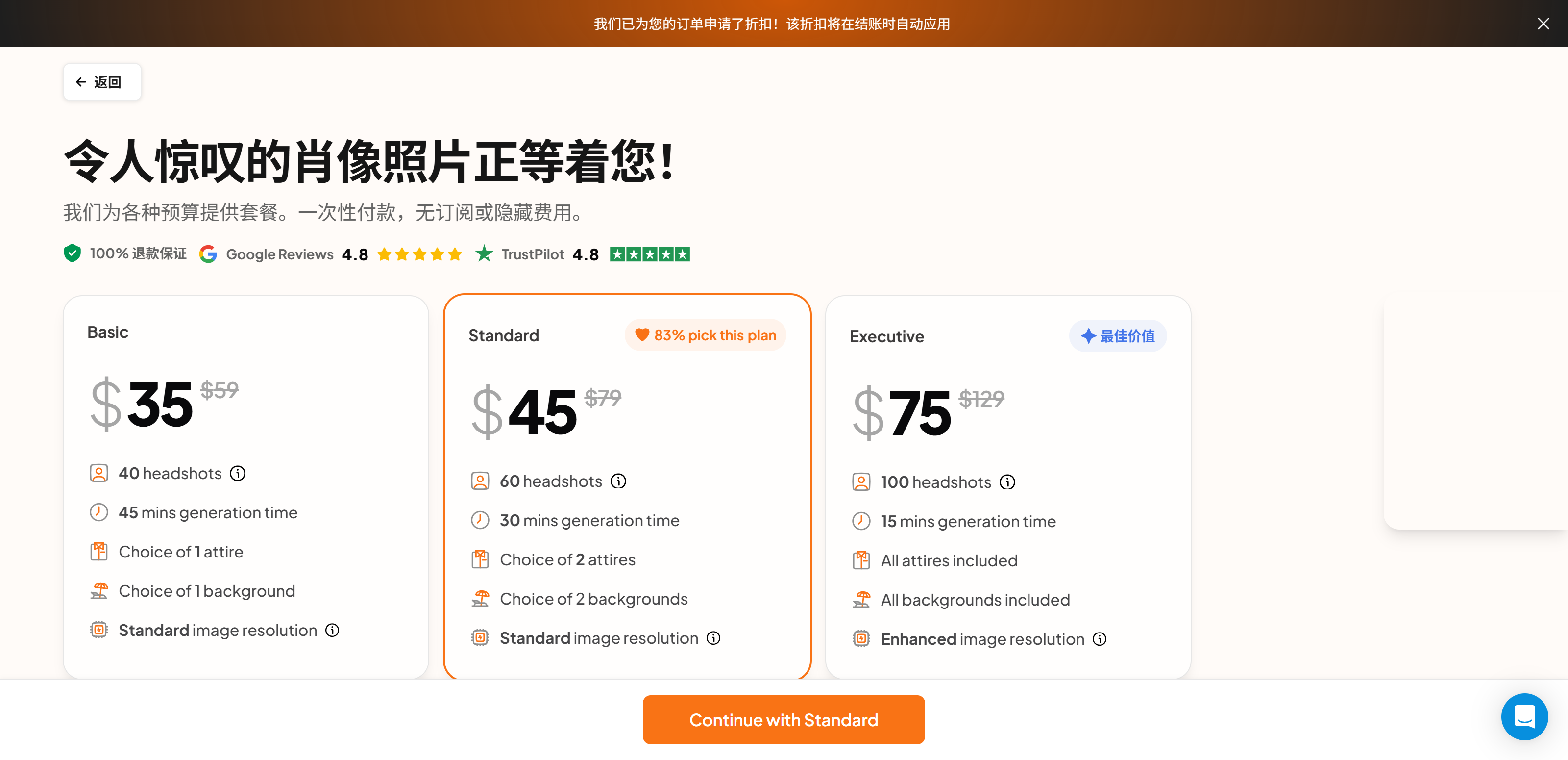
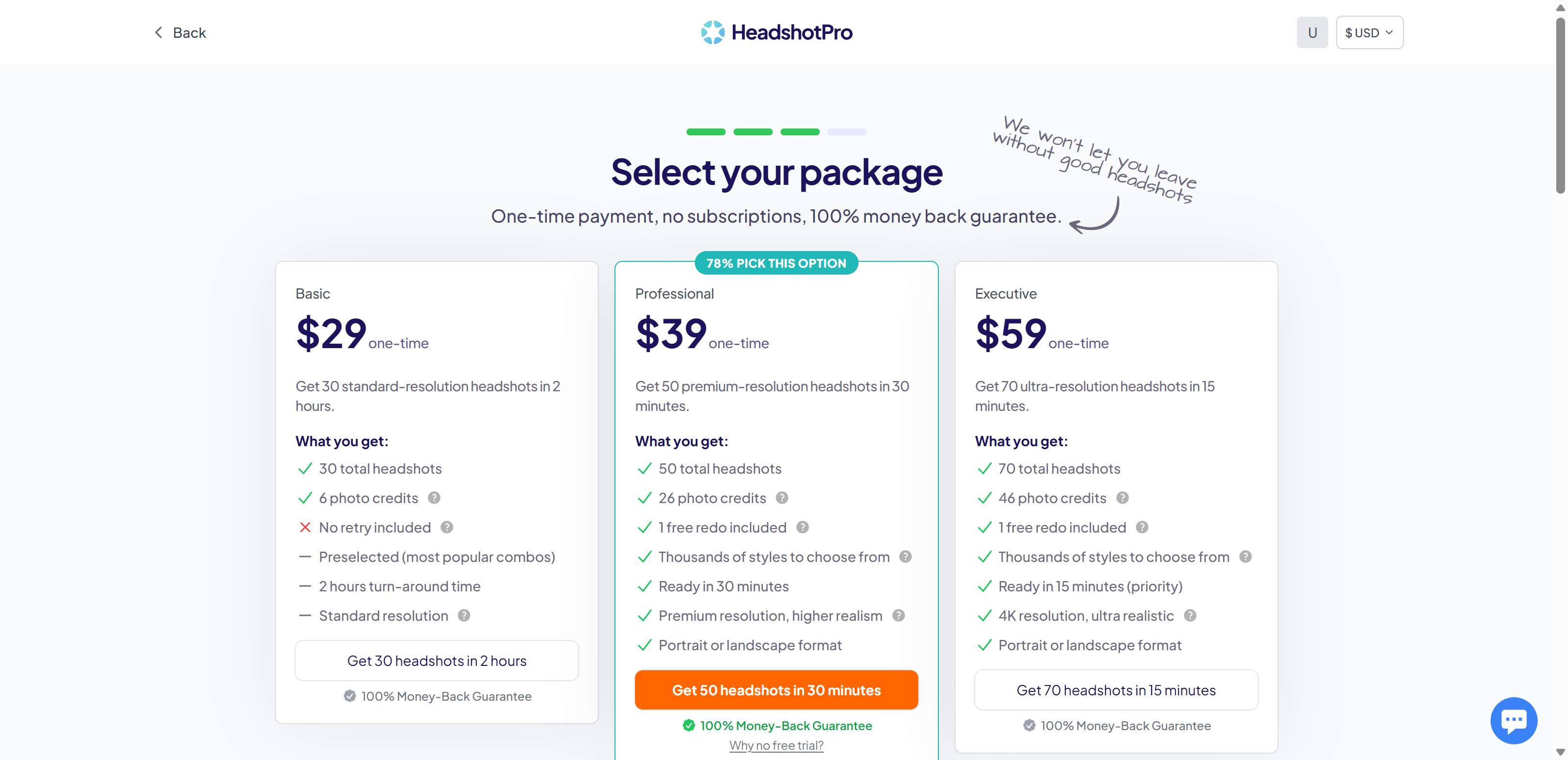
    Entry price $35 one-time (Basic, 40 headshots) $29 one-time (Basic, 30 headshots)
    Top plan $75 (Executive, 100 headshots, enhanced res) $59 (Executive, 70 headshots, 4K)
    Free way to test 16 free credits (creative packs) None — no free trial, no credits
    Billing One-time, no subscription One-time, no subscription
    Turnaround 15–45 min 15 min – 2 hrs
    Resolution Standard / enhanced Standard / premium / 4K
    Photo validation Strict — rejects AI-generated input (tested) Not tested (paid flow)
    Output (our test) ✅ Realistic, slightly soft (free-credit gen) ⚠️ Not tested — 4.7/5 from 3,542 public reviews
    Reviews 4.8/5 4.7/5 (3,542)
    Team plans Headshots for Teams page Dedicated team plans
    Extras AI photo editor, video, fashion studio Redo option, photo credits, styles
    Try it Aragon AI HeadshotPro

    Aragon AI: what it's strong at

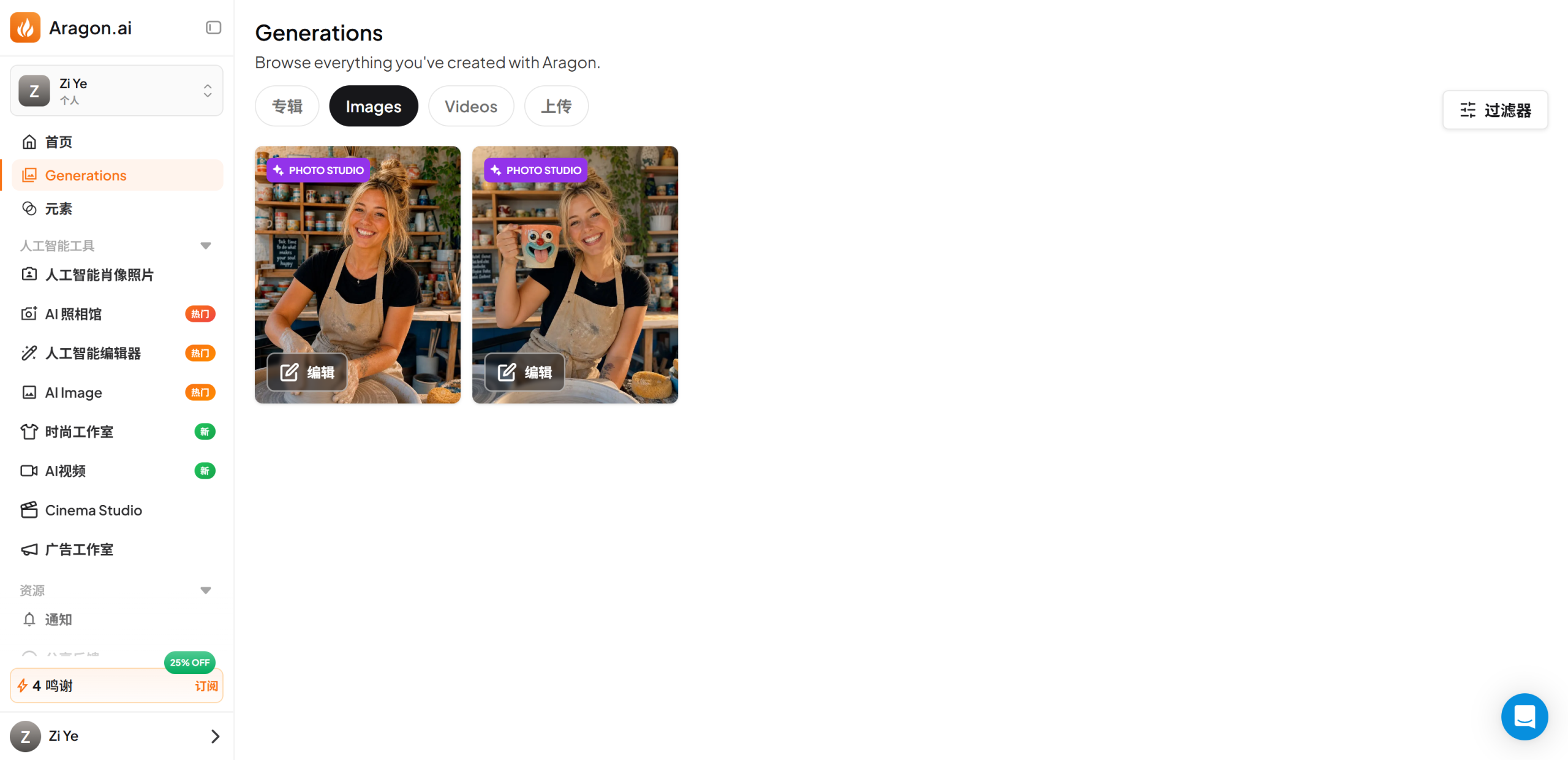
    I registered and tested Aragon hands-on (full review) — the only one of the two I actually generated with.

    • Free credits to test. 16 credits at signup are enough for one creative-style generation — the only free way to see either tool's output before paying.
    • Slick onboarding wizard. Gender → age → hair → body → attire → background, fast and well-designed.
    • Strict photo validation. It rejected 2 of my 6 AI-generated test photos — annoying for synthetic input, but it means real photos get quality-checked before you spend money.
    • Broader photo-tool suite. Beyond headshots: AI photo editor, fashion studio, AI video, 100+ style packs.

    Aragon pricing

    Basic $35 (40 headshots), Standard $45 (60), Executive $75 (100) — one-time.

    HeadshotPro: what it's strong at

    I created an account and walked HeadshotPro's full flow to checkout, but did not pay for a generation (full review).

    • Cheaper entry. Basic is $29 vs Aragon's $35 — and the top Executive plan ($59) undercuts Aragon's ($75) while offering 4K.
    • Higher-resolution tiers. Premium (Pro) and 4K ultra-realistic (Executive) with portrait/landscape formats.
    • Redo option. Professional and Executive include 1 free redo — useful if the first batch misses.
    • Strong public trust signals. 4.7/5 from 3,542 reviews, 18M+ headshots created, 250,000+ customers.

    HeadshotPro pricing

    Basic $29 (30 headshots), Professional $39 (50), Executive $59 (70) — one-time, no free trial.

    The differences that matter

    1. Free testing. This decides it for cautious buyers: Aragon gives 16 free credits; HeadshotPro gives nothing. If you want to see any output before paying, only Aragon allows it.

    2. Price. HeadshotPro is cheaper at every level ($29/$39/$59 vs $35/$45/$75). But note Aragon's free credits can offset that for a one-off test.

    3. Output quality. Only Aragon's free-credit output was tested by us — realistic, not template-y, slightly soft on detail. HeadshotPro's output is untested by us but publicly rated 4.7/5 (3,542 reviews); its 4K Executive tier is its quality argument.

    4. Input validation. Aragon actively rejects AI-generated or low-quality input (we saw it flag 2 of 6 photos). HeadshotPro's upload checks are behind the paywall, so we couldn't verify.

    5. Resolution & extras. HeadshotPro's top tier is 4K with a redo option; Aragon's is "enhanced resolution" but no redo mention, and it compensates with a wider tool suite (editor, video, fashion packs).

    6. Turnaround. Comparable at the top: Aragon Executive ~15 min, HeadshotPro Executive ~15 min (priority). HeadshotPro's Basic is slower (2 hours vs Aragon's 45 min).

    7. Trust & maturity. HeadshotPro shows more reviews (3,542 vs Aragon's ~4.8-score base) and customer counts; Aragon is backed by a $2.1B valuation. Both are established.

    Who should buy which

    • Want to test before payingAragon. 16 free credits are the only zero-risk way to see AI headshot output from either tool.
    • Cheapest one-time buyHeadshotPro. Basic $29; Executive $59 with 4K.
    • 4K / ultra-realistic outputHeadshotPro Executive ($59).
    • Need a redo optionHeadshotPro (Professional/Executive include 1 free redo).
    • Want a broader AI photo suite (editor, video, style packs) → Aragon.
    • Have AI-generated or low-quality photos → caution: Aragon's checker rejects them; HeadshotPro untested on this.
    • For a team → both have team options; HeadshotPro's team plans are more explicit.

    FAQ

    Which is cheaper, Aragon or HeadshotPro?
    HeadshotPro at every tier: Basic $29 vs Aragon's $35, Executive $59 (4K) vs Aragon's $75. Aragon partially offsets this with 16 free credits at signup.

    Which has a free way to test?
    Only Aragon. It gives 16 free credits (enough for one creative-style generation). HeadshotPro has no free trial and no free credits — the pricing page itself asks "Why no free trial?"

    Which produces better headshots?
    We hands-on tested only Aragon's free-credit output: realistic and not template-y, but slightly soft on detail. HeadshotPro's output is untested by us; it's publicly rated 4.7/5 from 3,542 reviews, and its Executive plan advertises 4K ultra-realistic output.

    Can I use AI-generated photos with these tools?
    Aragon rejected 2 of our 6 AI-generated test photos and lists AI-generated images under photo restrictions. HeadshotPro's photo checks sit behind its paywall, so we couldn't verify — expect similar caution.

    Which is better for teams?
    HeadshotPro has dedicated team plans and a "set up a team account" flow. Aragon also offers headshots for teams, but HeadshotPro's team offering is more front-and-center.

    Aragon vs HeadshotPro: which should I pick?
    Pick Aragon if you want to test free first, need a free-credit path, or want a broader AI photo suite (full Aragon review). Pick HeadshotPro if you're ready to commit one-time, want the cheapest entry or 4K output with a redo option (full HeadshotPro review).

    Disclosure & CTA

    I'm an affiliate of both Aragon AI and HeadshotPro: if you sign up through my links, I may earn a commission at no extra cost to you. I only recommend tools I've actually registered and built with — Aragon was fully tested including a free generation; HeadshotPro's review covers flow and pricing (no paid generation).

    Try Aragon AI free (16 free credits) → aragon.ai — promo code ZI for 15% off

    Visit HeadshotPro (cheapest 4K option) → headshotpro.com

    Grab the free checklist (2026 Solopreneur Tool Stack) → Get the free checklist


  • Fliki vs Zebracat (2026): Which Text-to-Video Tool Wins?

    Fliki vs Zebracat (2026): Which Text-to-Video Tool Wins?

    Verdict first: Fliki and Zebracat both turn text into video, but they are different tools for different jobs — and my side-by-side test made that clear. Pick Fliki if you already have the words (blog posts, scripts, product pages) and want a talking video with the strongest AI voiceover library (2,000+ voices, 80+ languages), a real free plan to evaluate, and a mature ecosystem. Pick Zebracat if you make marketing videos / ad creatives and want fast, animation-first output with a surprisingly natural default voice — and you're OK paying from day one (entry at US$19/month billed yearly). In my tests both rendered a short video in about 3 minutes; Fliki won on voice selection, URL-to-video repurposing and free-plan usability, Zebracat won on default-voice naturalness and marketing-style output. Neither is a video editor. Details and numbers below.

    Who should use Fliki: bloggers repurposing posts, course creators, cross-border sellers making multi-language product videos, anyone who needs strong AI voiceover or a usable free plan.

    Who should use Zebracat: marketers and solopreneurs making short marketing videos / ad creatives fast, early adopters who don't need a huge tutorial library, buyers who are ready to commit yearly from day one.


    The short version: one decision, two paths

    Fliki Zebracat
    Best for Blog post / script / URL → talking video with strong voiceover Marketing script → animated short video / ad creative
    Entry price ~US$21/mo billed yearly (US$28 monthly) US$19/mo billed yearly (US$39 monthly)
    Free plan 3 credits/mo — watermark + 720p, enough to actually test 1 generation total — a trial, not an evaluation
    Voices 300+ free · 2,000+ premium (500 ultra-realistic) Standard AI voice, 175+ languages; premium voice + cloning at Super Cat
    Languages 80+ 175+ (standard voice); video translation into 25+ on Super Cat
    Video style Stock media + AI voiceover + avatars; URL/blog repurposing Marketing animation first; output reads like a real ad
    Billing model Credit-based, monthly (3 / 180 / 600 per month) Credit-based, monthly (1 gen / 350 / 1,400 / 3,600 per month)
    Render speed (my test) ~3 min for a short clip ~3 min for a 22s video (with a confusing ~1-min pause first)
    Ecosystem 12M+ users, G2 4.8, large tutorial library Young tool, smaller community, fewer tutorials
    Try it Fliki free Zebracat free

    Fliki: what it's genuinely strong at

    Fliki's core is "I have the words, I need the voice and the video." It is the strongest text-to-video + voiceover combo of the two, and it's built for people who already write.

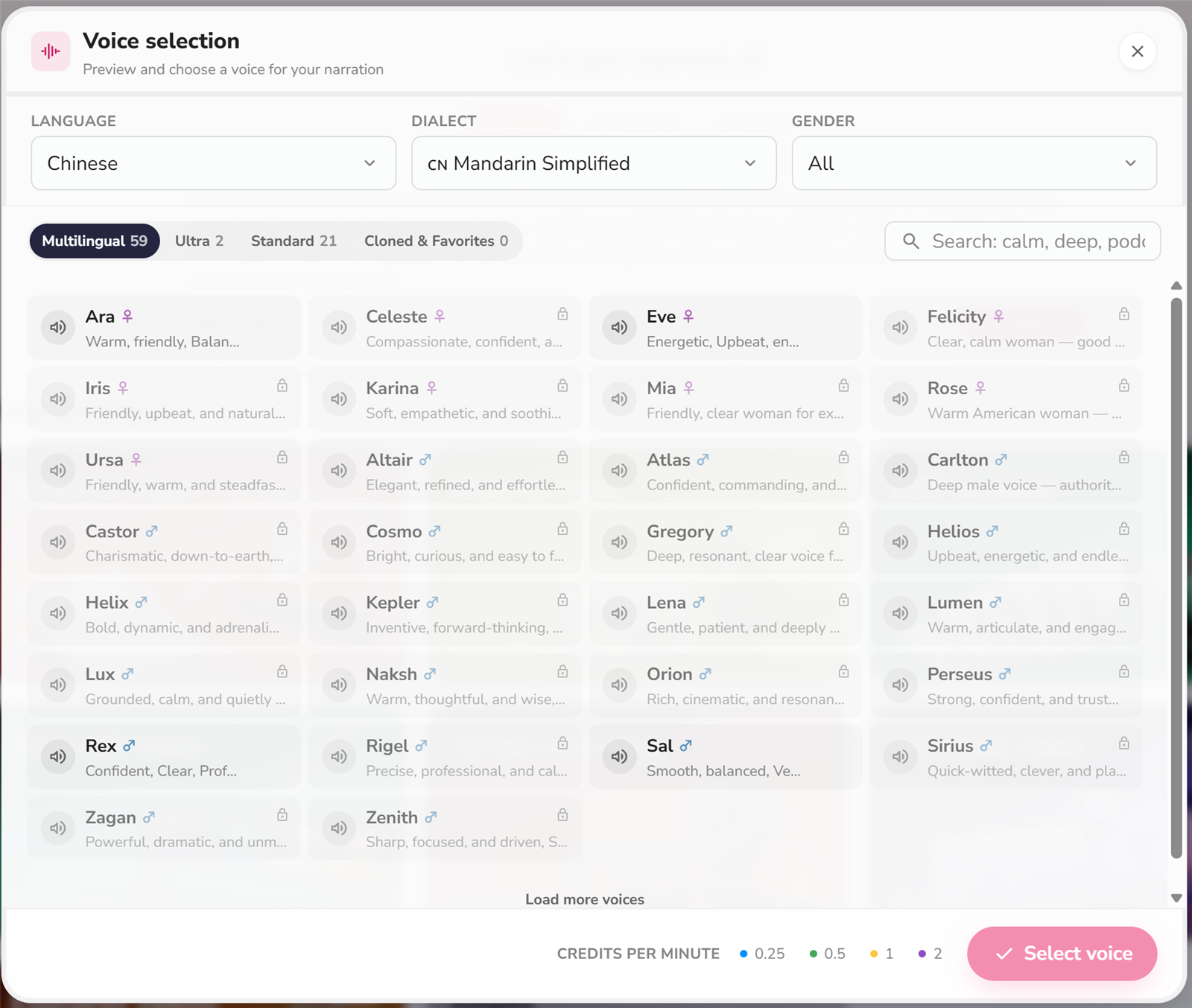
    • Voiceover is the moat. 300+ voices on the free plan, 2,000+ on Premium, 80+ languages, voice cloning on paid plans. No other tool in this comparison comes close on selection.
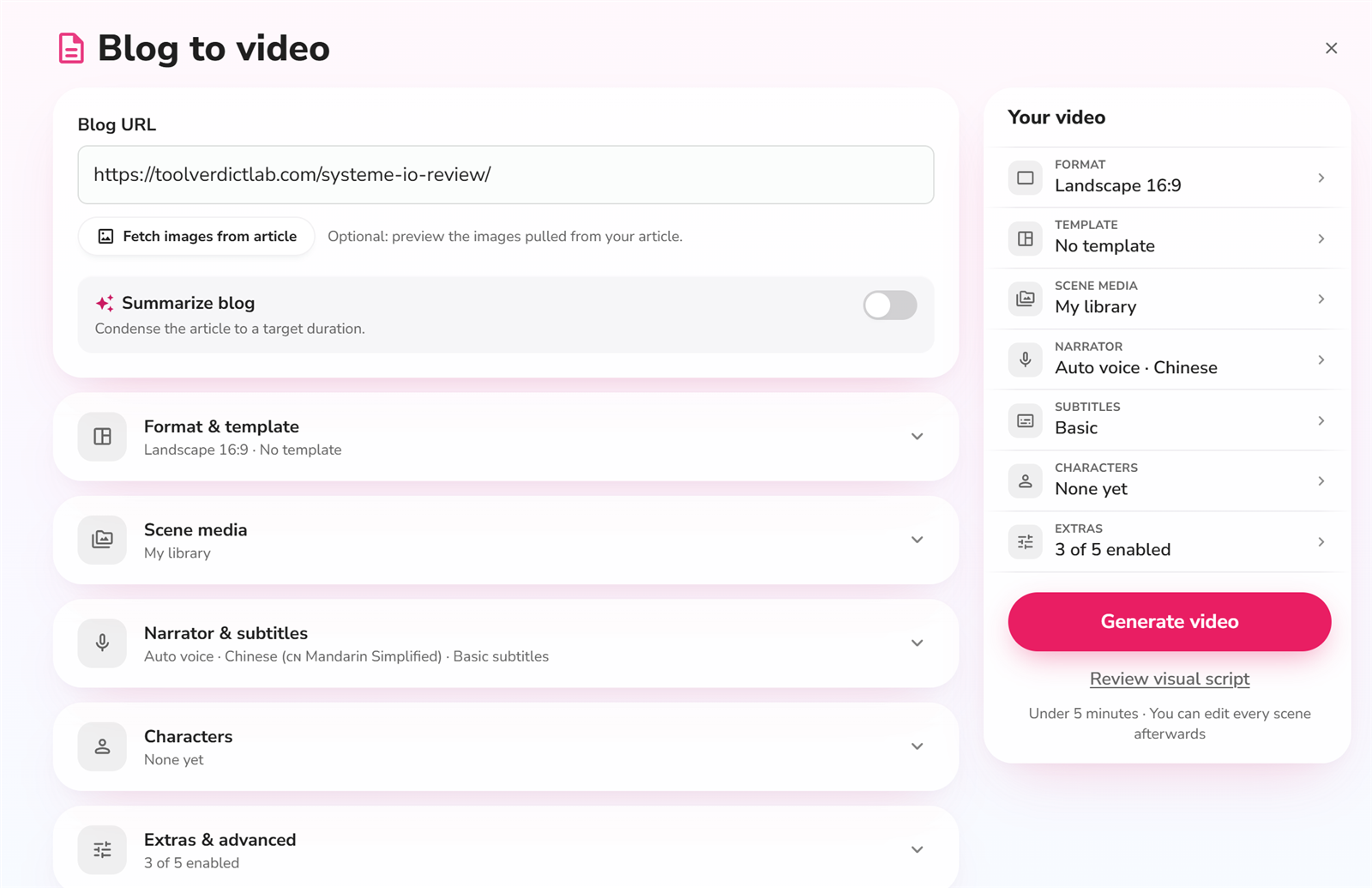
    • URL → video is the signature feature. Paste a blog URL and Fliki grabs the content and matches images — I tested it and it pulled my post accurately. That's repurposing on autopilot.
    • A free plan you can actually judge. 3 credits/month with watermark + 720p is enough to build a real video and decide. Zebracat's free plan is one generation and done.
    • Mature ecosystem. 12M+ users, G2 4.8, and a big library of tutorials — you will never be stuck.

    Fliki voice selection

    Voice selection is where Fliki pulls ahead: 300+ voices on the free tier alone.

    Fliki URL to video

    The URL-to-video flow: paste a link, get a video. I ran a blog post through it and the content came out accurate.

    Zebracat: what it's genuinely strong at

    Zebracat's core is "marketing script → short animated video," and it's aimed at people who need ad creatives, not repurposed blogs.

    • The output doesn't look template-y. This was the first surprise in my test: my 22-second video read like a real ad, not a stock template with a voiceover slapped on.
    • The default AI voice is natural. In my comparison it sounded more natural than Fliki's default voice on a marketing script — the first thing I noticed. Premium voice + voice cloning start at Super Cat.
    • More credits per dollar. Cat Mode packs 350 credits/month at US$19/mo (billed yearly) — roughly double Fliki Standard's 180 credits at a similar price. For bulk short-video production, the math favors Zebracat.
    • A real niche, not another clone. Marketing-animation-first is genuinely different from generic text-to-video.

    Zebracat style selection

    Style selection is where Zebracat differentiates — marketing-animation templates first.

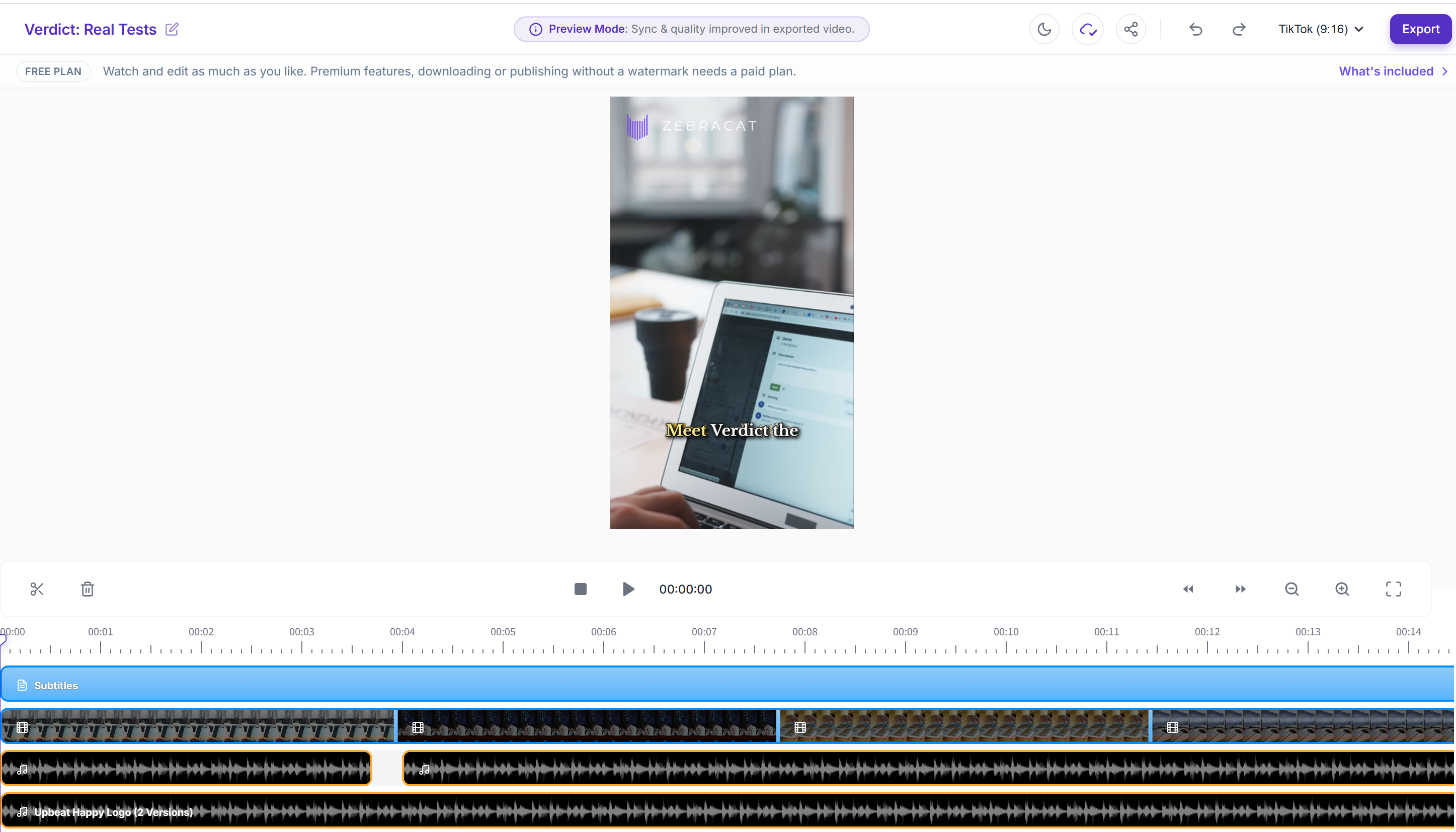
    Zebracat result editor

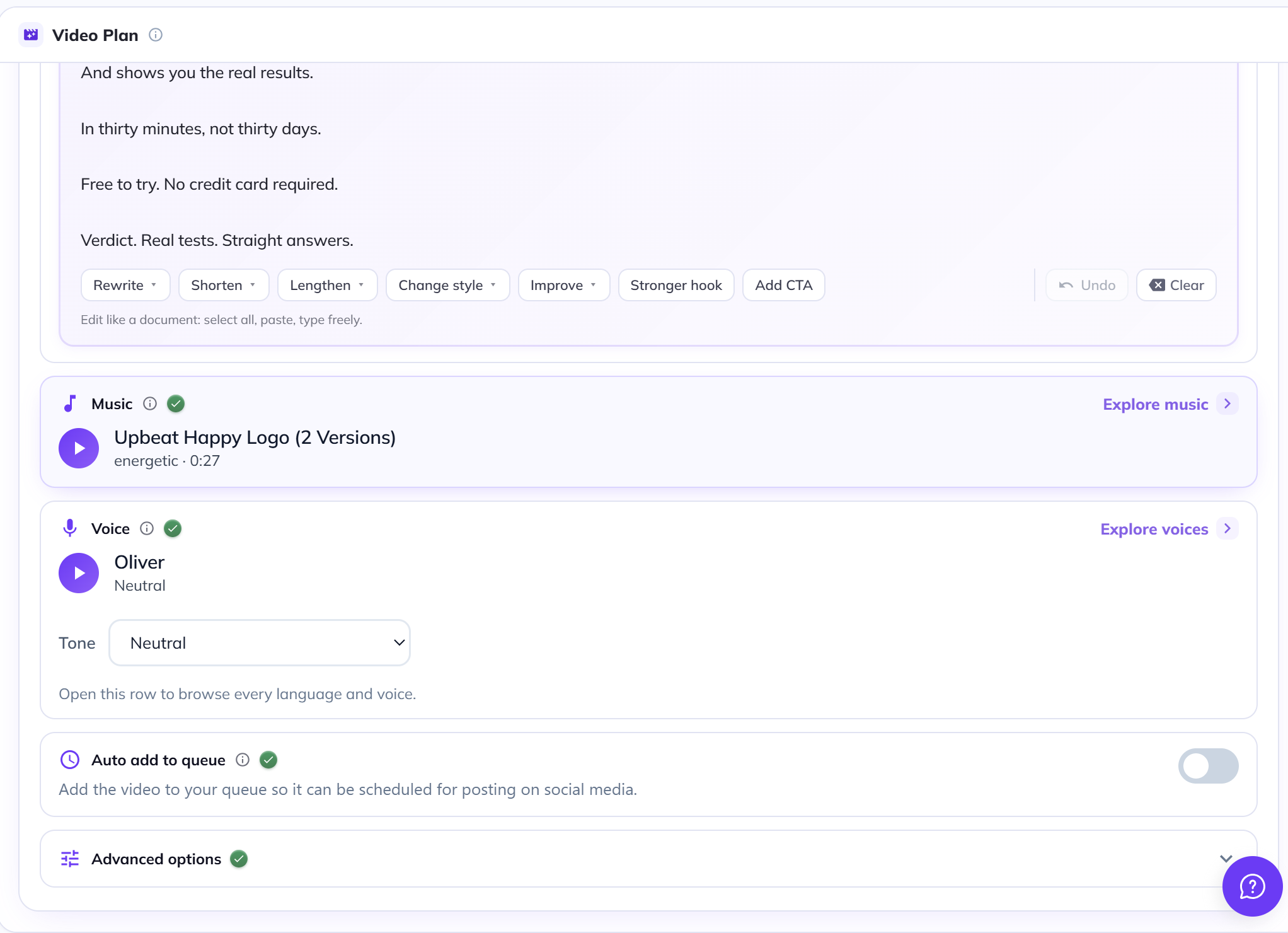
    The generated video opens in an edit view. 22 seconds, rendered in ~3 minutes in my test.

    The 7 differences that actually matter

    1. Voiceover quality and choice. Fliki wins on selection (2,000+ voices, 80+ languages, cloning). But in my actual test, Zebracat's default voice sounded more human on a marketing script. If you want a great voice out of the box for English marketing lines, Zebracat surprises; if you want a library and per-language choice, Fliki.

    2. Video style. Fliki = stock media + voiceover + avatars, built for repurposing written content. Zebracat = animation-first, ad-style output. Different output, different intent.

    3. Multi-language support. Fliki: 80+ languages with dedicated voice sets — the safer bet for Chinese and non-English output. Zebracat: standard voice covers 175+ languages, but video translation into 25+ languages only starts at Super Cat (US$49/mo billed yearly).

    4. Pricing model. Both are credit-based, and yearly billing puts them within ~US$2 of each other: Fliki Standard is US$21/mo billed yearly (US$28 monthly), Zebracat Cat is US$19/mo billed yearly (US$39 monthly). The old "Zebracat costs US$19 a year" reading was wrong — that's per month, billed yearly. The real gaps: Fliki's no-commitment monthly rate (US$28) is cheaper than Zebracat's (US$39), and Zebracat packs more credits per dollar at the entry tier.

    5. Free plan usability. Fliki: 3 credits/month, watermark + 720p — enough to build and evaluate. Zebracat: exactly one generation, full stop. If evaluating before paying matters, that alone decides it.

    6. Render speed. Both hit ~3 minutes in my tests. Zebracat had a confusing ~1-minute dead pause after clicking generate (nothing visible happening); Fliki's rough edge was the export flow (queuing, no progress state, occasional failures).

    7. Ecosystem and tutorials. Fliki: 12M+ users, G2 4.8, huge tutorial library. Zebracat: young tool, smaller community, fewer tutorials — fine if you're comfortable figuring things out.

    Pricing: the honest math

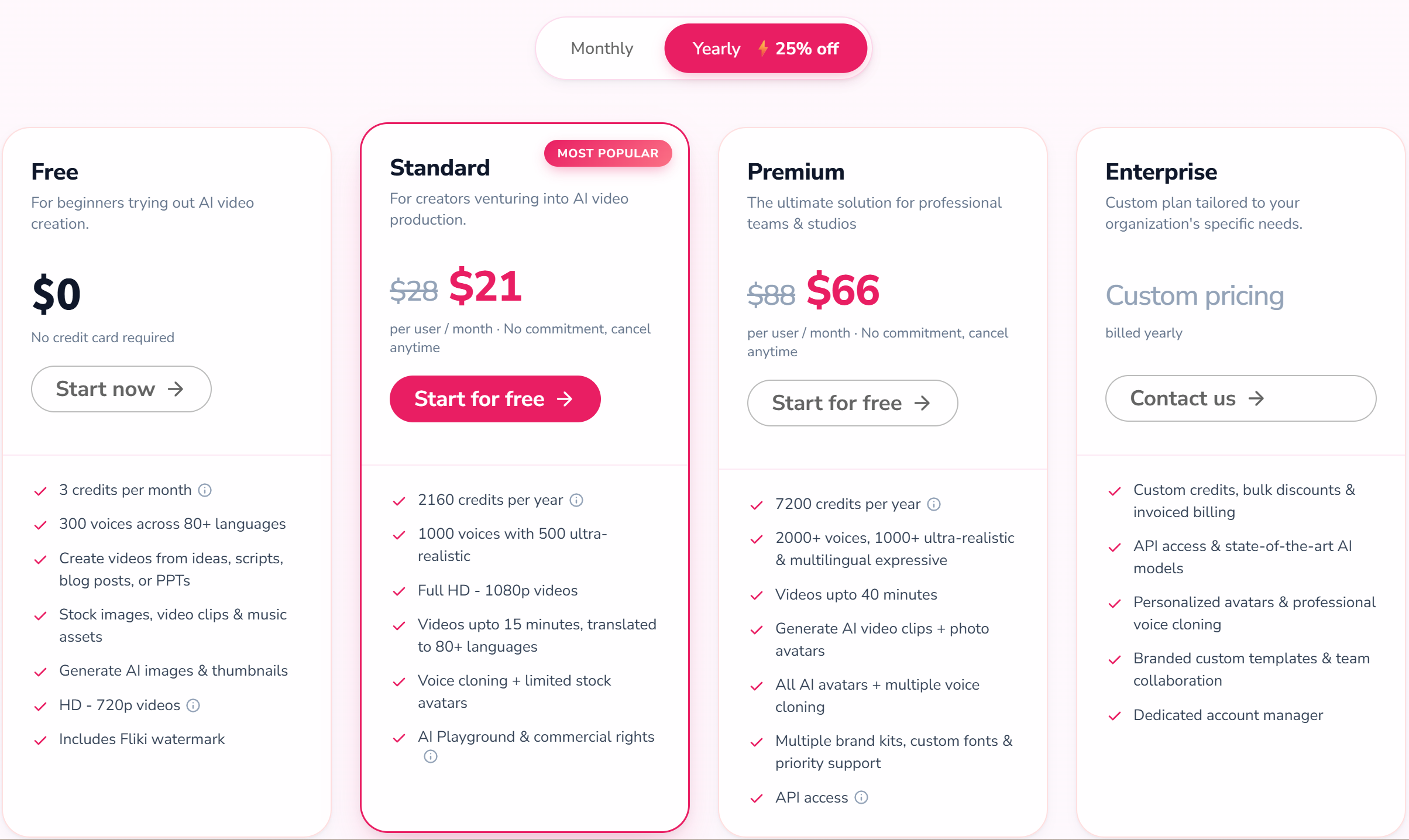
    Fliki pricing plans

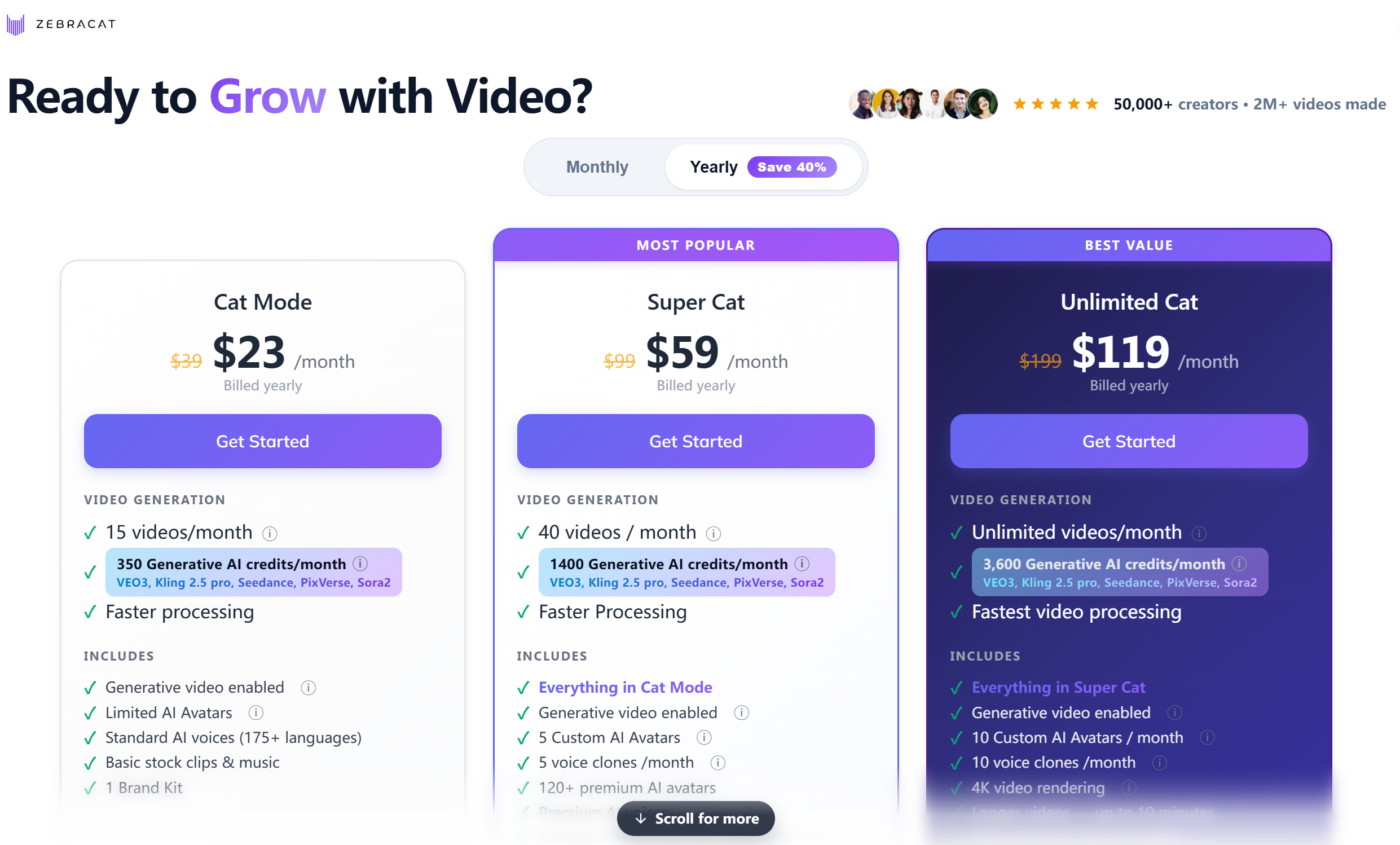
    Zebracat pricing plans

    Fliki (USD, credit-based; prices verified from the live pricing page, 2026-08-28):

    Plan Price Credits/mo What changes
    Free $0 3 720p, watermark, 300+ voices
    Standard $28 $21/mo (billed yearly; $28 monthly) 180 1080p, 1,000+ voices (500 ultra-realistic), 15-min videos, 80+ languages, voice cloning, commercial rights
    Premium $88 $66/mo (billed yearly; $88 monthly) 600 2,000+ voices, 40-min videos, AI video clips + photo avatars, brand kits, API

    Zebracat (USD, credit-based; per-month prices when billed yearly, verified 2026-08-28):

    Plan Price Videos / credits per month Key differences
    Free $0 1 generation (total) Trial only
    Cat Mode $39 $19/mo (billed yearly; $39 monthly) 15 videos · 350 credits Standard AI voice (175+ languages), basic stock + music, 1 brand kit
    Super Cat $99 $49/mo (billed yearly; $99 monthly) 40 videos · 1,400 credits Premium AI voice, 5 voice clones/mo, 120+ premium avatars, translation into 25+ languages
    Unlimited Cat $199 $99/mo (billed yearly; $199 monthly) Unlimited videos · 3,600 credits Fastest processing, 10 voice clones/mo, unlimited brand kits, priority support
    Enterprise $599+/mo Unlimited · custom credits Custom plans, API access, "Talk to Sales"

    The honest math: with yearly billing, the two land within ~US$2 of each other — Fliki Standard US$21/mo vs Zebracat Cat US$19/mo. The idea that Zebracat is "a whole year for US$19" was a misread: that's US$19 per month when billed yearly. The real pricing differences are (1) commitment — Fliki's monthly rate (US$28) is cheaper than Zebracat's (US$39) if you don't want to commit for a year, and (2) credits — Zebracat Cat gives 350 credits/month (15 videos) for ~the same money as Fliki Standard's 180 credits. Neither tool is dramatically cheaper; the free plan and feature fit should decide.

    Who should buy which

    • Blogger repurposing posts into videoFliki. The URL-to-video feature is built for exactly this.
    • Course creator turning scripts into lessonsFliki. Strong voiceover, avatars, and a free plan to test with.
    • Cross-border seller making multi-language product videosFliki. 80+ languages with real voice selection is the safer bet for Chinese and other non-English output.
    • Marketer / solopreneur making ad creatives and short marketing videosZebracat. Animation-first output, natural default voice, and more credits per dollar.
    • Bulk short-video production on a yearly budgetZebracat. 350 credits/month at ~US$19/mo beats Fliki Standard's 180 credits at a similar price.
    • Must evaluate on a free plan firstFliki. 3 credits/month is enough to build a real video; Zebracat's one generation is not.

    FAQ

    Is Fliki cheaper than Zebracat?
    Similar numbers, different billing. With yearly billing: Fliki Standard is US$21/mo, Zebracat Cat is US$19/mo — essentially a tie. Without a yearly commitment (monthly billing): Fliki is US$28/mo, Zebracat is US$39/mo — Fliki is cheaper. Note: Zebracat's US$19 is a per-month price billed yearly, not a per-year total.

    Which has better AI voiceover, Fliki or Zebracat?
    In my test, Zebracat's default AI voice sounded more natural than Fliki's on a marketing script. But Fliki has the far bigger library — 300+ voices free, 2,000+ on Premium, 80+ languages, voice cloning — and more per-language choice. Zebracat's premium voice and cloning start at Super Cat (US$49/mo billed yearly).

    Which is better for Chinese voiceover?
    Fliki. It covers 80+ languages with dedicated voice sets, and while English is its strongest language, Chinese output is well supported. Zebracat's standard voice covers 175+ languages, but its video translation feature into 25+ languages only starts at Super Cat (US$49/mo billed yearly), and I tested English only. If Chinese output is critical, Fliki is the safer pick.

    Can I use Fliki and Zebracat videos commercially?
    Fliki includes commercial usage rights from the Standard plan up; the free plan is for testing. For Zebracat, the paid plans are positioned for real marketing use and the free plan is a trial — confirm the exact commercial terms for your plan on the live pricing page before publishing.

    Do Fliki and Zebracat need a credit card to sign up?
    No. I registered both with just an email on the free plan. No credit card anywhere in either signup flow.

    Fliki vs Zebracat: which should I pick?
    Pick Fliki if you repurpose existing text (blogs, scripts, URLs), need strong voiceover in many languages, want a real free plan to test, or value a mature ecosystem (full Fliki review here). Pick Zebracat if you make marketing videos/ad creatives, want animation-first output with a natural default voice and more credits per dollar, and are OK committing yearly from day one (full Zebracat review here).

    Disclosure & CTA

    I'm an affiliate of both Fliki and Zebracat: if you sign up through my links, I may earn a commission at no extra cost to you. I only recommend tools I've actually registered for and built with.

    Try Fliki free (best for repurposing text → video with strong voiceover) → fliki.ai

    Try Zebracat free (best for fast marketing animations) → zebracat.ai

    Grab the free checklist (2026 Solopreneur Tool Stack) → Get the free checklist


  • Systeme.io vs ClickFunnels vs Kajabi (2026): Which Should a Solopreneur Pick?

    Systeme.io vs ClickFunnels vs Kajabi (2026): Which One Should a Solopreneur Actually Pick?

    Verdict first: If you are a solopreneur starting from zero — or bootstrapping on a budget — pick Systeme.io. Its permanent free plan covers a full funnel, unlimited emails, courses, and an affiliate program, and I built a working email funnel on it in about 30 minutes. ClickFunnels is the pick only if your whole business is high-ticket sales funnels and you already have revenue. Kajabi is the pick only if your business is courses/memberships first and you can comfortably spend $140+/month before launch.

    There is no “best” here — there’s “best for your stage.” This page compares the three from a solopreneur’s perspective: what you actually get at each price point, where each platform hurts, and which one you should start with in 2026.

    How this was tested: Systeme.io was hands-on tested on the free plan — real account, real funnel, real emails, real course shell, with screenshots. ClickFunnels and Kajabi are assessed from their current 2026 pricing, official documentation, and public reviews. I do not claim a paid hands-on test of either — this page is updated as we test more. Pricing below is what each vendor lists today; check before you buy.

    The 30-second comparison

    Systeme.io ClickFunnels Kajabi
    Starting price $0 (free plan) / from $17/mo from $97/mo from ~$143/mo (annual)
    Free plan Yes, permanent (2,000 contacts, 3 funnels) No (14-day trial) No (14-day trial)
    Funnel builder Yes Yes (best-in-class) Yes
    Email marketing Unlimited on all plans Included, capped by plan Included
    Courses / memberships Yes Add-on ecosystem Yes (strongest)
    Built-in affiliate program Yes Add-on (Backpack) Yes (Affiliate system)
    Ease for a beginner Simple, menu-driven Steeper; powerful Simple but opinionated
    Best for Bootstrapped solopreneurs Sales-focused marketers with revenue Course & membership businesses with budget

    Systeme.io: the $0 stack that actually works

    I registered a free account and built a complete mini-business in one sitting: a landing page, a 2-step opt-in funnel, a 3-email welcome sequence with a PDF attached, a course shell, and the built-in affiliate program — about 30 minutes of real work, $0 spent, and no paywall appeared.

    What’s genuinely good:

    • The free plan is permanent and usable — 2,000 contacts, 3 funnels, unlimited emails. It’s a real product, not a trial.
    • Funnel + email + course + affiliate program in one place. You never leave the app.
    • The affiliate program is built in — both Systeme.io’s own 60% lifetime-recurring program and your own program for your products.

    Where it tripped me:

    • Templates ship with demo content (“Volunteer in your Community”, Lorem ipsum). You must replace every block before publishing — it won’t warn you.
    • “3-step funnel” is not the default: opt-in templates create 2 steps; adding a sales page is manual.
    • Your own affiliate program defaults to 40%, but each order form defaults to 0% affiliate commission. Easy to miss.

    Full hands-on details, screenshots, and the honest oops-moments are in the Systeme.io review.

    ClickFunnels: the funnel-first industry standard

    ClickFunnels was built around one job: selling through funnels. Its templates, upsell flows, and checkout design are still the benchmark the others copy. In 2026 pricing is simpler than it used to be: Launch from $97/mo, Scale $197/mo, Optimize $297/mo (annual billing drops Launch to about $81/mo). There is no free plan — a 14-day trial is the only free taste.

    Who it’s actually for: marketers and coaches whose revenue already depends on conversion funnels and who will spend hours a week in the builder. If a funnel page’s conversion rate is your business, ClickFunnels earns its price.

    Who it’s not for: a bootstrapped founder who just needs email + a landing page. You’re paying for power you won’t use yet, and email/membership features live in an add-on ecosystem that raises the true cost above the sticker price.

    Kajabi: the course-and-membership heavyweight

    Kajabi’s superpower is courses: video hosting, student management, progress tracking, communities, and payments all built around teaching. It’s the most polished all-in-one for a knowledge business. After its January 2026 restructure, plans start around $143/mo (annual Basic), with Growth at $199/mo and Pro at $399/mo; monthly billing is higher. A 14-day trial is available.

    Who it’s actually for: course creators and coaches who already have (or are confident in) an audience — the platform pays for itself once you’re selling courses at a real price.

    Who it’s not for: anyone who hasn’t validated a first offer yet. Paying $140+/month before you have a single student is how solo projects die quietly.

    Which one should you pick? (decision guide)

    Your situation Pick Why
    Zero revenue, one idea, tight budget Systeme.io Free until you’ve validated demand; upgrade only when limits bite.
    Already selling and funnels are your lever ClickFunnels Best templates and upsell flows; the cost is an investment in conversion.
    Courses/memberships are the core business, budget available Kajabi Best integrated course + community + payments experience.
    Not sure yet — test demand first Systeme.io Build the lead magnet + welcome sequence free, then decide with data.

    What I’d actually do: start on Systeme.io’s free plan, publish the lead magnet, collect emails, and run one offer. If the offer converts, upgrade Systeme.io or migrate to ClickFunnels/Kajabi — with real numbers justifying the $100-140/month, not hope.

    FAQ

    Is Systeme.io really free?

    Yes. The free plan includes 2,000 contacts, 3 funnels, unlimited emails, and courses, with no credit card required. Paid plans start around $17/month.

    Is ClickFunnels worth it for a beginner?

    Usually not as a first tool. At $97+/month with no free plan, it makes sense once you’re already selling and need proven funnel templates and upsell flows. Start free elsewhere until revenue justifies it.

    Is Kajabi good for solopreneurs?

    Yes, if courses are the business and you have budget. It’s the strongest all-in-one for teaching, but at ~$143/month it’s expensive before you have students.

    Can I migrate from Systeme.io to ClickFunnels or Kajabi later?

    Yes. Contacts (CSV export), funnels, and email sequences can all be exported and rebuilt. Starting on Systeme.io doesn’t lock you in.

    Which platform has the best affiliate program?

    Systeme.io’s is built in and generous (60% lifetime recurring on their own program, plus you can run your own program). ClickFunnels uses Backpack (add-on); Kajabi has a native affiliate system for your courses.

    Grab the free checklist first: The 2026 Solopreneur Tool Stack — 10 tools, free tiers, and the exact moments to upgrade. Get the free checklist

    Or start free with Systeme.io (free plan, no card required).

    Disclosure: I’m an affiliate of Systeme.io — if you sign up through my link I may earn a commission at no extra cost to you. I only recommend tools I’ve actually registered for and built with.